
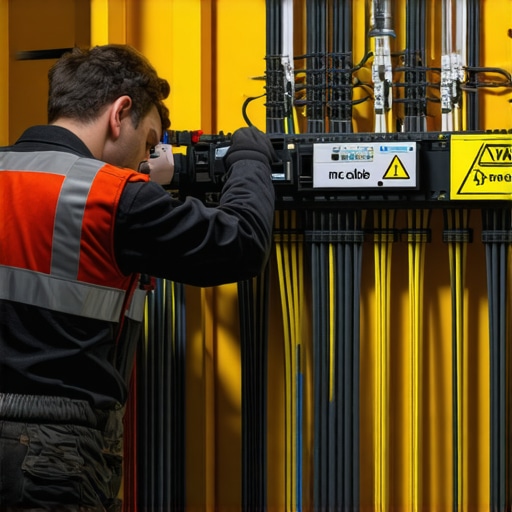
The Price of a Nicked Wire
My journeyman used to smack my hand if I stripped a wire with a knife. ‘You nick the copper, you create a hot spot,’ he’d scream. He was right. That microscopic gouge in a 12-gauge conductor isn’t just a cosmetic flaw; it’s a cross-sectional reduction that forces electrons to bottleneck. Under a 20-amp load, that bottleneck generates heat. Heat causes the copper to expand. When the load drops, it contracts. Over a thousand cycles, that expansion and contraction—the ‘breath’ of the circuit—loosens the screw terminal at the home run. Eventually, you get an arc-fault that smells like ozone and burnt fish, right before the drywall ignites. As we approach the 2026 OSHA audit cycles, I’m seeing the same ‘handyman’ shortcuts being scaled up to industrial levels. Whether you’re running a warehouse or a multi-unit complex, electricity doesn’t care about your production deadlines. It only cares about the path of least resistance, and usually, that path goes through something expensive or someone’s heart.
1. The Myth of the ‘Temporary’ Subpanel Installation
In the frantic rush to expand operations, I often see subpanel installation jobs that look like they were wired by a caffeinated squirrel. OSHA 1910.303(b)(1) isn’t a suggestion; it’s a mandate for structural integrity. I’ve walked into garages and warehouses where a subpanel was hung with drywall screws instead of proper lag bolts. When the building vibrates from heavy machinery, those screws shear. But the real forensic failure is the missing equipment grounding conductor. Many ‘weekend electrician services’ think they can bond the neutral and ground in a subpanel. That is a lethal mistake. In a subpanel, the neutral must be isolated. If you bond them, you create a parallel path for return current through the metal casing of the panel. Anyone touching that enclosure becomes the path to ground. We call that a ‘Widow Maker’ setup. For proper garage wiring services, every lug must be torqued to the specific inch-pounds listed on the manufacturer’s label. If you aren’t using a torque screwdriver, you aren’t doing electrical work; you’re just guessing with fire.
“Aluminum wire connections can overheat and cause a fire without tripping the circuit breaker.” – CPSC Safety Alert 516
2. Warehouse Lighting Retrofits and Ballast Neglect
The push for energy efficiency has led to a massive wave of warehouse lighting retrofit projects. Moving from old metal halide to LED is smart, but the execution is often a forensic nightmare. I’ve seen crews leave old, leaking PCB ballasts in the ceiling, simply bypassing them. These ballasts are ticking time bombs of toxic ‘monkey shit’ (duct seal) and hazardous chemicals. Furthermore, when you change the load profile of a circuit, you change the harmonic distortion on the neutral wire. OSHA inspectors in 2026 are going to be looking specifically at ‘abandoned wiring.’ If those old wires aren’t terminated in a listed junction box with a proper cover, you’re looking at a five-figure fine. In high-bay environments, the heat rises. If you used standard Romex instead of MC cable or EMT conduit for those retrofits, the insulation will bake until it turns into a brittle shell that flakes off with the slightest vibration.
3. The Invisible Danger of Fire Damage Wiring Restoration
After a small electrical fire, most facility managers just want the lights back on. They hire a general contractor who wipes down the soot and replaces the charred outlet. This is a recipe for a secondary, more violent fire. Fire damage wiring restoration requires a forensic approach to ‘carbon tracking.’ When electricity arcs through plastic, it creates a path of carbonized material. Carbon is conductive. Even if you replace the burnt device, the wire three feet back inside the conduit might have compromised insulation. I use a ‘Wiggy’ (solenoid voltmeter) and a megohmmeter to pressure-test the insulation. If that wire can’t hold 1000 volts of DC pressure without leaking, it stays in the wall. You cannot ‘clean’ a wire that has been through a thermal event. The molecular structure of the copper has changed; it’s become brittle, a phenomenon known as work-hardening, which increases resistance and guarantees a future failure.
4. Access Control Wiring and the Low-Voltage Fallacy
There is a dangerous assumption that low voltage equals low risk. I’ve seen access control wiring and doorbell camera install jobs where 120V power leads were run in the same J-box as Cat6 data lines. This is a direct violation of the NEC. If the insulation on the high-voltage line fails, it can send 120V through your fiber optic cabling tray or your security cameras, blowing out every piece of silicon in the building. During a lockout tagout training session, I always emphasize that ‘dead’ data lines can become ‘live’ through induction. If a high-current motor lead is run parallel to a shielded data cable for 100 feet, that data cable can pick up a capacitive charge. It might not kill you, but it’ll knock you off a ladder. OSHA is cracking down on the ‘nesting’ of mismatched voltages. Everything needs its own space, its own conduit, and its own clear labeling.
5. Attic Fan Installation and the Hidden Inferno
In industrial attics, ventilation is key to keeping the ambient temperature below the rating of the wire insulation (usually 90°C for THHN). A failed attic fan installation doesn’t just make the building hot; it turns the ceiling into an oven that degrades every circuit in the facility. When I do a forensic inspection, I look at the color of the wire jackets. If that white Romex has turned a toasted marshmallow brown, you’ve got an ambient heat problem. The 2026 audits will focus heavily on environmental factors. If your fans aren’t wired to a dedicated circuit, and instead are tapped into a lighting load, you’re likely overloading the neutral. I’ve seen fans seize up, the motor windings melt, and because there was no localized overcurrent protection, the wire became the fuse, glowing red-hot in a pile of dry insulation.
“Employees shall be trained in the safety-related work practices that pertain to their respective job assignments.” – NFPA 70E Standard for Electrical Safety in the Workplace
The Forensic Verdict
Electricity is a lazy, opportunistic force. It is constantly looking for a way to get back to the transformer, and it doesn’t care if it has to burn your warehouse down to do it. The 2026 OSHA audits aren’t about paperwork; they are about preventing the ‘arc-flash’ events that send people to the burn unit. Stop looking for weekend electrician services that promise the lowest bid. You need someone who carries a Tick Tracer in their pocket but trusts a Wiggy more. You need someone who understands that a subpanel installation is a matter of physics, not just aesthetics. Before the auditor walks through your door, take a walk through your own mechanical room. If you see ‘monkey shit’ oozing out of a conduit, or if you hear a sizzle coming from your access control wiring hub, the time for ‘maintenance’ has passed. It’s time for a forensic intervention. Torque those lugs, verify your grounds, and for the love of everything holy, stop nicking the copper.