
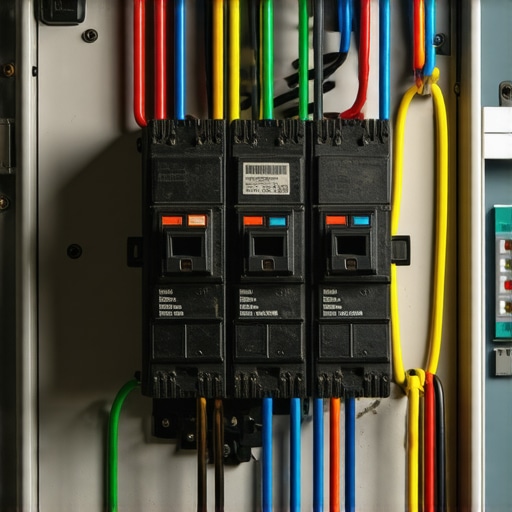
The Anatomy of a Mid-Century Time Bomb
Your home’s electrical system isn’t a fine wine; it doesn’t get better with age. If your house was framed when bell-bottoms were first in style, you’re likely sitting on a ticking clock. As a forensic inspector, I’ve spent decades pulling back the drywall of homes that ‘looked fine’ from the outside, only to find the guts of the system charring silently. By 2026, the demand on our residential grids has skyrocketed. Between EV chargers, high-end workshop electrical setup requirements, and the sheer volume of smart devices, those old circuits are screaming for mercy.
I remember my first year as a green apprentice, Old Man Miller shoved a scorched 15-amp breaker under my nose. ‘Smell that?’ he growled. ‘That’s the smell of a homeowner who thought a flickering light was just “character.” It’s actually the smell of carbonizing plastic.’ He taught me that by the time you see the smoke, the physics of failure have been at work for a decade. He used to smack my hand if I stripped a wire with a knife. ‘You nick the copper, you create a hot spot,’ he’d scream. He was right. That microscopic nick reduces the cross-sectional area of the conductor, increasing resistance. In the world of physics, resistance plus current always equals heat. Always.
“Aluminum wire connections can overheat and cause a fire without tripping the circuit breaker.” – CPSC Safety Alert 516
The Physics of Failure: Why Aluminum and Old Panels Die
If your home was built between 1965 and 1978, you likely have aluminum branch circuit wiring. The problem isn’t the metal itself, but a phenomenon we call Cold Creep. Aluminum has a much higher thermal expansion coefficient than copper. Every time you run a toaster or a vacuum, the wire heats up and expands. When you turn it off, it contracts. Over years of these cycles, the wire literally ‘creeps’ out from under the terminal screws on your outlets. This creates a loose connection. A loose connection creates an arc—a miniature lightning bolt jumping the gap. This arc generates temperatures exceeding 1,000 degrees Fahrenheit, which is more than enough to ignite the wood studs or the ‘Monkey Shit’ (duct seal) someone used to plug a hole poorly.
Then there’s the panel. If you see the name Federal Pacific Electric (FPE) or Zinsco on your door, you don’t just need a 60 amp panel upgrade; you need an exorcism. The FPE Stab-Lok breakers are notorious for a design flaw where the internal trip bar jams. You could have a dead short, and that breaker will sit there like a lump of coal while the Romex in your walls turns into a heating element. Forensic testing has shown these breakers fail to trip up to 60% of the time when they should.
Red Flag 1: The ‘Sizzling’ Wall and the Fishy Stench
If you hear a faint buzzing or ‘sizzling’ sound when you plug in a lamp, that’s not ‘ghosts.’ That is the sound of electricity jumping a gap. It’s a high-frequency vibration of the air molecules caused by an arc. This is often accompanied by a pungent, fishy smell. That smell is the urea-formaldehyde or phenolic resin in the plastic outlet housing beginning to decompose under intense heat. If you smell fish near an outlet, don’t reach for the Febreze; reach for your Wiggy or a Tick Tracer to see if that circuit is still live, then shut it down at the main. This is a primary indicator that preventative electrical maintenance is no longer an option—it’s an emergency.
Red Flag 2: The Dimming Ritual and Load Stress
Does your kitchen light dip when the refrigerator compressor kicks on? In 2026, we call this ‘voltage sag,’ and it’s a symptom of an undersized service. Many mid-century homes are still running on 60 or 100-amp services. Modern life—especially if you’ve added tiny home wiring for a backyard ADU or a heavy-duty workshop electrical setup—requires 200 amps minimum. When the demand exceeds the supply, the voltage drops. This doesn’t just flicker the lights; it kills the sensitive electronics in your computers and appliances. If you’re seeing this, a meter socket replacement and a service heavy-up are likely overdue.
“Ground-fault circuit-interrupter protection shall be provided for all 125-volt, single-phase, 15- and 20-ampere receptacles installed in bathrooms, kitchens, and crawl spaces.” – NEC Article 210.8
Red Flag 3: The Lack of GFCI and AFCI Protection
Walk into your bathroom or out to your dock. If you see standard outlets instead of GFCI outlet installation with ‘Test’ and ‘Reset’ buttons, you are living in the past. On a dock, this is even more critical. Dock electrical services face constant salt-air corrosion, which leads to galvanic reactions between different metals. Without a GFCI, a stray current can leak into the water, creating a ‘Widow Maker’ scenario where a swimmer can be paralyzed by an electric shock. Similarly, 2026 codes require Arc-Fault Circuit Interrupters (AFCI) for almost every room in the house. While a standard breaker protects against shorts and overloads, an AFCI detects the specific ‘signature’ of a dangerous arc and kills the power before the fire starts.
Red Flag 4: Brittle Insulation and ‘Rough-in’ Errors
If you ever have to go into the attic, take a look at the wires. If the outer jacket of the Romex cracks when you touch it, the plasticizers have leached out. This leaves the conductors exposed. I’ve seen attics where rodents have chewed this brittle insulation, leaving bare copper resting on dry wood. This is common in older tiny home wiring retrofits where heat wasn’t properly dissipated. When the insulation fails, the house becomes a tinderbox. This is also why emergency exit lighting and proper smoke detector hardwiring are vital; they give you the seconds you need when the hidden wires finally give up the ghost.
Red Flag 5: Data Throttling and EMI
In 2026, our ‘wiring’ isn’t just about power; it’s about data. If your high-speed internet feels sluggish despite paying for a gigabit, it might be due to Electromagnetic Interference (EMI). Old, unshielded power lines running parallel to your data cables create ‘noise.’ Modern ethernet wiring services use shielded Cat6a or Cat7 to prevent this, but if your home’s electrical backbone is a mess of 1970s ‘spaghetti’ wiring, your data will suffer. Upgrading your home’s electrical system often involves separating these paths to ensure your smart home actually stays smart.
The Path to Safety: Don’t Settle for the Handyman Special
I’ve seen too many ‘handyman specials’ where someone tried to save a buck by burying a junction box behind drywall or using electrical tape instead of proper wire nuts. When you get free electrical estimates, look for the contractor who talks about torque. Every terminal screw has a specific inch-pound rating. If it’s too loose, it arcs. If it’s too tight, it crushes the wire and creates a hot spot. A real Master Electrician uses a torque screwdriver, not just a pair of Dikes and a prayer. Whether you are doing a 60 amp panel upgrade or a full workshop electrical setup, the goal is the same: sleep at night knowing that the physics of electricity are working for you, not against you. Get the inspection. Find the red flags. Fix the time bomb before it goes off.