
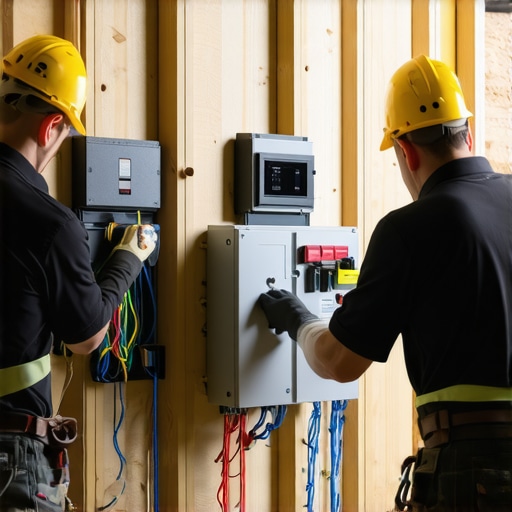
The Ghost of Electrical Past: Why Your ADU Project Is Already Failing
Before you ever break ground on that Accessory Dwelling Unit (ADU), before you even pick out the trendy tile for the backsplash, you are likely making a mistake that will haunt you during the rough-in inspection. I’ve spent over three decades in this trade, and if there’s one thing I’ve learned, it’s that electricity is lazier than a second-year apprentice on a Friday afternoon—it always takes the path of least resistance, and usually, that path leads to a fire or a red tag from the city inspector. My journeyman used to smack my hand if I stripped a wire with a knife. ‘You nick the copper, you create a hot spot,’ he’d scream. ‘That nick reduces the cross-sectional area of the conductor, increasing resistance and generating heat exactly where you don’t want it.’ He was right, of course. That lesson stuck with me for 35 years. Today, I see ‘pro’ installers doing much worse, treating ADU wiring like a weekend hobby rather than the complex engineering challenge it actually is. As we approach the 2026 permit cycle, the National Electrical Code (NEC) is tightening its grip on load calculations and safety redundancies. If you think you can just daisy-chain a sub-panel off your existing 1970s service, you’re in for a violent awakening.
Mistake 1: The Myth of the ‘Infinite’ 100-Amp Panel
The most common failure I see in ADU planning is the refusal to address the main service capacity. You’ve got a Mid-Century home, likely sitting on a 100-amp service with a meter base that looks like it’s been through a war. You want to add an ADU with an electric range, a mini-split HVAC, a water heater, and maybe a 240V EV charger. You are trying to squeeze a gallon of water through a cocktail straw. When you add that ADU load, you aren’t just adding a few lights; you’re adding a continuous duty load that can thermally stress your old bus bars to the point of structural failure. Most homeowners skip the meter base replacement because it’s expensive and requires coordination with the utility, but skipping it is a recipe for a 2:00 AM emergency call. I’ve seen aluminum bus bars in 1970s panels that have undergone ‘Cold Creep’—the metal literally flows away from the pressure of the lug screw over decades of thermal cycling. When you torque a new lug onto that compromised metal, you’re just waiting for the arcing to begin.
“The calculated load shall be not less than the sum of the loads on the branch circuits served, as determined by Part II of this article, after any applicable demand factors have been applied.” – NEC Section 220.10
Without a licensed master electrician performing a rigorous load calculation, you are guessing with your life. If your main panel is an old Zinsco or Federal Pacific, you aren’t just making a mistake; you’re building a time bomb. Those breakers are notorious for ‘jamming’—they won’t trip even when the wire is glowing cherry red. A full service heavy-up is often the only path to a 2026 permit approval.
Mistake 2: Trenching Electrical Conduit Without Forensic Precision
When we talk about underground wiring services, most guys think it’s just about digging a ditch and tossing some grey pipe in. It’s not. The physics of the earth are brutal. Soil expands and contracts. Moisture find its way into everything. I’ve pulled out Romex—which should never be underground anyway—that looked like a bloated, black snake because the outer jacket had decomposed in the alkaline soil. The mistake here is usually depth or material choice. If you’re doing trenching electrical conduit for an ADU, you need to be at 18 inches for PVC or 24 inches for direct burial (which I never recommend for a primary feed). I’ve seen ‘handymen’ bury Schedule 40 PVC only 6 inches deep under a garden bed. One misplaced shovel from a landscaper and you’ve got a widow maker waiting in the mud. Furthermore, you must use ‘Monkey Shit’—that’s duct seal for the uninitiated—at the entrance points of the conduit to prevent moisture and radon from migrating into your clean data closet organization or the main panel. If you don’t, the temperature differential between the warm house and the cold ground will cause condensation to drip directly onto your main lugs, leading to galvanic corrosion that eats the copper alive. This is even more critical if you’re dealing with boat lift wiring nearby; salt air and moisture will bridge the gap between phases faster than you can grab your Wiggy to test the dead circuit.
Mistake 3: The Data Afterthought and the EMI Nightmare
In 2026, an ADU isn’t just a shed; it’s often a remote office or a ‘data center’ for the modern professional. The third mistake is failing to separate high-voltage power runs from ethernet wiring services. I’ve walked into brand-new ADUs where the installer ran the Cat6 cables right alongside the 120V Home Run lines. The electromagnetic interference (EMI) makes the internet speed drop to a crawl, and the ‘pro’ can’t figure out why. You need 12 inches of separation, or you need to cross at 90-degree angles. A proper data center power setup in a small ADU requires a dedicated data closet organization strategy. If you jam your router, your switch, and your patch panel into a corner with no airflow and 240V lines humming nearby, you’re going to be replacing hardware every two years. I always tell my apprentices: ‘Treat data like silk and power like a sledgehammer.’ If you don’t provide a clean, shielded path for your data, you’ll never get the performance you’re paying for. This is where warranty backed repairs become essential—if your electrician doesn’t understand signal-to-noise ratios, they shouldn’t be touching your low-voltage infrastructure.
Mistake 4: Neglecting the Whole-House Shield
The final mistake is treating whole house surge protection as an ‘optional’ upsell. It’s not. With the 2020 NEC updates (and moving into 2026), surge protection is often a code requirement for new services and ADU additions. Think about the sensitivity of modern appliances. Your ADU’s mini-split has an inverter board that costs $800 to replace. Your smart fridge, your LED drivers, your laptop—they all rely on clean sine waves. A single lightning strike or even a utility switching surge can send a spike through your underground feeders that fries everything in the ADU before the breaker even thinks about tripping. A breaker only cares about overcurrent; a surge protector cares about voltage spikes.
“A surge protective device (SPD) shall be installed in or on all new and replaced service equipment.” – NFPA 70 (2020 NEC Section 230.67)
If your licensed master electrician isn’t installing a Type 1 or Type 2 SPD at the ADU sub-panel, they are doing you a disservice. I’ve stood in front of panels where the smell of ozone and toasted silicon was so thick you could taste it. The homeowner saved $300 on the surge protector and lost $15,000 in electronics. Don’t be that person. Ensure your contract specifically mentions warranty backed repairs that cover surge-related failures. When I do a trim-out, I want to know that when I flip that main breaker, the system isn’t just ‘on’—it’s fortified.
The Final Torque: Why 2026 Permits Demand Precision
Permit offices are getting smarter. They are tired of ‘flipper specials’ where the wiring looks like a bird’s nest. They are looking for torqued lugs, proper grounding electrode systems, and clear labeling. If you try to cut corners on your ADU wiring, you’re not just risking a failed inspection; you’re risking the structural integrity of your property. Electricity is a violent force we’ve merely tamed with copper and plastic. Respect the physics. Use a tick tracer before you touch anything, but don’t rely on it—always verify with a meter. If you’re building in 2026, do it right the first time. Get the meter base replacement, dig the trenching electrical conduit to the proper depth, organize your ethernet wiring services, and shield the whole thing with a surge protector. Only then can you sleep at night knowing your ADU isn’t just a structure, but a safe, code-compliant extension of your home. Any licensed master electrician worth their salt will tell you the same: the most expensive wire you’ll ever buy is the one you have to install twice.