
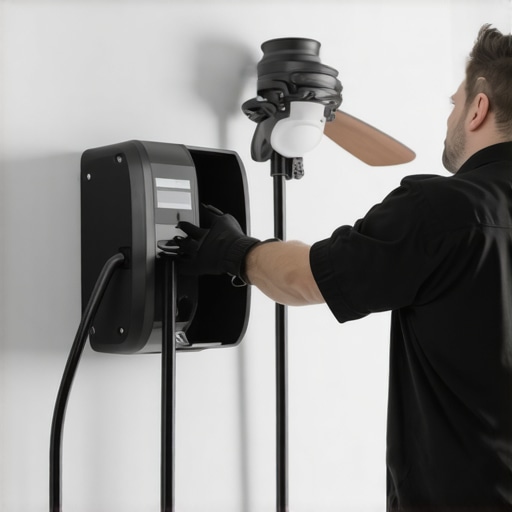
The Sudden Click of Disaster
You hear it before you smell it. That sharp, metallic ‘clack’ of a circuit breaker throwing itself into the neutral position, followed by the silence of a dead room. Maybe it happened when you plugged in your new Tesla, or perhaps it was the moment you toggled the high setting on that vintage-style ceiling fan. To the average homeowner, it’s a nuisance. To me, after 35 years of chasing phantoms through crawlspaces, that click is a forensic data point. It’s the sound of a system screaming for help because it can no longer handle the thermal stress of modern life. When we talk about EV charger installation or ceiling fan troubleshooting, we aren’t just talking about making things work; we are talking about preventing the oxidation-induced fires that turn a ‘renovated’ 1970s split-level into a pile of ash.
My journeyman, an old-timer named Pops who’d been wiring since the Truman administration, used to smack my hand with his dikes if I ever got sloppy with a wire stripper. ‘You nick that copper, kid, and you’ve just built a fuse that’ll blow when the homeowner isn’t looking,’ he’d growl while we were mid-rough-in. He wasn’t being a jerk; he was teaching me about the cross-sectional area of a conductor. When you nick a wire, you create a high-resistance bottleneck. High resistance under load generates heat. Heat causes the copper to expand and contract, eventually loosening the terminal screw. This ‘cold creep’ cycle is the silent killer in mid-century homes, especially those cursed with aluminum wiring or those Federal Pacific ‘Stab-Lok’ panels that I refuse to even touch without a full panel changeout quote in my hand.
“Aluminum wire connections can overheat and cause a fire without tripping the circuit breaker.” – CPSC Safety Alert 516
The EV Charger: Why Your 100-Amp Panel is Lying to You
The most common call I get these days involves an EV charger that keeps tripping the main. Most folks think adding an EV station is like plugging in a toaster. It’s not. An EV charger is a ‘continuous load,’ meaning it pulls full power for hours on end. According to the National Electrical Code, you can only load a circuit to 80% of its rated capacity for continuous use. If you have a 60-amp circuit for your charger, you’re pulling 48 amps. If that home run goes back to a subpanel that’s already feeding a dryer and a heat pump, you are flirting with a localized meltdown. This is where a professional electrical safety audit becomes non-negotiable.
When I perform an audit for an EV charger, I’m looking at the service mast, the meter can, and the bus bars. In mid-century homes, we often find the bus bars in those old panels are pitted or corroded. When you pull 48 continuous amps through a pitted bus bar, you get arcing. Arcing creates carbon tracks. Carbon is conductive, but highly resistive, creating a runaway heat loop. If your breaker feels warm to the touch, it’s not ‘working hard’—it’s failing. A circuit breaker replacement isn’t just about swapping the plastic switch; it’s about inspecting the tension of the bus bar clips. If those clips have lost their spring tension due to previous overheating, a new breaker will fail just as fast as the old one.
Ceiling Fans and the ‘Widow Maker’ Junction Box
Ceiling fan troubleshooting often starts with a ‘wobble’ or a ‘hum,’ but for a forensic inspector, the real horror is usually hidden behind the canopy. I’ve lost count of how many times I’ve seen a heavy fan hung on a standard plastic ‘nail-on’ box designed for a 2-pound light fixture. That is what we call a ‘widow maker.’ A ceiling fan generates dynamic loads—vibration and torque. Over time, those vibrations fatigue the plastic tabs or the wood screws holding the box to the joist. Eventually, the whole unit comes down. If you’re lucky, it just hits the floor. If you’re unlucky, it rips the Romex out of the ceiling, creating a live, whipping conductor above your head.
When troubleshooting a fan that won’t start, I skip the ‘tick tracer’ (non-contact voltage tester) and go straight for my Wiggy. A tick tracer will lie to you—it picks up ‘ghost voltage’ or electromagnetic fields that don’t have the current to actually move a motor. A Wiggy (solenoid voltmeter) puts a physical load on the circuit. If the Wiggy doesn’t vibrate, you don’t have real power. Usually, the failure point is a loose neutral in a junction box buried three rooms away, or a burnt-out capacitor in the fan motor itself. If your fan hums but doesn’t spin, the start-winding or the capacitor has likely surrendered to the heat.
Water and Watts: The Invisible Danger of Docks and Pools
If you have a dock or a pool, the stakes for electrical safety are exponentially higher. Swimming pool bonding is the most misunderstood concept in residential electricity. It’s not the same as grounding. Bonding connects all the metal parts of the pool structure—ladders, pumps, lights, and even the rebar in the concrete—to create an ‘equipotential plane.’ This ensures that there is no voltage difference between two objects you might touch simultaneously. If your pool isn’t bonded correctly, you can become the path to ground just by reaching for the ladder while standing in the water.
For dock electrical services, the enemy is salt air and moisture. I’ve seen meter cans on coastal properties that looked fine on the outside, but when I popped the cover, the lugs were so oxidized they looked like green cauliflower. This is where we use ‘Monkey Shit’ (duct seal) and dielectric grease to seal out the corrosive atmosphere. For driveway sensor lights and architectural lighting near the water, everything must be stainless steel or heavy-duty composite, and every connection must be torqued to spec. A loose connection in a salt-air environment will oxidize in weeks, leading to a service call that could have been avoided with five minutes of proper trim-out technique.
“All metal parts of the electrical system and all metal piping and structural steel that are likely to become energized shall be bonded together to form an electrically conductive path.” – NEC Article 250.4(A)(3)
The Solution: Don’t Treat Electricity as a Hobby
Whether you’re looking at a generator transfer switch for storm season or installing high-end chandelier lighting, the physics remains the same: Electricity is always trying to find a way to the ground, and it will go through you or your house’s framing if you give it a shortcut. A subpanel installation to handle the load of a new workshop or EV charger isn’t just a matter of slapping in some breakers; it’s about load balancing. If you put all your heavy hitters on ‘Phase A’ and leave ‘Phase B’ empty, you’ll overheat the neutral and potentially fry every sensitive electronic device in the house.
Stop relying on ‘handyman’ fixes. If a contractor tells you they can ‘just pig-tail’ that aluminum wiring without using proper AlumiConn connectors or the Copalum crimp method, show them the door. If your lights flicker when the AC kicks on, don’t ignore it. That flicker is the sound of a voltage drop, and a voltage drop is a sign of a high-resistance connection somewhere in your home run. Get a real audit. Sleep at night knowing your lugs are torqued, your bonding is solid, and your system isn’t a ticking time bomb hidden behind the drywall.
This article really hits home for anyone who’s had to deal with the aftermath of an improperly wired ceiling fan or an overlooked junction box. I especially appreciate the emphasis on the ‘widow maker’ junction box—I’ve seen too many cases where a lightweight ceiling fixture turns into a safety hazard over time. Using proper loads and ensuring junction boxes are secure is such a simple yet critical step. Regarding EV charger setups, I’ve learned the hard way that taking the time for a professional load analysis can prevent costly repairs and even dangerous overheating issues down the line. Out here in coastal California, corrosion is a constant threat, so sealing connections and using corrosion-resistant materials is a must. I’m curious, has anyone implemented smart load balancing systems to automatically monitor and adjust EV charging load? Would love to hear real-world experiences or recommendations on smart panels or devices that can help distribute power more evenly.
Reading through this article really resonated with me, especially the part about the ‘widow maker’ junction boxes. I’ve seen firsthand how a simple ceiling fan can turn into a dangerous hazard if installed on a flimsy box, which over time, fatigues and fails under the dynamic load. Your point about vibration causing fatigue really hit home, as I’ve had to replace a couple of those boxes myself, thankfully before any mishaps. On the topic of EV chargers, I’ve recently installed a smart load balancing system that monitors real-time power consumption and redistributes loads to prevent overloads. It’s been a game-changer, especially with my electric vehicle charging station running for hours daily. For those considering upgrades, do you think integrating smart panels with load management features is worth the investment? It seems like a proactive way to mitigate risks associated with high continuous loads and aging infrastructure. Would love to hear others’ experiences—are these systems reliable and easy enough for DIY homeowners to manage, or is professional setup always recommended?
This article really highlights some critical points that often get overlooked by homeowners. The mention of ‘cold creep’ and high-resistance connections causing silent but deadly issues resonates with me. I recently had an experience where I noticed my ceiling fan was humming louder than usual, and after reading this, I realize it might have been a capacitor or loose connection behind the canopy that was silently degrading. It’s a reminder that proper inspection, especially behind ceiling fans and junction boxes, can prevent catastrophic failures or even fires. The part about corrosive environments on coastal properties also caught my attention—My friend lives near the coast, and he recently had to replace his outdoor electrical connections due to salt air corrosion, which could have been minimized with proper sealing from the start. Has anyone here used real-time load monitoring devices or smart panels for their EV chargers and home systems? I’d love to hear firsthand how effective and manageable those solutions are for everyday homeowners. Safe electrical installations are truly a matter of proactive maintenance and professional oversight.