
The Anatomy of a Hidden Fire: Why Your Breaker Won’t Stay Reset
You hear that rhythmic, metallic click from the garage, and suddenly the kitchen goes dark. Again. Most homeowners treat a tripping breaker like a minor annoyance, a puzzle to be solved by flipping a plastic lever back and forth. But to an inspector who has spent 35 years pulling back the drywall to find charred studs, that click is a warning shot. It’s the sound of a system struggling to prevent your house from becoming a statistic. If you’re dealing with constant nuisance trips, you aren’t just looking at a ‘sensitive’ breaker; you’re looking at a forensic trail of heat, resistance, and aging infrastructure that demands 2026-grade AFCI technology and a master’s eye for NEC code updates.
The Old Timer’s Lesson: The Ghost in the Wire
I remember my first week as a green apprentice back in the late 80s. My journeyman, a guy named ‘Red’ who’d survived a 480v blast that took the hair off his arms, saw me using a utility knife to strip back the jacket on a 12/2 Romex. He didn’t just correct me; he slapped the knife out of my hand with a force that stung for an hour. ‘You nick that copper, kid, you just built a fuse where a wire should be,’ he growled. ‘Heat finds the weakness. Always.’ He was right. That microscopic nick creates a hot spot where resistance climbs, the wire thins, and eventually, an arc begins to jump the gap. That’s why I don’t trust ‘handyman’ work. When we do a rough-in or a trim-out, every single conductor is treated with the respect a live bomb deserves.
The Autopsy of a Failure: Understanding the Arc
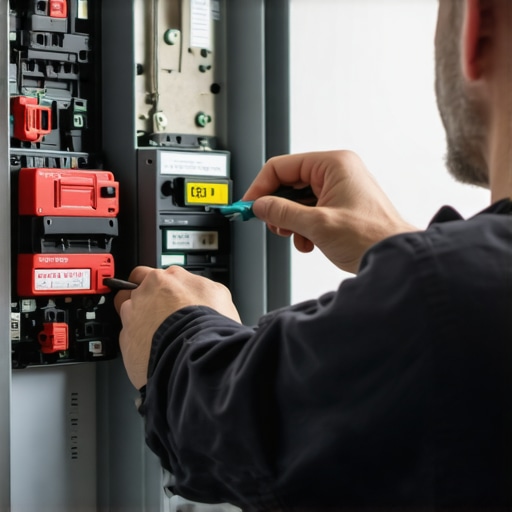
When a standard breaker trips, it’s usually because of an overload (too many appliances) or a short circuit (hot touching neutral). But Arc-Fault Circuit Interrupters (AFCIs) are different. They are essentially tiny computers that ‘listen’ to the heartbeat of your home’s electricity. They are looking for the ‘stutter’ of an arc—a high-frequency signature that occurs when electricity jumps through the air because of a loose connection or damaged insulation. [IMAGE_PLACEHOLDER]
“Arc-fault circuit interrupters (AFCIs) are required by the National Electrical Code for many areas of the home to protect against fires caused by arcing faults.” – NFPA 70, National Electrical Code (NEC)
The ‘nuisance’ trips people complain about often aren’t mistakes by the breaker; they are the breaker doing exactly what it was designed to do: detecting a problem before it generates enough heat to ignite the lumber behind your walls. However, 2026 AFCI technology has evolved. Older units were easily fooled by the ‘brush noise’ of a vacuum cleaner or the switching power supplies in modern electronics. The latest 2026-spec units utilize advanced digital signal processing to distinguish between the ‘good’ arcs of a motor starting up and the ‘bad’ arcs of a Home Run wire that’s been gnawed by a rodent in the attic.
Component Zooming: The Physics of Cold Creep and Aluminum Disaster
In mid-century homes built between 1960 and 1980, we often find the ‘Widow Maker’ of electrical systems: aluminum wiring. The physics here is brutal. Aluminum has a high coefficient of thermal expansion. Every time you turn on a space heater, the wire heats up and expands. Because it’s softer than copper, it crushes itself against the steel terminal screws of your outlets. When the load turns off, the wire cools and contracts, but it doesn’t return to its original shape. It leaves a microscopic gap. This is ‘Cold Creep.’ Over time, that gap becomes a playground for arcs. The oxygen in the air reacts with the aluminum to form aluminum oxide—a terrible conductor that adds even more resistance and heat. This is where aluminum wiring repair becomes a non-negotiable safety requirement. We don’t just ‘tighten the screws’; we use AlumiConn connectors and specialized torque drivers to ensure a gas-tight, permanent bond. Ignoring this is why people end up calling for after hours electrical repair when their outlet starts melting at 2 AM.
The Load Calculation Crisis: 100 Amp Service vs. Modern Life
Many older homes are still chugging along on a 100 amp service upgrade that was performed decades ago. Back then, a ‘heavy load’ was a toaster and a color TV. Today, we are installing RV hookup installation points in the driveway, spa grounding services for 50-amp hot tubs, and high-speed CAT6 cabling services that connect a dozen smart devices. When you pull 80 amps through an old bus bar, the heat is incredible. You can feel it radiating through the panel cover. We call it ‘cooking the bus.’ This heat damages the spring tension in the breakers, making them prone to tripping at lower and lower thresholds. A 100 amp service upgrade to a 200-amp system isn’t an ‘upsell’; it’s about providing the headroom necessary so your breakers don’t have to live at 90% capacity, which leads to thermal fatigue and, eventually, a catastrophic failure.
“Aluminum wire connections can overheat and cause a fire without tripping the circuit breaker.” – CPSC Safety Alert 516
The Forensic Inspector’s Toolkit: Wiggy vs. Tick Tracer
When I walk into a house to diagnose nuisance trips, I see ‘sparkies’ pull out a cheap non-contact voltage tester—what we call a Tick Tracer. Those things are liars. They can pick up ghost voltages and phantom frequencies that don’t mean a thing. I trust my Wiggy (a solenoid voltmeter). It puts a physical load on the circuit. If there’s a loose neutral or a high-resistance connection, the Wiggy will tell me the truth. We also look at power factor correction issues. In modern homes with LED up lighting services and variable speed motors, the electricity can get ‘dirty.’ This ‘noise’ is a common cause of AFCI trips. By analyzing the wave signature, we can identify if the problem is the wiring or if we need to install filtering to clean up the power factor.
The Fix: Warranty Backed Repairs and Peace of Mind
If your breakers are tripping, don’t just swap them out for ‘standard’ breakers to bypass the AFCI protection. That’s like removing the batteries from a smoke detector because you don’t like the beeping. Our warranty backed repairs focus on finding the root cause. We use Dikes to prune back damaged conductors, we apply Monkey Shit (duct seal) to keep moisture out of the service mast, and we ensure every terminal is torqued to the exact inch-pound specification required by the manufacturer. We check your spa grounding services to ensure there’s no stray voltage leaking into the water, and we verify that your CAT6 cabling services aren’t being interfered with by high-voltage electromagnetic fields. When we leave, you aren’t just ‘back in power’; you’re safe. You can sleep knowing that the 2026 AFCI tech is standing watch, and that every connection in your panel is as solid as a weld. Electricity isn’t a hobby, and your home isn’t a laboratory for ‘good enough’ repairs. Get it done right, or get it done twice—and the second time might involve a fire truck.