
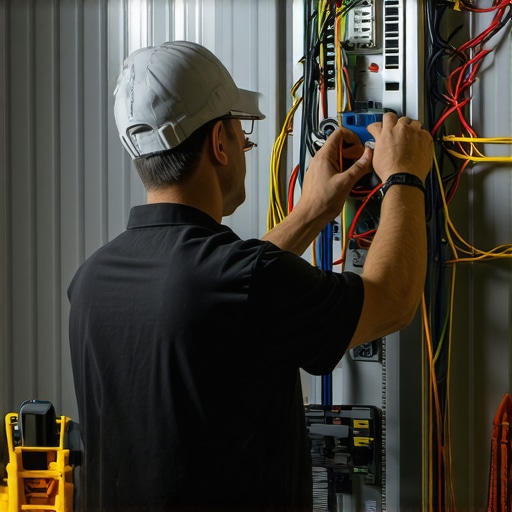
The Ghost in the Walls: Why Your Mid-Century Home is a Silent Hazard
You do not smell it at first. It is a faint, metallic tang—ozone—drifting through the hallway of a house built during the Nixon administration. To a homeowner, it is a mystery. To a Master Electrician with 35 years in the trenches, it is the sound of a countdown. When you are looking to hire a licensed master electrician for same day fixes in 2026, you aren’t just paying for a guy with a van and a Tick Tracer. You are paying for the forensic eye that knows why your lights flicker when the microwave kicks on and why your 1970s panel is currently trying to turn itself into a toaster.
My journeyman used to smack my hand if I stripped a wire with a knife. ‘You nick the copper, you create a hot spot,’ he’d scream over the sound of a hammer drill. He was right. That microscopic notch reduces the cross-sectional area of the conductor, creating a point of high resistance. In the world of high-amperage draws, resistance equals heat. Heat equals fire. It is a lesson I carry every time I perform an aluminum wiring repair or a rough-in for a tiny home wiring project.
“Aluminum wire connections can overheat and cause a fire without tripping the circuit breaker.” – CPSC Safety Alert 516
The Physics of Failure: Aluminum and Cold Creep
If your home was built between 1965 and 1973, you are likely sitting on a structural vulnerability known as ‘Cold Creep.’ Aluminum was the darling of the industry during the copper shortages of the Vietnam era, but it has a fatal flaw: its coefficient of thermal expansion is significantly higher than copper. Every time you run your pool pump electrical system or plug in a space heater, that wire heats up and expands. When you turn it off, it contracts. Over decades, this cycle causes the wire to literally ‘creep’ out from under the terminal screws of your outlets and breakers. This creates a gap. Electricity, being the lazy, violent force it is, jumps that gap. We call that an arc. An arc is 35,000 degrees Fahrenheit. It doesn’t care about your drywall or your memories.
A proper aluminum wiring repair involves more than just swapping outlets. We use AlumiConn connectors or COPALUM crimps to create a cold-weld bond between the aluminum house wire and a copper ‘pigtail.’ This stops the expansion cycle dead. It is the difference between a permanent fix and a home run to the emergency room.
Modern Loads on Ancient Infrastructure: The EV Charger Crisis
By 2026, the demand on residential grids has hit a breaking point. Homeowners are buying an EV charger and expecting a 1960s 100-amp service to handle a 48-amp continuous load for eight hours straight. That is like trying to shove a fire hose through a soda straw. When I perform a load calculation, I am looking at the thermal capacity of your service mast and the integrity of your main lugs. If those lugs aren’t torqued to the specific inch-pounds required by the manufacturer, they will vibrate at 60Hz until the oxidation layer builds up enough resistance to melt the bus bar. This is why storm damage electrical repair often reveals more than just wind damage; it reveals decades of neglect that the storm finally pushed over the edge.
Industrial Muscle: Warehouse Retrofits and Motor Controls
In the commercial sector, the stakes are higher. A warehouse lighting retrofit isn’t just about sticking in LEDs. It’s about harmonics and the neutral bus. High-efficiency ballasts can dump ‘dirty power’ back onto the neutral, causing it to overheat even if the hot legs are balanced. In industrial motor controls, we deal with inductive kickback and ‘ghost voltages’ that can fry a PLC in a heartbeat. I keep my Wiggy—a solenoid-based tester—handy for these jobs because digital meters can be fooled by phantom voltage. A Wiggy puts a physical load on the circuit; it tells you if the power is real or just a capacitive ghost.
“Only qualified persons shall perform tasks such as testing, troubleshooting, and voltage measuring within the limited approach boundary of energized electrical conductors.” – NFPA 70E Standard for Electrical Safety in the Workplace
The Outdoors: From RV Hookups to Tree Mounted Lights
Water and electricity are ancient enemies. When I install an RV hookup installation, I’m not just slamming a box on a post. I’m worried about the ‘lost neutral’ that can send 240 volts through your camper’s sensitive electronics. I use Monkey Shit (duct seal) to plug the conduits, preventing moist air from the ground from traveling up into the panel and rotting the breakers from the inside out. The same applies to landscape lighting install and tree mounted lights. Trees grow. They stretch wires. They hold moisture against the insulation. If you don’t use the right strain reliefs and UV-rated Romex (or better, UF cable), your beautiful garden becomes a series of widow makers hidden in the brush.
The Master’s Verdict
Don’t trust your family’s safety to a ‘handyman’ with a pair of dikes and a roll of electrical tape. Electricity is an invisible predator. It doesn’t bark before it bites. Whether it is a tiny home wiring challenge or a complex industrial motor controls failure, you need someone who understands the metallurgy of the wire and the physics of the arc. Sleep at night knowing your lugs are torqued, your grounds are bonded, and your system is up to the 2026 code. Call a professional who has seen the fire and knows how to keep it inside the wire.