The Ghost in the Plaster: Understanding the Time Bomb Behind Your Walls
You smell it before you see it. It’s a faint, metallic tang—ozone mixed with the scent of 100-year-old dust getting cooked. Most homeowners ignore it until the flickering starts, or worse, until a tick tracer starts screaming at a wall where there isn’t even an outlet. As a forensic inspector who has spent three decades dragging a Wiggy through crawlspaces, I’ve seen the hubris of the modern world collide with the electrical standards of the 1920s. We’re living in an era of level 2 EV chargers and high-draw kitchen range hood wiring, yet many of our heritage homes are still sucking juice through a system designed when a single 40-watt bulb per room was considered a luxury.
The Old Timer’s Lesson: Why the Nick Matters
My journeyman used to smack my hand if I stripped a wire with a knife. ‘You nick the copper, you create a hot spot,’ he’d scream. He was right. Back in the day, the conductors in knob-and-tube (K&T) systems were often hand-soldered and wrapped in rubber and cotton. If you nicked that copper during a rough-in, you didn’t just weaken the wire; you created a point of high resistance. In a K&T system, which lacks a dedicated equipment grounding conductor, that resistance leads to heat that has nowhere to go but into the surrounding wood lath. I’ve seen ‘hot spots’ that had been smoldering for decades, just waiting for a modern load—like a solar panel electrical hookup or a heavy-duty appliance—to finally push the temperature past the flash point.
The Anatomy of Obsolescence: Physics of Knob and Tube
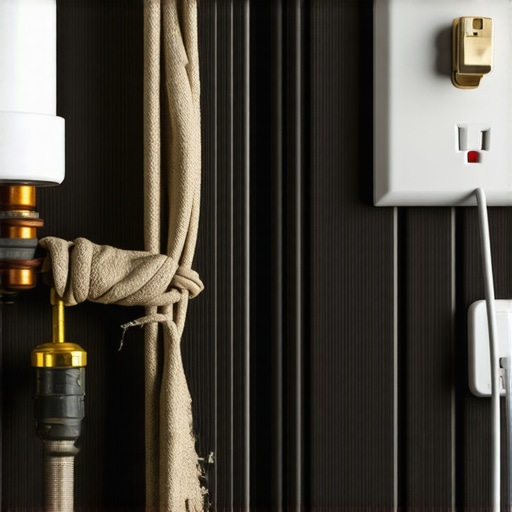
Knob and tube wiring is a single-conductor system. Unlike modern Romex, where the hot, neutral, and ground are bundled in a single sheath, K&T keeps them separated by several inches. The wires are supported by porcelain knobs and protected by porcelain tubes where they pass through joists. The physics was sound for 1910: air was the primary insulator. By separating the wires, the heat generated by the current could dissipate into the wall cavity.
“Aluminum wire connections can overheat and cause a fire without tripping the circuit breaker.” – CPSC Safety Alert 516
While that quote refers to mid-century aluminum, the principle of thermal stress is even more acute in K&T. The insulation is the weak link. Over a century, the vulcanized rubber becomes brittle. If you touch it, it crumbles like an old cigar. This is ‘Cold Creep’ in a different form—not the movement of metal, but the slow death of organic insulation. When you try to install underground wiring services or upgrade a smart meter installation, the vibration alone can cause that brittle insulation to fall off inside the walls, leaving bare 120-volt copper resting against ancient, kiln-dried timber.
The Insulation Trap: A Fatal Mistake
The biggest threat to a K&T home isn’t the wire itself; it’s the ‘energy efficiency’ expert. Modern building codes require thick layers of cellulose or fiberglass insulation. If you pump that stuff into a wall cavity containing knob and tube, you’ve just built a furnace. K&T relies on the ‘free air’ in the wall to stay cool. Burying it in insulation traps the heat, causing the wire temperature to skyrocket. This is where insurance claim electrical work usually begins—after the fire department has left. Most insurance companies will flat-out refuse to cover a home once they spot those porcelain knobs, and for good reason.
Modern Demands vs. Antique Infrastructure
We are trying to run 21st-century lives on a 19th-century straw. A level 2 EV charger pulls 32 to 48 amps continuously. A K&T circuit was often fused at 15 amps for an entire floor. When you plug in a Tesla, you aren’t just ‘using’ electricity; you are stress-testing a museum piece. The same goes for pathway lighting install projects or adding a smoke detector installation that requires a hardwired interconnect. If an electrician tells you they can ‘just pig-tail’ onto your existing K&T, run. They are setting you up for an arc-fault. Proper safety in a modern home requires tiny home wiring standards at a minimum—dedicated circuits, grounded conductors, and Arc-Fault Circuit Interrupter (AFCI) protection.
The Forensic Breakdown: How K&T Fails
When I do a forensic sweep, I look for ‘bootleg grounds.’ This is a classic ‘handyman special’ where someone takes a three-prong outlet and jumps the neutral screw to the ground screw. On a tick tracer, it looks grounded. But in reality, you’ve just energized the metal chassis of your toaster. If the neutral wire fails—a common occurrence in K&T due to rough-in oxidation—that toaster stays live. I’ve seen kitchen range hood wiring that was so corroded at the junction that the metal housing was sitting at 90 volts. You touch the hood and the stove at the same time, and you become the home run for that current.
“The use of AFCI breakers is a critical step in mitigating the fire hazards associated with aging branch circuit wiring.” – NFPA 70E Guide
The Solution: A Total Tactical Retreat
There is no ‘repairing’ knob and tube. You replace it. A full trim-out and rewire is the only way to sleep at night. This involves running new Romex or MC cable from a modern 200-amp panel to every device. When we do this, we often find ‘widow makers’—splices hidden inside walls without junction boxes, wrapped in nothing but friction tape that has long since turned to dust. If you’re doing tiny home wiring or a renovation, do not compromise. Use monkey shit (duct seal) to plug the holes in the basement, pull your new lines, and abandon the old porcelain in the walls. It’s the only way to ensure your smart meter installation is actually measuring a safe system rather than a slow-motion disaster. Electricity isn’t a hobby, and 100-year-old wire isn’t ‘vintage charm’—it’s a liability.