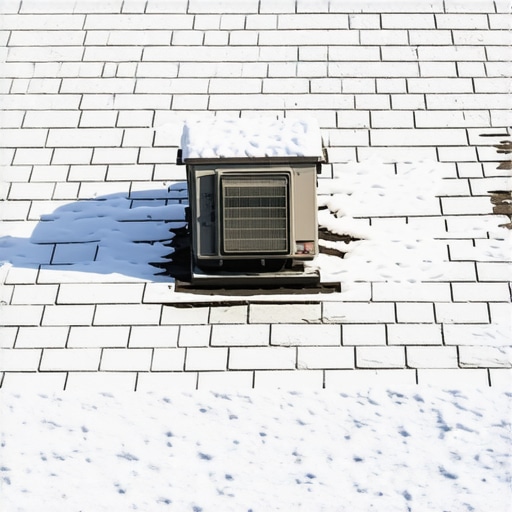
The 3:00 AM Wake-Up Call: The Forensic Reality of Ice Dams
You’re lying in bed, and you hear it. A rhythmic tink, tink, tink coming from inside the wall. It’s not a ghost; it’s the sound of water migrating through your headers and pooling on your top plates. By the time you see the yellow stain on the ceiling, the forensic damage is done. As a master inspector, I’ve seen this play out in a thousand attics. You think the snow on your roof is a Hallmark card, but without a properly wired attic fan, that snow is a ticking time bomb. The physics are brutal: heat escapes your living space, hits the underside of the roof deck, and creates a micro-climate that melts the bottom layer of snow. That water runs down to the eaves—which are cold because they overhang the house—and flash-freezes into a ridge of ice. That’s the dam. Behind it, a lake of slush builds up, finds a way under your shingles, and begins the slow rot of your structure. This is where the after hours electrical repair calls start, usually because that water has found its way into a ceiling fan box or a recessed light fixture, turning your home into a conductive nightmare.
My journeyman used to smack my hand if I stripped a wire with a knife. ‘You nick the copper, you create a hot spot,’ he’d scream. He was right. Electricity and heat have a symbiotic relationship that most homeowners ignore until the smoke starts. When we talk about attic fans, we aren’t just talking about summer cooling. We are talking about maintaining a ‘Cold Roof’ strategy. In the winter, an attic fan’s job is to equalize the temperature between the attic space and the exterior air. If your attic is 50 degrees and it’s 20 degrees outside, you are asking for a structural autopsy. You need to pull that warm air out before it can bake the roof deck.
“Aluminum wire connections can overheat and cause a fire without tripping the circuit breaker.” – CPSC Safety Alert 516
In many older homes built between 1900 and 1950, the electrical infrastructure is already screaming for help. I’ve seen fuse box to breaker conversion projects where the homeowner was trying to run a modern gable fan on a 15-amp glass fuse circuit shared with the microwave. It doesn’t work. You’re looking at a massive resistance hit. When you rough-in a new fan, you need to think about the continuous load. A fan running 24/7 to combat a week-long blizzard is a different beast than a fan that kicks on for an hour in July. We’re talking about thermal expansion in the windings. If that motor isn’t rated for it, or if your wiring is brittle Romex from the Eisenhower era, you’re trading a roof leak for a house fire.
The Anatomy of Failure: Why Fans Die When You Need Them Most
Let’s zoom into the motor of a standard attic ventilator. Inside, you have copper windings and a start capacitor. In the dead of winter, grease in the bearings can thicken. If your fan is old, the ‘Cold Creep’ in the electrical connections can lead to a loose neutral. When that happens, the motor struggles to turn, the amperage spikes, and the heat builds up. I’ve used my Tick Tracer on fans that were humming but not spinning, and the heat radiating off them was enough to ignite the ‘monkey shit’ (duct seal) used by some hack to close the junction box. This is why a drone light inspections can be so valuable; an infrared camera on a drone can spot a hot attic fan motor from fifty feet away before it turns into a structure fire.
When we do ADU electrical services, the attic ventilation is often the most overlooked component. People focus on the kitchen range hood wiring or making sure they have a doorbell camera install to see their Amazon packages, but they forget that a sealed ADU is a moisture trap. That moisture rises into the attic, condenses on the cold nails of the roof deck, and creates ‘attic frost.’ When the sun hits the roof, that frost melts, mimicking a roof leak. A humidistat-controlled attic fan is the only solution. It pulls that moist air out before it can undergo a phase change back into liquid water.
“All electrical equipment shall be installed in a neat and workmanlike manner.” – NEC 110.12
Let’s talk about the permanent holiday lighting trend. I see guys tapping into the attic fan circuit to power their LEDs. It’s a violation of everything I hold holy. You’re adding a parasitic load to a circuit that needs to be dedicated. If your holiday lights short out because of a salt-air-corroded socket, they trip the breaker, and suddenly your attic fan is dead. You won’t know it until the ice dam has already breached your shingles. This is why I always recommend a home run for any attic ventilation system. You want it on its own 15-amp breaker, preferably an AFCI (Arc-Fault Circuit Interrupter) so that if a squirrel decides to sharpen its teeth on your wire, the system shuts down before the wood glows cherry red.
The Forensic Inspection: Beyond the Fan
When I’m called out for a forensic inspection after a winter storm, I’m not just looking at the fan. I’m looking at the whole system. Did the driveway sensor lights fail because of ice falling from the eaves? Are the emergency exit lighting systems in the basement flooded? Usually, the culprit is the same: poor thermal management. We have to look at arc flash studies in industrial settings to understand the power of a short circuit, but the same principles apply to your attic. A short in a damp environment is an invitation for disaster. If you’re still living with an old fuse panel, you are playing a dangerous game. A fuse box to breaker conversion isn’t an upgrade; it’s a survival tactic. Fuses don’t care about a slow, smoldering arc; breakers do.
Properly installing a fan requires more than just a Wiggy and a pair of dikes. You need to calculate the CFM (Cubic Feet per Minute) required for your roof’s square footage. If the fan is too weak, it’s just a noise maker. If it’s too strong and you don’t have enough intake venting (soffit vents), it will actually pull conditioned air from your house through the ‘bypasses’ like your recessed lights. Now you’re paying to heat the neighborhood, and you’re creating a vacuum that can back-draft your water heater’s exhaust. That’s a carbon monoxide scenario that turns a ‘handyman special’ into a funeral.
To get the trim-out right, you need to ensure the thermostat is set correctly. In winter, you aren’t looking for 70 degrees. You’re looking to keep that attic within 10 degrees of the outside air. It sounds counterintuitive to ‘waste’ energy running a fan in the winter, but compare a $20 monthly electrical increase to a $40,000 roof replacement and a mold remediation claim. The math isn’t hard. Sleep at night knowing your attic is cold, your wires are torqued to spec, and your breaker won’t jam when the ‘widow maker’ tries to strike.