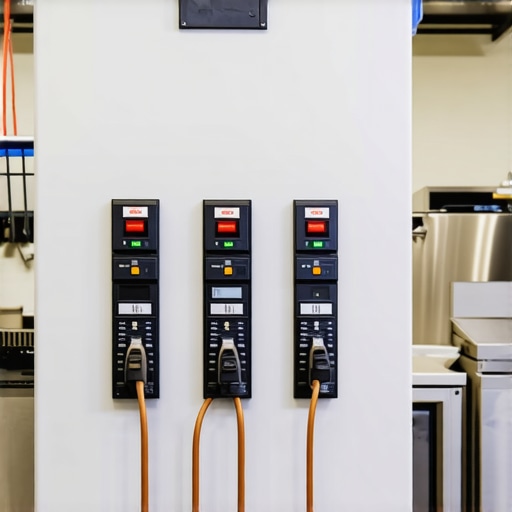
The Anatomy of a Tripped Breaker: Why Your Kitchen is Starving for Amps
The sound of a commercial kitchen shouldn’t include the metallic clunk of a 200-amp main breaker giving up the ghost right in the middle of a Friday night rush. If you’ve ever stood in a dark line-prep area, smelling the distinct, ozone-heavy scent of an overheated panel, you know that electricity isn’t just a utility; it’s the lifeblood of your business. Most restaurateurs inherit a space and assume the ‘juice’ is sufficient. They add a double-stack convection oven, a high-temp dishwasher, and a bank of induction burners, then wonder why the lights flicker like a horror movie every time the compressor on the walk-in freezer kicks over. The reality is that commercial electrical infrastructure isn’t about just ‘having power’—it’s about the physics of resistance, heat dissipation, and the brutal reality of continuous loads.
The Flipper’s Grave: A Forensic Discovery
I walked into a ‘fully renovated’ bistro last year where the owner was complaining about a mysterious ‘burnt toast’ smell that wasn’t coming from the toaster. I pulled out my tick tracer and started scanning the wall behind a beautiful subway-tiled backsplash. The signal was screaming. I took a hammer to a small section and found what I call a ‘Friday Afternoon Special.’ The previous flipper had buried three live junction boxes behind the tile with no access plates. They had used residential-grade 14-gauge wire to feed a commercial panini press. The insulation had melted into a sticky, black goo—what we call ‘monkey shit’ in the trade—and the copper was starting to pit from the heat. I found it just before the arcing turned into an interior wall fire. This is why we perform an electrical safety audit before a single stove is plugged in. You can’t hide bad physics behind pretty tiles.
Ohm’s Law and the Cruelty of Heat
To understand a commercial upgrade, you have to understand the ‘Continuous Load’ rule. In the electrical world, if a device runs for more than three hours, it’s a continuous load, and you have to size the circuit at 125% of that load. A 40-amp oven doesn’t just need a 40-amp breaker; it needs a 50-amp circuit to account for the heat buildup in the wire. When you pack twenty of these circuits into a single panel, the internal temperature of that cabinet starts to climb. This leads to ‘thermal creep,’ where the physical expansion and contraction of the bus bars loosen the screws holding your breakers in place. A loose connection creates resistance. Resistance creates heat. Heat creates a fire.
“Aluminum wire connections can overheat and cause a fire without tripping the circuit breaker.” – CPSC Safety Alert 516
While most commercial kitchens use copper, the principle remains: if your connections aren’t torqued to the exact inch-pound specification required by the manufacturer, you are building a furnace inside your wall. This is where power quality analysis becomes vital. We don’t just look at whether the light stays on; we look at the ‘noise’ on the line—the total harmonic distortion caused by modern LED drivers and variable-frequency drives on your exhaust fans. This noise generates extra heat in the neutral wire, which can lead to a fire damage wiring restoration project you didn’t budget for.
The Blueprint for a Heavy-Up: From Service Mast to Sub-Panel
Upgrading capacity isn’t just about swapping a breaker. It’s a systemic overhaul. First, we look at the service entrance. If you’re trying to pull 600 amps through a 400-amp service mast, you’re going to melt the weather head. We often have to coordinate with the utility company to pull larger ‘Home Run’ feeders from the transformer. Then comes the ‘Rough-in’ phase. In a commercial kitchen, we don’t use Romex. We use EMT (Electrical Metallic Tubing) or MC (Metal-Clad) cable. Why? Because rats love the taste of plastic insulation, and a single rodent can take down a million-dollar restaurant by chewing through a 120v line near a grease trap.
We also need to talk about AFCI breaker services. While the code for kitchens focuses heavily on GFCI (Ground Fault Circuit Interruption) for moisture protection, AFCI (Arc Fault) is becoming more prevalent in the ‘front of house’ and office areas to prevent fires from damaged cords. For the heavy equipment, we install dedicated sub-panels for the cooking line and the refrigeration. This keeps the ‘dirty’ power of a massive motor start-up away from your sensitive home automation setup or POS systems. If you have a data closet organization issue, the heat from the kitchen will migrate there, cooking your servers. Proper separation and cooling are non-negotiable.
Environmental Enemies: Grease and Vibration
In a commercial kitchen, the environment is hostile. You have ‘grease-laden vapors’ that act as a solvent on certain types of wire insulation. I’ve seen ‘Trim-out’ jobs where the electrician didn’t use liquid-tight conduit for the floor drains or dishwashers. Within two years, the soap and water had wicked up the wire, corroding the copper until it looked like green powder. This is why we use remote electrical diagnostics to monitor phase imbalance before a motor burns out. If your 3-phase power is unbalanced by even 5%, your walk-in freezer motor will run 20 degrees hotter than it should, cutting its lifespan in half.
“Branch-circuit conductors shall have an ampacity not less than the maximum load to be served.” – NEC 210.19(A)(1)
If you’re adding architectural lighting to your dining room or fence line lighting for an outdoor patio, those need to be on separate circuits from the kitchen. I’ve seen a electric gate opener short out and take down the entire line-prep station because some ‘handyman’ tapped into the nearest available junction box. That’s a Widow Maker of a mistake. Always keep your utility and specialty loads isolated.
Final Torque: Why You Can’t DIY This
When I finish a Rough-in, I don’t just flip the switch and walk away. I use a Wiggy to check for phantom voltages and a thermal camera to look for ‘hot spots’ on the lugs. If I see a lug that’s 10 degrees hotter than the others, I know it’s not torqued correctly. We use ‘Dikes’ to trim back any nicked copper, because a single nick in the strand can concentrate current and create a localized heat zone. This isn’t a hobby. It’s forensic science. You want to sleep at night? Make sure your kitchen’s power is engineered, not just ‘connected.’ From remote electrical diagnostics to the final architectural lighting install, every amp must be accounted for and every wire must be protected from the heat, grease, and vibration of the culinary battlefield.