The Invisible Heat: Why Your Eyes Are Liars in Electrical Safety
I remember my first journeyman, a guy named ‘Big Sal’ who had hands like leather and a permanent squint from forty years of looking at arcs. He used to tell me, ‘Kid, copper has a memory for every time you over-torqued a lug or let a connection get loose. It’ll forgive you for a year, maybe two, but eventually, it’ll scream.’ He’d make us hover our bare palms an inch away from the switchgear—never touching, unless you wanted a one-way ticket to the morgue—just to feel for the ghost of a heat signature. He was right about the physics, but he’d be the first to admit his hands weren’t as precise as a thermal sensor. In today’s commercial landscape, we don’t rely on ‘the feel’; we use infrared thermography because what you can’t see is exactly what’s going to burn your building down at 3:00 AM.
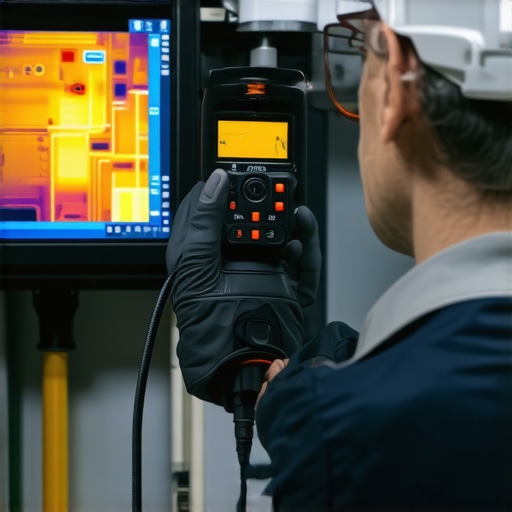
When we perform electrical inspections today, we aren’t just checking for outlet switch repair needs or making sure the bathroom exhaust fan isn’t rattling. We are looking for the thermal reality of a system under load. Infrared scans have become the industry standard for preventative electrical maintenance because they reveal the molecular struggle happening inside your conductors. When a connection is loose, or when a breaker is failing internally, it creates resistance. In the world of Ohm’s Law, resistance equals heat. That heat radiates outward, and an IR camera catches it as a bright, glowing warning sign. It’s the difference between guessing and knowing.
“Thermal imaging is a non-destructive testing method that allows for the detection of anomalies in electrical systems before they lead to catastrophic failure or fire.” – NFPA 70B Standard for Electrical Equipment Maintenance
The Physics of the Failure: Component Zooming into Resistance
To understand why an electrical panel upgrade is often triggered by an IR scan, you have to understand Contact Resistance. Every time electricity moves through a junction—a lug, a wire nut, or a breaker bus bar—it needs a clean, tight path. If that path is compromised by oxidation, improper torque, or the dreaded ‘Cold Creep’ seen in older aluminum systems, the electrons have to fight to get through. This fight generates kinetic energy in the form of heat. In a commercial setting, where you might have a 400-amp service running 24/7, even a micro-ohm of extra resistance can create a hotspot that exceeds 300 degrees Fahrenheit. You won’t see it with a tick tracer or a wiggy. You won’t even see the smoke until the insulation has already turned to carbon. By the time the breaker trips, the bus bar is likely pitted beyond repair.
This is why electrical wiring services now mandate thermal imaging for any facility audit. We look at the ‘Home Run’—the main feed from the utility—all the way down to the sub-panels. We’ve found pathway lighting install jobs where the underground spice was taking on water, creating a high-resistance ground fault that was costing the owner hundreds in ‘ghost’ electricity. Without the IR scan, that power would have just kept bleeding into the dirt until the wire disintegrated. We use the same tech when we provide free electrical estimates for complex commercial retrofits. It tells us if we can tap into an existing panel or if the whole thing is a ticking time bomb of internal corrosion.
From the Service Mast to the Doorbell: A Holistic View of Safety
While most people think of IR scans for big industrial motors, the logic applies to everything. We’ve scanned small commercial offices and found that a simple doorbell camera install or a set of driveway sensor lights had been tapped into a circuit that was already running at 90% capacity. On the thermal screen, that wire looked like a glowing filament. It wasn’t a problem yet, but in a heatwave, that Romex would have melted. This is why forensic inspectors like me get so agitated about ‘handyman’ work. A guy with a pair of dikes and some electrical tape can make a light turn on, but he can’t see the thermal stress he’s putting on the system. He doesn’t know that he’s created a ‘Widow Maker’ by failing to account for load balance.
“Aluminum wire connections can overheat and cause a fire without tripping the circuit breaker.” – CPSC Safety Alert 516
When we do a rough-in for a new commercial space, we ensure all connections are torqued to manufacturer specifications. But metal expands and contracts. Over thousands of cycles, those screws can back off. During the trim-out phase and subsequent yearly audits, we use IR to verify that everything stayed tight. If we see a hot spot on a neutral wire, we know we have a bigger problem—likely a harmonic distortion or a shared neutral that’s being overloaded. We don’t just tighten the screw; we find the ‘Why’. We might use monkey shit (duct seal) to prevent moist air from entering a panel through the conduit, which prevents the oxidation that leads to these hot spots in the first place.
The Economic Reality of Preventative Maintenance
Insurance companies are no longer asking for IR scans; they are demanding them. If you haven’t had a certified thermographer look at your switchgear in three years, your premiums are going to reflect that risk. It’s not just about fire; it’s about downtime. A $200 outlet switch repair is nothing compared to a main lug failing and shutting down a data center for 48 hours. By identifying the need for an electrical panel upgrade through IR, we can schedule the outage on a Sunday morning rather than dealing with an emergency explosion on a Tuesday afternoon. We catch the failing capacitors in your bathroom exhaust fan motors and the arcing contacts in your driveway sensor lights before they become insurance claims. In the end, you don’t pay for the scan; the scan pays for itself by keeping the lights on and the building standing.