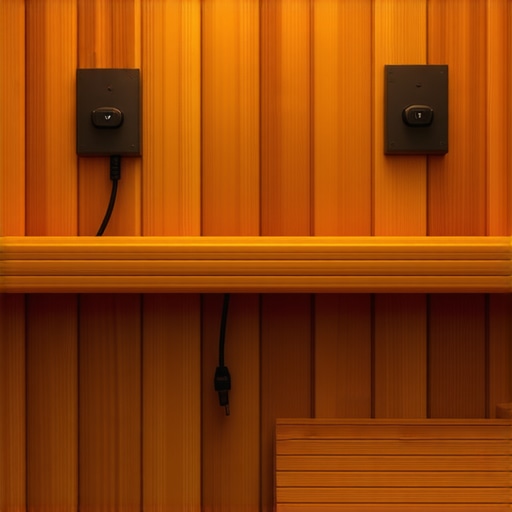
The Invisible Heat: Why Sauna Heaters Are Not Just Another Appliance
I have spent three decades hunting for the smell of burning fish in crawlspaces and tracing the distinct ozone scent of an arcing bus bar. When a homeowner asks me about adding a sauna, they usually focus on the cedar smell or the digital timer. I focus on the 30 to 50 amps of continuous current that is about to scream through their service entrance upgrade. A sauna heater is one of the few residential loads that operates at near 100% duty cycle for hours; it is a brutal stress test for your home’s infrastructure. If you choose the wrong connection method or ignore the math, you aren’t building a spa; you are building a thermal runaway event. My old journeyman used to say, ‘Electricity is a lazy beast, but it has a nasty temper when you crowd it.’ He once saw me using a cheap pair of dikes to strip a 10-gauge Romex run and nearly threw his Wiggy at me. ‘You nick that copper, you’re creating a bottleneck for every electron in that circuit,’ he barked. He was right. In a high-heat environment like a sauna, that tiny nick becomes a localized hotspot, leading to oxidation, increased resistance, and eventually, a call to the fire department.
The Plug-in ‘Solution’: Convenience vs. The Physics of Failure
Plug-in sauna heaters are tempting because they promise a ‘no-permit’ installation. This is the first lie. Even a 120V unit requires a dedicated circuit, often involving electrical wiring services to ensure the wire gauge matches the breaker. Most plug-in units use a NEMA 6-20 or 5-15 configuration. The problem is the contact point. Every time you plug and unplug a device, you weaken the tension of the brass tabs inside the receptacle. In a high-vibration or high-heat environment, that loose connection creates ‘series arcing.’ I have seen receptacles in a workshop electrical setup where the plastic had carbonized—turned into a conductor itself—because the plug was pulling 15 amps through a loose contact for two hours a day.
“Aluminum wire connections can overheat and cause a fire without tripping the circuit breaker.” – CPSC Safety Alert 516
While most modern heaters use copper, the principle of thermal expansion remains. In a sauna, the temperature swings are radical. A plug-in connection experiences ‘creep,’ where the metal expands and contracts, slowly backing the wires out of their terminals. If you are using a camper electrical panel for an outdoor mobile sauna, this risk is doubled by the constant vibration of travel. If you must go the plug-in route, you better be using industrial-grade receptacles and checking them with a tick tracer or a thermal camera every season.
The Hardwired Gold Standard: Torque and Thermal Management
Hardwiring a sauna heater is the only way I sleep at night as an inspector. By bypassing the plug and receptacle, you eliminate the primary point of failure. You are creating a continuous path from the home run at the main panel to the heater terminals. This requires permit pulling services because it involves a permanent modification to your home’s electrical system and adherence to the latest NEC code updates. When hardwiring, we use THHN wire inside Liquidtight Flexible Nonmetallic Conduit (LFNC). We seal the penetrations with monkey shit (duct seal) to prevent moisture from the sauna from migrating back into the wall cavity. This is critical for flood water electrical safety if the sauna is located in a basement or near a pool deck. The hardwired approach also allows for a proper service entrance upgrade. Many older homes have 100-amp services that are already pinned to the max. Adding an 8kW sauna heater without a 400 amp service entrance or at least a 200-amp upgrade is asking for a main breaker failure during the first cold snap of winter.
Load Calculations: Ohm’s Law Does Not Negotiate
Before you even look at a heater catalog, you need to perform a demand load calculation. You don’t just add up the breakers; you calculate the square footage and the fixed loads. If you have a doorbell camera install, deck lighting services, an EV charger, and a workshop, your 200-amp panel might already be at 80% capacity. Continuous loads (those running for more than 3 hours) must be calculated at 125% of their rated amperage. An 8,000-watt heater at 240 volts pulls 33.3 amps. Multiply that by 1.25, and you need a 45-amp or 50-amp breaker and 6-gauge wire. This is where electrical wiring services become non-negotiable. Using a 40-amp breaker on a 33-amp continuous load is a violation that will cause the breaker to ‘nuisance trip’ because the thermal element inside the breaker gets too hot.
“Overcurrent protection devices shall be sized at not less than 125 percent of the continuous load.” – NEC Article 210.20(A)
This isn’t a suggestion; it’s physics. When you ignore this, the heat builds up in the panel bus bar, eventually annealing the metal and ruining the entire panelboard. I’ve seen 400 amp service entrance lugs that were glowing cherry red because some ‘handyman’ didn’t use a torque wrench to meet the manufacturer’s specifications. If those lugs aren’t torqued to the inch-pound, you’re creating a high-resistance bridge that will eventually melt the insulation off the feeders.
The Final Inspection: Professionalism Over Pinterest
Choosing between hardwired and plug-in isn’t just about cost; it’s about the infrastructure of your home. If you are doing a workshop electrical setup and want to tuck a small 120V sauna in the corner, a plug-in might suffice IF the circuit is dedicated and the receptacle is spec-grade. But for any real sauna experience, hardwiring into a robust system—potentially supported by a service entrance upgrade—is the only way to ensure the safety of your family. Electricity doesn’t give warnings; it just fails. Whether it’s a doorbell camera install or a massive 400 amp service entrance, every connection matters. Don’t be the person whose house I have to visit with a forensic camera and a notepad to explain to the insurance company why the ‘renovation’ resulted in a total loss. Get the permits, do the load calcs, and torque those lugs like your life depends on it—because it does.