The Invisible Fulcrum: Why Your Service Entrance is a Physics Experiment Waiting to Fail
I’ve spent thirty-five years watching homeowners stare at a pile of splintered oak and mangled aluminum, wondering why their lights are flickering like a horror movie. They think it’s just a branch. I see it differently. I see a thousand pounds of kinetic energy using a two-inch Rigid Metal Conduit (RMC) as a crowbar to peel the soffit right off their house. My old journeyman, a guy who had missing fingertips and a permanent scowl, used to smack my hand if I even thought about stripping a wire with a pocket knife. ‘You nick that copper, you create a hot spot, and you’re just waiting for the house to do the rest of the work for you,’ he’d scream. He wasn’t just talking about the wire; he was talking about respect for the mechanical stresses of electricity. If you don’t treat your service entrance with that same level of paranoia, you’re just a storm away from an after hours electrical repair that’ll cost you five times what a pruning job would have.
“Service-drop conductors shall have a vertical clearance of not less than 8 feet from the surface of roofs through which they pass.” – NEC 230.24(A)
When we talk about the service entrance, we’re talking about the lifeline of the structure. In mid-century homes, especially those built between 1960 and 1980, we deal with the specific nightmare of aluminum lateral conductors. The physics of Cold Creep is your primary enemy here. Aluminum expands and contracts at a different rate than the brass lugs in your meter can. Over decades, this thermal cycling loosens the connection. Now, add a swaying tree branch into the mix. Every time that triplex cable tugs on the weatherhead, it’s vibrating those loose connections. It’s not just about the branch hitting the wire; it’s about the mechanical fatigue at the point of attachment. If you’re running an EV charger or have a complex home theater wiring setup, that micro-arcing at the service head will wreak havoc on your sensitive electronics long before the branch actually snaps the line.
The Anatomy of a Failure: From Weatherhead to Meter Socket
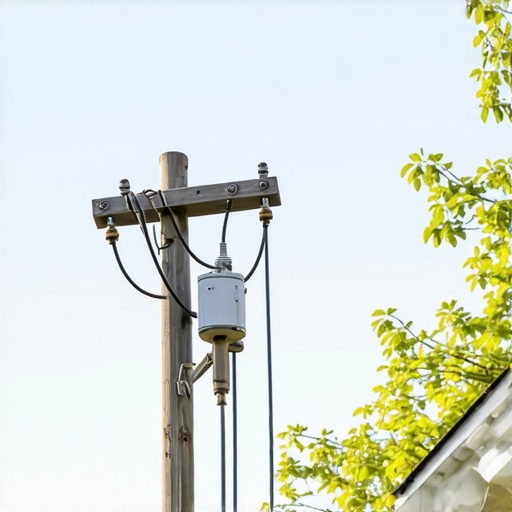
Let’s perform a forensic autopsy on a standard mast failure. It starts at the weatherhead. We use what we call “monkey shit”—that’s duct seal for the uninitiated—to keep the rain out, but if the mast isn’t guyed properly, a falling limb will bend that pipe until the seal breaks. Once water enters the conduit, it’s a straight shot down to your 200 amp panel install. I’ve opened panels where the main lugs were so corroded from water ingress that they looked like they’d been pulled from the bottom of the Atlantic. This is why a service entrance upgrade isn’t just about capacity; it’s about structural integrity. We’re talking about using heavy-wall RMC and through-bolted porcelain insulators that can actually take a hit. If your mast is held on by a couple of wood screws into the fascia, you don’t have a service entrance; you have a temporary hook.
When a branch finally does take down the line, the most dangerous scenario isn’t a total blackout—it’s the ‘floating neutral.’ If the branch snaps the neutral carrier but leaves the two hot legs intact, your house starts looking for a path back to the transformer through your landscape lighting install or your plumbing. I’ve seen driveway sensor lights glowing at twice their rated brightness right before they exploded because the voltage on one leg spiked to 200V while the other dropped to 40V. This is why a power quality analysis is mandatory after any physical strike to the service equipment. You can’t just slap a new wire up and call it a day. You have to check the integrity of the grounding electrode system. If your ground rods are old galvanized pipes from the 50s, they’ve likely rotted away to nothing, leaving you with no safety net when the tree takes out the utility’s return path.
“Aluminum wire connections can overheat and cause a fire without tripping the circuit breaker.” – CPSC Safety Alert 516
Hardening Your Infrastructure: The Professional Approach
If you’re serious about protection, you don’t just trim the trees; you harden the target. This involves a pathway lighting install that’s trenched deep enough to avoid root heave and a service mast that’s braced back to the rafters, not just the roof deck. When I do a commercial electrical services consult, I’m looking at the tension of the overhead span. Most residential masts are over-tensioned by the utility, meaning there’s zero slack for when a limb adds weight. We need a proper drip loop—a literal ‘U’ shape in the wire before it enters the weatherhead. If that loop is too small, water follows the wire right into the pipe. I use my Wiggy to test for stray voltage on the mast itself after a storm; if that pipe is energized because of a frayed wire, it’s a widow maker for anyone touching the gutters.
Don’t trust a tick tracer to tell you it’s safe after a branch hit. Those non-contact voltage testers are liars in a high-static environment. You need a load-prospecting meter to ensure the connection is solid. If you see signs of ‘tracking’—those little carbon spiderwebs on the porcelain—it’s time to pull the dikes out of the pouch and start cutting for a replacement. A 200 amp panel install is the perfect time to relocate the service entrance away from that overhanging maple. We call it a home run for a reason; you want the shortest, cleanest path from the utility to your main breaker, away from the ‘lever’ of the trees. Sleep better knowing your lugs are torqued to spec and your mast is braced for a hurricane, not just a breeze.