The Invisible Safety Net: Why Your Grounding System Might Be a Ghost
You can’t smell a bad ground, and you certainly can’t see it by glancing at your service panel. It’s a silent failure. I’ve walked into too many homes where the owner spent thousands on energy storage systems and high-end CAT6 cabling services, only to have a lightning strike fry the entire rack because their grounding electrode was effectively a piece of decorative copper-clad steel. When your grounding system fails, the earth ceases to be a sink for stray electrons. Instead, your sensitive electronics—or your body—become the path of least resistance. If you’re feeling a tingle when you touch a faucet while standing on a damp floor, your grounding system isn’t just failing; it’s an active threat.
“A grounding electrode system shall be installed at each building or structure served to provide a path to earth for lightning, surges, and unintentional contact with higher-voltage lines.” – NEC 250.50
My old journeyman used to carry a heavy brass hammer in his belt. He’d watch me drive a rod into the Georgia clay, and if I stopped swinging before that rod was flush, he’d use that hammer to demonstrate the importance of surface area contact. ‘If that rod isn’t in deep enough to hit the water table’s moisture, you’re just burying a lightning rod that doesn’t work,’ he’d growl. He wasn’t being mean; he was being honest. He knew that a grounding electrode is only as good as the soil it’s wedged into. If you’ve ever used a tick tracer near a panel and seen it light up like a Christmas tree without touching a wire, you’re likely looking at a high-resistance ground issue where the system can’t bleed off the static charge.
The Forensic Breakdown: The Physics of Earth Resistance
To understand why your ground might be lying to you, we have to look at the chemistry of the dirt. In mid-century homes, we often see ‘cold creep’ in older aluminum connections, but the grounding electrode faces a different enemy: galvanic corrosion. When you clamp a copper wire to a galvanized steel rod, you’re creating a battery. Over thirty years, that clamp (often called an ‘acorn’) oxidizes. This creates a layer of non-conductive crust that can turn a 5-ohm connection into a 500-ohm insulator. During a shed wiring install, I once found a ground rod that had been sliced clean through by a lawnmower five years prior. The homeowner had no idea until their security camera wiring started showing ghosting images from 60Hz interference.
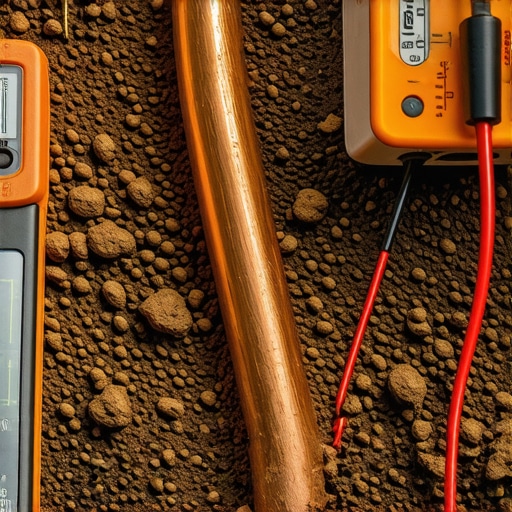
Testing this isn’t about using a simple multimeter. A standard ‘Wiggy’ or digital volt meter won’t tell you the resistance of the earth itself. You need a Fall-of-Potential test. This involves driving two temporary stakes into the ground at specific distances from your main electrode. We inject a known current and measure the voltage drop. If your resistance is over 25 ohms, the National Electrical Code requires a second rod. But here’s the truth most weekend electrician services won’t tell you: 25 ohms is still too high for modern energy storage systems or delicate network cable installation. I aim for 5 ohms or less. If your soil is sandy or rocky, you might need to use ‘monkey shit’—that’s duct seal—to protect the connection points, or even specialized backfill to lower the resistivity of the earth.
The Anatomy of a Failure: From Track Lighting to Main Service
When you hire someone for track lighting services or a complex holiday light installation, the last thing they check is the service entrance. But think about the load. Modern homes are packed with switching power supplies. These devices dump high-frequency noise onto the grounding system. If your electrode is disconnected or corroded, that noise has nowhere to go. It reflects back into the house, shortening the life of your LED drivers and causing augmented reality troubleshooting tools to glitch because of electromagnetic interference. I’ve seen CAT6 cabling services fail certification tests not because of the crimps, but because the building’s ground potential was floating 10 volts above ‘true’ earth.
“Aluminum wire connections can overheat and cause a fire without tripping the circuit breaker, especially when grounding paths are compromised.” – CPSC Safety Alert 516
If you’re looking into rebate assistance programs for energy efficiency, make sure the ‘heavy-up’ includes a forensic look at your grounding. A new heat pump or EV charger is a massive investment. If the service mast is corroded or the grounding conductor is just a 10-gauge wire from the 1960s, you’re asking for a thermal event. During a rough-in, I always ensure the grounding conductor is a continuous piece of copper—no splices. Every splice is a potential point of failure. If I see a ‘bootleg ground’—where some hack connected the neutral to the ground screw at an outlet—I know the whole house is a ticking time bomb. That’s not a ground; that’s a shortcut to a funeral.
The Fix: Code Compliance vs. Forensic Reliability
The solution isn’t just pounding another rod. You need to inspect the ‘Home Run’—the main grounding electrode conductor that runs from your panel to the rod or the water pipe. In many older cities, the city has replaced lead or iron water mains with PVC. If your house was grounded to the water pipe, you effectively have no ground anymore. You’re floating. This is why we now use Ufer grounds—encasing the electrode in the concrete footer of the house. It’s the most reliable connection to mother earth we’ve got. For those doing a shed wiring install, remember: you can’t just rely on the ground wire in the Romex. You need a local grounding electrode at that structure to handle any localized surges.
Before you spend another dime on holiday light installation or fancy track lighting services, get a Master Electrician to put a clamp-on ground resistance meter on your system. It takes five minutes and can save your life. Don’t let a ‘handyman special’ be the reason your house becomes a forensic case study. Ensure your connections are torqued to spec, your electrodes are deep enough to hit the moisture, and your ‘acorn’ clamps are free of oxidation. In the world of high-voltage, we don’t guess. We test. Because once the smoke starts, the testing phase is over.