The Invisible Fire: Why Your Event Power is a Waiting Disaster
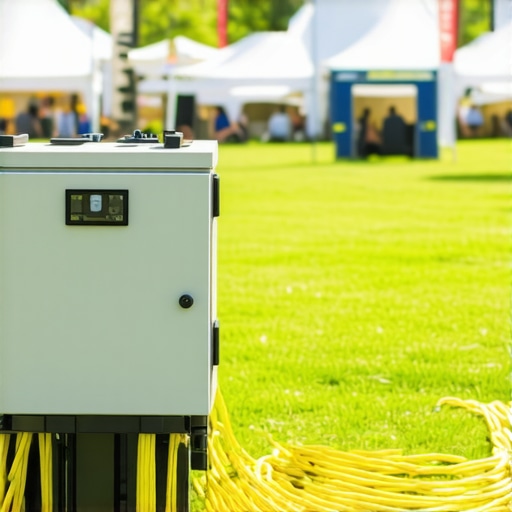
I’ve walked onto festival grounds where the smell of charring PVC was so thick you could taste it over the smell of funnel cakes. People treat temporary power like it’s just a matter of plugging in a few orange extension cords and calling it a day. It isn’t. I remember one specific ‘community fundraiser’ where the local ‘handyman’ had wired a stage by tapping directly into a street lamp circuit using bare copper hooks and a prayer. I found it with my tick tracer screaming before I even touched the metal casing of the stage. One stray rain shower and that stage would have been a massive toaster. That’s the reality of temporary setups: if you don’t respect the physics of resistance and grounding, you aren’t hosting an event; you’re building an electric chair. When we talk about NEC code updates regarding Article 525, we aren’t talking about bureaucratic red tape. We’re talking about preventing cardiac arrest.
“Parties operating or exhibiting at carnivals, circuses, fairs, and similar events shall provide an equipment grounding conductor that is bonded to the system grounded conductor at the service or at the separately derived system.” – NEC 525.10 (Equipment Grounding)
The biggest mistake I see during a rough-in for outdoor events is a complete ignorance of Ohm’s Law. You have a vendor who wants to run three commercial coffee urns and a deep fryer off a single 20-amp circuit. Let’s do the math that keeps me up at night. A 1500-watt urn pulls 12.5 amps at 120 volts. Three of those, and you’re looking at 37.5 amps. Your breaker won’t just trip; if it’s a faulty unit, the wire insulation will liquefy before the thermal element even moves. This is why electrical safety audits are non-negotiable. I use infrared thermography scans on temporary distribution boxes (spider boxes) to find those glowing hot spots where a loose lug is creating high-resistance arcing. If I see a white-hot signature on the screen, that home run is getting shut down immediately. No exceptions.
The Coastal Curse: Salt, Humidity, and Conductivity
If your event is anywhere near the coast, you’re fighting a two-front war. Salt air isn’t just corrosive; it’s conductive. In these environments, salt bridges the gap between phases in your outlets. I’ve seen sign lighting installation projects fail within 48 hours because the installer didn’t use monkey shit (duct seal) or dielectric grease on the connections. The moisture gets into the SOOW cord ends, creates a path for electricity to track across the plastic, and suddenly your ‘grounded’ enclosure is sitting at 60 volts relative to the earth. That’s why grounding electrode install procedures are different in sandy or salt-rich soil. You can’t just slap a rod three feet down. You need to hit the water table or use multiple rods bonded together to ensure your spa grounding services—or in this case, your event water features—actually have a low-resistance path to trip the breaker during a fault.
The Anatomy of a Temporary Power Hub
When setting up a pathway lighting install for a nighttime festival, you aren’t just laying wire. You’re managing voltage drop. If you run 200 feet of 14-gauge wire, the resistance of that copper starts eating your voltage. By the time it reaches the end of the line, your 120V has dropped to 105V. Your motors (like those in bouncy houses) will run hot, pull more current, and eventually burn out their windings. This is why I insist on 10-gauge or 8-gauge feeders for any significant distance. It’s also why deck lighting services for permanent structures often fail to translate to temporary setups—people forget the sheer scale of the outdoor environment. During the trim-out of a temporary panel, every single neutral must be torqued to spec. A loose neutral in a multi-wire branch circuit can send 240V through a 120V line, instantly frying every piece of speaker system setup equipment you have plugged in. I’ve seen $20,000 sound boards turned into expensive paperweights because someone didn’t use a Wiggy to verify their phases before flipping the main.
“Temporary electrical power and lighting installations shall be permitted during the period of construction, remodeling, maintenance, repair, or demolition of buildings, structures, equipment, or similar activities.” – NFPA 70 (National Electrical Code)
Security is the final pillar. You have children running around, people spilling beer, and heavy foot traffic. All your cables need to be protected by heavy-duty ramps, and every single outlet must be GFCI protected—no excuses. If I’m doing an electrical safety audit and I find a ‘cheater plug’ or a bypassed ground, the event stops. We also look at rebate assistance programs for organizers who switch to LED-based sign lighting installation because it lowers the total amperage demand, making the entire site safer by default. Don’t let a ‘handyman’ with a pair of dikes and some electrical tape handle your community’s safety. Get a master who knows the difference between a secure connection and a thermal event waiting to happen.