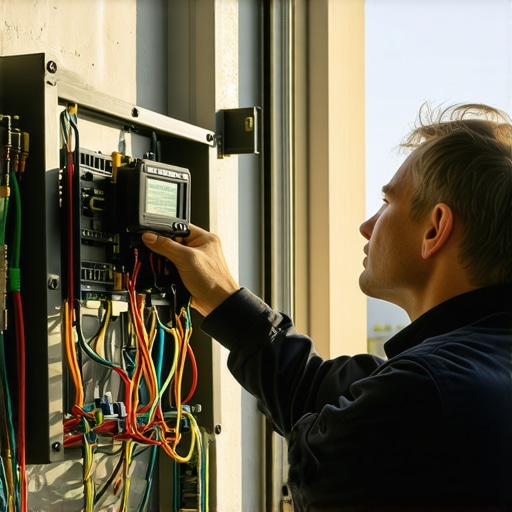
You smell it before you see it. It’s a sharp, chemical tang—part ozone, part burning fish—that hangs in the garage or utility room. As a forensic inspector with 35 years of chasing shorts and charred conductors, I’ve learned that the smell of a failing service entrance is the scent of a ticking clock. Last Tuesday, I pulled up to a 1974 ranch-style home where the homeowner complained of ‘lights that dim when the toaster kicks on.’ I didn’t even need my Wiggy to tell me where the trouble was. The meter hub was vibrating with a low 60-cycle hum, and the heat radiating off the enclosure felt like a radiator in mid-winter.
The Old Timer’s Lesson on Torque
My first journeyman, a grizzled guy who could tell the voltage of a circuit by the sound of the arc, used to smack my knuckles with a pair of dikes if he saw me tightening a main lug without a torque wrench. ‘You nick that copper, or you leave it loose enough to breathe, you’re building a furnace, not a circuit,’ he’d growl. He was right. Most homeowners, and even many modern ‘handymen,’ think that ‘tight is tight.’ In the world of high-amperage service entrances, that ignorance is a death sentence for your equipment. If a lug isn’t torqued to the manufacturer’s exact inch-pound specifications, you invite the demon of resistance into your home.
“Terminal connection torque is not a suggestion; it is a fundamental requirement of a safe electrical installation. Failure to apply proper torque leads to increased resistance and thermal runaway.” — National Electrical Code (NEC) 110.14(D)
The Physics of Thermal Runaway: Component Zooming
When we talk about an overheating service entrance, we have to look at the metallurgy of the conductors. Most homes built in the mid-70s utilized aluminum for the heavy-feeders. There’s nothing inherently wrong with aluminum, but it has a different coefficient of thermal expansion than the steel or tin-plated copper lugs it’s sitting in. This leads to a phenomenon known as Cold Creep. Every time you turn on your HVAC or an EV charger installation, the wire heats up and expands. When the load drops, it cools and contracts. Over decades, this microscopic movement works the wire loose. Once that gap opens, even by a micron, oxygen enters. Aluminum oxide—a high-resistance insulator—forms instantly. Now, the electricity has to fight its way through that oxide layer, generating heat. This heat causes more expansion, which leads to more oxidation, creating a feedback loop called thermal runaway. By the time I arrived at this job, the main service lug was reaching 340 degrees Fahrenheit. The insulation on the Romex was beginning to liquefy.
The Forensic Breakdown: The Failed Service Entrance
The autopsy of this specific system revealed a catastrophic failure at the main bus bar. The service entrance upgrade was long overdue. Because the home had recently added high-draw appliances without a proper load calculation, the old 100-amp panel was screaming for mercy. We found that the neutral wire—the most important wire in your house—was barely hanging on by a few strands. A loose neutral doesn’t just cause flickering; it can send 240 volts through your 120-volt electronics, frying everything from your fridge to your laptop in a millisecond. We also noted the absence of a proper grounding electrode install. The original ground rod was a rusted piece of rebar that had lost all connectivity to the earth, leaving the system with no path for surge dissipation.
“Aluminum wire connections can overheat and cause a fire without tripping the circuit breaker.” — CPSC Safety Alert 516
The Fix: More Than Just a Band-Aid
We didn’t just tighten the screws and leave. A real repair requires a full service entrance upgrade. We stripped back the charred ‘Stage 3’ oxidation from the feeders, applied a heavy coat of anti-oxidant joint compound (the gray ‘monkey shit’ as we call it in the field), and installed a new 200-amp copper-bus panel. We also ensured the grounding electrode install met modern standards, driving two copper-clad rods six feet apart and bonding them to the water main. For the homeowner, we also looked at the future. They were asking about deck lighting services and Christmas light services for the upcoming season. On a compromised, overheating system, adding those decorative loads is like throwing gasoline on a campfire. With the new panel, they finally had the ‘headroom’ to power their lives safely. For businesses, this is even more critical; we often perform similar forensic audits for restaurant kitchen electrical systems and data closet organization where a single hot lug can cost thousands in downtime.
Why You Can’t Ignore the Hum
If you hear a buzzing at your panel, or if the door feels warm to the touch, you are past the point of ‘DIY’ fixes. You need a professional to put a tick tracer and a thermal imager on those lugs. We provide free electrical estimates because I’d rather spend twenty minutes looking at a panel for free than twenty hours investigating a house fire for the insurance company. Whether it’s aluminum wiring repair or a fiber optic cabling project that needs a clean power source, the foundation is always the same: a cool, torqued, and grounded service entrance. Don’t let your home’s electrical heart suffer a stroke because a lug wasn’t tightened thirty years ago. Get it inspected, get it torqued, and sleep through the night without sniffing the air for smoke.