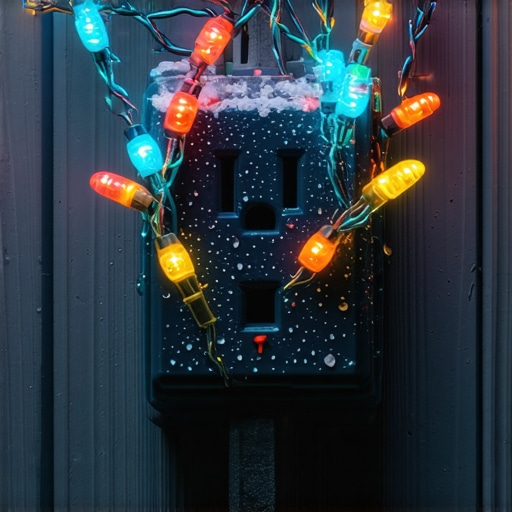
The Anatomy of a Mid-December Blackout: A Forensic Perspective
You’re standing in the wet mulch, the smell of damp pine needles and ozone hanging in the air, staring at a dark lawn. You’ve just hit the reset button on that outdoor GFCI for the tenth time, and it won’t hold. Most people see a nuisance; I see a forensic puzzle involving moisture migration, cumulative leakage current, and the unforgiving physics of the Ground Fault Circuit Interrupter. When that button pops, it’s not just ‘being sensitive.’ It’s doing exactly what it was engineered to do: preventing you from becoming the path of least resistance to ground.
My journeyman used to smack my hand if I stripped a wire with a knife. ‘You nick the copper, you create a hot spot,’ he’d scream. He was right. That lesson from thirty years ago applies every time someone drags a 50-cent string of lights across a sharp gutter edge. A tiny nick in the insulation, invisible to the naked eye, is all it takes for the current to find a new home in your aluminum siding. When you’re dealing with the damp, salty air of a coastal winter or the freezing thaw cycles of the Midwest, that nick becomes a gateway for disaster.
“Aluminum wire connections can overheat and cause a fire without tripping the circuit breaker.” – CPSC Safety Alert 516
The 5-Milliamp Executioner: How Your GFCI Thinks
To understand why your festive display is failing, we need to talk about the differential transformer inside that outlet. A Class A GFCI is designed to trip when it detects a current imbalance between the hot and neutral conductors of as little as 4 to 6 milliamperes. For context, it takes about 10 to 30 milliamperes to cause muscle contraction where you can’t let go of the wire. The GFCI is literally calibrated to save your life before you even know you’re in danger.
When you plug in those cheap holiday strands, you’re introducing hundreds of potential leak points. Every plug-to-plug connection is a failure waiting to happen. Capillary action—the same physics that pulls water up a tree trunk—sucks moisture into the female end of the plug. Once moisture bridges the gap between the hot blade and the grounded exterior, you have a ground fault. The current ‘leaks’ out of the loop, the GFCI sees the math doesn’t add up, and—snap—total darkness. This isn’t a mystery; it’s a Rough-in reality that most homeowners ignore until they’re standing in a puddle with a Wiggy in their hand.
Component Zoom: The Physics of Cumulative Leakage
We often talk about electrical load calculations when we’re installing a PA system installation or a new RV hookup installation, but holiday lighting is its own beast. Each string of lights has a tiny amount of inherent ‘leakage.’ Even brand-new, high-quality LEDs have a minute capacitive coupling to the ground. When you daisy-chain twenty strings together on a single Home Run back to the panel, those tiny leaks add up. You might have 0.5mA of leakage per string. On five strings, you’re fine. On twelve strings, you’ve hit the 6mA threshold, and the GFCI trips even if everything is bone-dry.
If you’re living in a mid-century home, the situation is worse. Those old 1960s and 70s builds often have ungrounded circuits or, worse, aluminum wiring that has suffered from Cold Creep. Aluminum expands and contracts at a different rate than the steel screws on your outlets. Over forty years, that connection wiggles loose. This creates high resistance, which generates heat. I’ve opened outdoor boxes where the Romex insulation has literally melted off because a loose neutral was arcing every time the wind blew. Adding the heavy draw of a holiday display to these compromised circuits is like asking a marathon runner to sprint with a weighted vest; eventually, something is going to snap.
The Solution: Moving Beyond the ‘Handyman Special’
If you’re tired of the ‘click’ of death every time it rains, you need to stop treating your exterior power like an afterthought. Permanent holiday lighting is the professional’s answer to this annual headache. These systems are hard-wired, protected from the elements, and don’t rely on the flimsy 22-gauge wire found in seasonal strands. Furthermore, ensuring your home has whole house surge protection is critical. A surge doesn’t just come from lightning; it can come from the utility company switching grids, and those tiny LED chips in your lights are the first things to fry.
For those sticking with traditional lights, it’s time for an audit. Use a Tick Tracer to check for live voltage on your metal gutters—if it lights up, you have a major safety violation. Check your bonding jumper services; if your metallic piping and electrical system aren’t properly bonded, a ground fault can energize your entire plumbing system. I’ve seen bathroom exhaust fan housings become live because of a bootleg ground in the attic. Don’t let your Christmas lights be the catalyst that reveals these hidden ‘widow makers.’
“All 125-volt, single-phase, 15- and 20-ampere receptacles installed in crawl spaces and in unfinished basements… shall have ground-fault circuit-interrupter protection for personnel.” – NEC Article 210.8
Hard Truths About Your Electrical Service
Many homeowners are trying to run a 21st-century lifestyle on a 1950s 100-amp service. Between the EV charger, the hot tub, and now three thousand holiday lights, you are redlining your bus bars. This is where financing electrical upgrades becomes a safety investment rather than a luxury. Upgrading to a 200-amp service with a dedicated Home Run for exterior outlets isn’t just about convenience; it’s about OSHA compliance wiring standards applied to the domestic realm. We take these standards seriously in industrial settings to keep workers alive; why wouldn’t you do the same for your family?
For our older neighbors, we offer senior discount services to help manage the cost of these critical safety updates. It’s not just about the lights; it’s about ensuring the panel isn’t a Federal Pacific or Zinsco time bomb. When we perform a Trim-out on a new service, we ensure every screw is torqued to the manufacturer’s inch-pound specifications to prevent the thermal expansion issues that plague older homes. We also use Monkey Shit (duct seal) to plug the conduits, preventing moist basement air from hitting the cold outdoor air and condensing inside your outlets.
Final Forensic Checklist
Before you climb that ladder again, do the following: 1. Inspect every plug for green corrosion (oxidation). 2. Use Dikes to cut off any strands with frayed insulation. 3. Ensure your outdoor covers are ‘In-Use’ rated (the big bubbles), not the old flat flaps that let rain in when something is plugged in. 4. If the GFCI keeps tripping, stop resetting it. It’s trying to tell you that there is a path to ground that shouldn’t exist. Respect the click. Your house, and your life, depend on that 5-milliamp margin of error. Sleep at night knowing your connections are torqued, your bonding jumper services are secure, and your holiday spirit isn’t one puddle away from a forensic investigation.