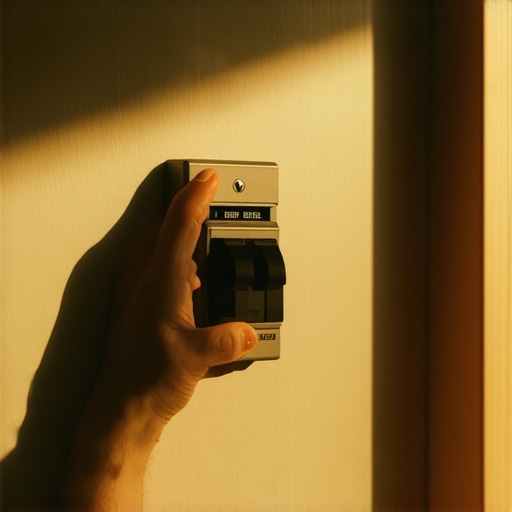
The Warning You Can Feel Through the Panel Door
The first time I realized how dangerous a warm breaker could be was during my third year as an apprentice. My journeyman, a guy we called ‘Ohm’s Ghost’ because of how many close calls he’d survived, didn’t use a thermal imager. He’d just walk up to a panel and hover the back of his hand near the main. If he saw me reaching for a lug without checking the temperature first, he’d smack my hand with his dikes. ‘If you can feel the heat radiating before you touch the steel, it’s already trying to kill you,’ he’d growl. He wasn’t being dramatic; he was being a pro. In the sweltering humidity of July, a hot main breaker isn’t just a nuisance—it’s a physical manifestation of resistance, and resistance is the precursor to a structure fire.
The Physics of the Summer Load: Why Heat Happens
To understand why your main breaker is acting like a space heater, you have to look at the physics of electrical resistance, specifically the I²R loss. In simple terms, as you pump more current through a conductor, the heat generated increases by the square of that current. During the summer, your home is under a relentless siege. Your A/C compressor is kicking in with a massive inrush current, your refrigerator is working overtime, and maybe you’ve just finished an EV charger installation to juice up your new car. All those electrons are screaming through the main lugs of your panel.
“Aluminum wire connections can overheat and cause a fire without tripping the circuit breaker.” – CPSC Safety Alert 516
In mid-century homes built between 1960 and 1980, this problem is magnified tenfold. These panels were often designed for a 100-amp or 125-amp service at a time when the biggest draw was a toaster and a tube TV. Today, we are asking those same bus bars to handle whole house fan wiring, high-speed internet hubs, and continuous loads that would have been unthinkable forty years ago. When a breaker gets hot, it’s often because the internal bi-metallic strip is reaching its limit, or worse, the connection between the breaker and the bus bar has begun to oxidize.
The Forensic Breakdown: Cold Creep and Oxidation
If your home has aluminum branch or service entry wiring, you are dealing with a phenomenon called ‘Cold Creep.’ Aluminum expands and contracts at a much higher rate than the steel or copper components it’s connected to. Over decades of summer heat and winter cold, the wire literally ‘creeps’ out from under the lug screw. This creates a microscopic gap. That gap introduces resistance. Resistance creates heat. Heat causes more expansion, which leads to more oxidation. It’s a death spiral for your electrical system. I have performed electrical inspections where the main lug was so corroded that the wire was held in place by nothing but the charred remains of the insulation and a prayer.
You might notice this first as a flickering light when the bathroom exhaust fan or a hair dryer kicks on. That’s not a ghost; it’s a voltage drop caused by the heat at the main breaker. This is why circuit breaker replacement isn’t always enough. If the bus bar is pitted or discolored, putting a new breaker on it is like putting a fresh tire on a snapped axle. You’re just delaying the inevitable ‘thermal event.’
The Load Calculation Reality Check
Modern living requires a modern backbone. If you are adding tiny home wiring to a sub-panel or integrating access control wiring for a security system, you are adding to the ‘continuous load.’ According to NEC code updates, a continuous load is anything expected to run for three hours or more. Your main breaker is only rated to handle 80% of its nameplate capacity for continuous loads. If you have a 100-amp main and you’re pulling 85 amps all afternoon while the sun beats down on the exterior meter can, that breaker is going to be hot enough to fry an egg. This is why a ‘heavy-up’ or service upgrade is often the only real solution.
“The service disconnecting means shall have a rating not less than the calculated load to be carried.” – NFPA 70: National Electrical Code (NEC) Section 230.79
When I’m doing a rough-in for a new service, I’m obsessive about torque. Every lug needs to be tightened to the exact inch-pounds specified by the manufacturer. If it’s too loose, you get arcing. If it’s too tight, you crush the wire strands and create a hot spot. I also never leave a job without applying a healthy dose of ‘monkey shit‘ (duct seal) to the service mast to keep moisture out, and antioxidant paste to the aluminum conductors. It’s the difference between a system that lasts 50 years and one that fails during the first heatwave.
Protecting the Infrastructure: Surges and Failures
Heat doesn’t just damage the breaker; it degrades everything around it. It dries out the Romex jacket until it’s brittle enough to snap. It ruins the tension in the bus bar clips. This is also where whole house surge protection becomes critical. A heat-stressed breaker is more susceptible to failure during a utility surge. I always recommend a surge protector installation directly at the panel. It’s the cheapest insurance policy you can buy to protect your sensitive electronics from the dirty power that often accompanies summer grid strain.
If you walk into your garage or utility room and smell ‘dead fish,’ that’s the smell of burning phenol resin—the plastic used in old breakers. If you see ‘the widow maker’ (a tick tracer or non-contact voltage tester) lighting up when it’s nowhere near a wire, you have a massive electromagnetic field being generated by high-resistance arcing. Stop what you’re doing and call a pro. This isn’t a DIY project. This is forensic territory.