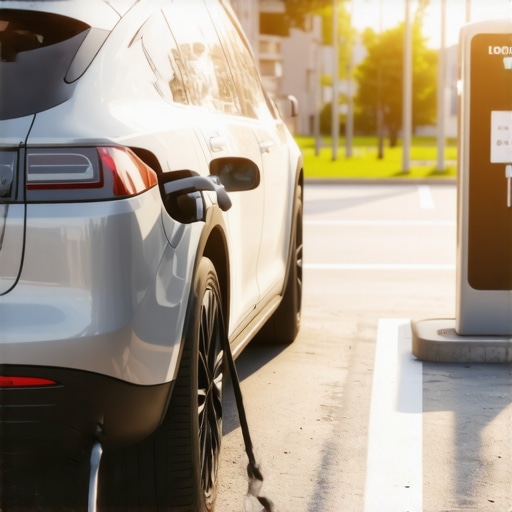
The Ghost in the Copper: Why Your Charger is Throttling Down
You spent thousands on the car and a few more on a high-end Level 2 charger. The manual promised 11.5 kilowatts of sustained power. You plug it in, walk away, and check the app an hour later only to find it’s dragging its feet at barely half that speed. You feel cheated. You think the car is a lemon or the charger is a dud. As someone who has spent 35 years tracking down phantom voltage and smelling out arcing breakers with more precision than a drug dog, I can tell you: it’s almost never the car. It’s the infrastructure you’re forcing that car to drink from.
My journeyman back in ’89 used to smack my hand with a pair of dikes if I stripped a wire with a utility knife instead of proper strippers. ‘You nick that copper, you create a bottleneck,’ he’d bark. ‘That nick is a hot spot waiting to happen.’ He wasn’t just being a hard-nose; he was teaching me the physics of resistance. When you’re pulling 48 amps for eight hours straight, every single connection point in your home’s electrical system—from the meter socket replacement you’ve been ignoring to the home run wire in your wall—becomes a potential heater. If those connections aren’t torqued to spec, the heat builds up, the resistance climbs, and the charger’s onboard thermal sensors do the only thing they can to prevent a structure fire: they throttle the amperage. You’re not just charging a car; you’re conducting a high-stress endurance test on your home’s aging nervous system.
“Aluminum wire connections can overheat and cause a fire without tripping the circuit breaker.” – CPSC Safety Alert 516
Ohm’s Law and the Cruel Reality of Voltage Drop
Let’s talk about the physics of the ‘heavy-up.’ Most residential homes, especially those built in the mid-century, weren’t designed for a continuous 50-amp load. A dryer or an oven cycles on and off. An EV charger is a 100% duty cycle load. This means if you have a 100-amp service and you’re trying to pull 48 amps for the car while your AC is humming and your water heater kicks on, you are redlining your system. This leads to voltage drop. If your voltage drops from 240V down to 215V because your service conductors are undersized or the three phase power services in your neighborhood are overtaxed, your charger’s efficiency plummets. I’ve seen meter socket replacement jobs where the lugs were so pitted from oxidation that they were glowing a dull orange under a thermal camera. That heat is wasted energy—energy you’re paying for but that never reaches your battery.
When I perform electrical inspections for new EV owners, the first thing I do is pull the dead front off the panel and pull out the Wiggy. If I see Romex stapled too tight or terminals that were tightened ‘by feel’ instead of with a torque wrench, I know exactly why the charging speed is low. Metals expand and contract. This is called thermal cycling. Over time, that expansion causes screws to back off just a hair. That microscopic gap allows oxygen in, creating an oxidation layer. Oxidation is an insulator. Now your electricity is fighting through a layer of rust to get to your car. The heat generated by that fight is what tells your charger to slow down before it melts the insulation off the bus bar.
The Infrastructure Bottleneck: More Than Just a Circuit
Often, the problem starts before the electricity even hits your breaker. If you have an older home, your service entrance cables might be aluminum. While aluminum is fine when installed correctly, it suffers from a phenomenon called ‘cold creep.’ It literally flows out from under the pressure of the terminal screws. If your electrician didn’t use an anti-oxidant joint compound—what we call monkey shit in the field—those aluminum leads are likely corroding right now. A faulty connection at the street or a weathered service mast can cause enough of a voltage dip to make your smart charger think there’s a grid instability issue, forcing it into a ‘safe mode’ at lower amperage.
“Continuous loads shall not exceed 80 percent of the rating of the branch circuit overcurrent device.” – National Electrical Code (NEC) Article 210.20(A)
Many homeowners try to solve this with a priority service membership to get a pro out fast, but the solution is often more than just a quick fix. It might require troubleshooting the entire grounding system. For example, if you have a pool, swimming pool bonding is critical. I’ve seen cases where poor bonding caused stray voltage to interfere with the sensitive communication protocols between the EV and the charger. The car ‘talks’ to the charger over a pilot wire. If there is enough electromagnetic interference from unshielded architectural lighting or poorly grounded parking lot lighting nearby, that communication gets garbled, and the car defaults to the slowest, safest charging rate.
Component Zooming: The Physics of Thermal Throttling
Why exactly does heat slow down the charge? It’s a feedback loop. Inside your wall-mounted charger is a thermistor. As the resistance at the breaker increases, the temperature of the wire increases. This heat travels down the copper—copper is a fantastic thermal conductor—and into the charger’s housing. Once that internal temperature hits a certain threshold (often around 122°F), the logic board tells the car to reduce the pilot signal amperage. You might see the car drop from 40A to 24A or even 16A. It’s not ‘broken’; it’s literally saving itself from a meltdown. This is especially common in garages without climate control during the summer months when the ambient air is already 90°F. If your pathway lighting install or spa grounding services were done by the same guy who didn’t torque your EV circuit, you’re sitting on a thermal time bomb.
The Fix: Stop Treating Electricity Like a Hobby
If you want the speeds promised in the manual, you need to treat your home’s electrical system like the high-performance machine it is. This means ensuring your meter socket replacement is done with high-quality, corrosion-resistant components. It means checking your grounding rods and ensuring your service mast is secure. I don’t care how many YouTube videos you’ve watched; electricity is a cold, indifferent force that is always looking for a path to ground, and it doesn’t mind going through your drywall to find it. When we do a rough-in for a high-speed charger, we aren’t just pulling wire; we are calculating load, checking for harmonic distortion, and ensuring that the trim-out is done with precision tools. Don’t let a ‘handyman’ install a 50-amp circuit. If he doesn’t own a tick tracer and a calibrated torque screwdriver, he has no business touching your panel. Sleep better knowing your connections are torqued, your grounds are solid, and your car is actually getting the juice you’re paying for.