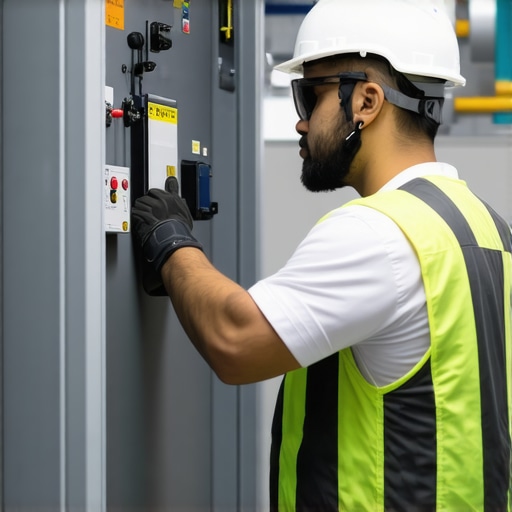
The air in a main switchgear room has a specific weight. It’s a mix of ionized ozone, dusty floor wax, and the low-frequency hum of sixty-cycle resonance. When you walk in with a Wiggy in your pocket and three decades of scars on your knuckles, you don’t just see grey metal boxes; you see potential energy looking for an excuse to expand. This isn’t residential Rough-in work where a short circuit might just melt a Romex jacket; this is commercial infrastructure where a phase-to-phase fault can turn a steel enclosure into a shrapnel grenade in less than half a cycle. This is why insurers are no longer asking—they are demanding—regular arc flash studies and electrical safety audits before they’ll even think about renewing a policy.
The Old Timer’s Lesson: The Memory of Copper
My old journeyman, a guy who had lost half an eyebrow to a 277-volt lighting circuit in the 70s, used to smack my hand if he saw me using a standard wrench on a bus bolt. ‘A torque wrench isn’t a luxury, it’s a life insurance policy,’ he’d bark. He was right. He once showed me a section of bus bar from a defunct factory that had a thumb-sized crater in it. A bolt had been ‘tightened’ by feel, but thermal expansion—the constant heating and cooling of the metal under load—had caused the connection to loosen over time. This created a high-resistance point, leading to a localized hot spot that eventually ionized the air around it. That’s all electricity needs: a path. Once the air is conductive, you have a plasma arc. He taught me that copper doesn’t forgive, and it definitely doesn’t forget a bad installation.
“Arc flash can generate temperatures up to 35,000°F, vaporizing metal and causing severe burns or death.” – NFPA 70E Standard for Electrical Safety in the Workplace
The Physics of a Disaster: Why Your Insurance Provider Is Terrified
From an actuarial standpoint, an electrical room is a liability goldmine. When we talk about an arc flash, we are talking about a massive release of energy caused by an electric arc through the air. The temperature can reach four times the surface of the sun. At those temperatures, copper doesn’t just melt; it expands 67,000 times its original volume as it transitions from a solid to a vapor. This creates a pressure wave—an arc blast—that can throw a grown man across a room and collapse a human lung. Commercial property insurance providers require studies because they are tired of paying out for total losses. If your main disconnect services aren’t properly labeled with incident energy levels, a technician might wear Category 2 PPE when the fault potential requires Category 4. That mistake leads to a lawsuit that the insurance company has to settle.
Component Zooming: The Role of Harmonics and AI Fault Detection
One of the most overlooked triggers for arc-related failure is non-linear load stress. Modern commercial buildings are packed with VFDs, LED drivers, and server racks that create ‘dirty’ power. This is where harmonic filter services become critical. Without proper filtration, harmonic distortion can cause neutral conductors to overheat and transformers to vibrate themselves to death. This vibration leads to mechanical fatigue in the insulation, which is a precursor to an arc event. Insurance companies are now looking for facilities that utilize AI fault detection systems. These aren’t just fancy gadgets; they use high-speed sensors to detect the signature ‘noise’ of micro-arcing long before a human can smell the burnt insulation. It’s the difference between a after hours electrical repair and a full-scale forensic investigation by the fire marshal.
The Hidden Vulnerabilities: From Meter Bases to Fire Alarms
The path of destruction rarely starts at the main breaker. Often, it begins at the meter base replacement that was deferred for five years or a sauna heater installation in a commercial gym that didn’t account for the total building load. When I perform an audit, I’m looking at the grounding electrode system. I’m looking for Monkey Shit (duct seal) that has dried out and let moisture into the conduit, leading to corrosion on the lugs. Even your fiber optic cabling and track lighting services play a role. If a high-voltage fault occurs, it can jump to low-voltage systems if they aren’t properly segregated, turning your data lines into heaters. Furthermore, a fire alarm system install that isn’t integrated with the electrical shut-offs can fail to notify the department until the building is already a skeleton. Insurance companies want to see a cohesive system where everything is torqued, labeled, and monitored.
“The incident energy of an arc flash is proportional to the duration and the current of the fault.” – IEEE 1584 Guide for Performing Arc-Flash Hazard Calculations
The Forensic Breakdown: The Autopsy of a Switchgear Failure
I recently inspected a facility that suffered a catastrophic failure in their main distribution section. The hook? The facility manager noticed a ‘sizzling’ sound, like bacon frying, coming from behind the dead front. He ignored it. Two days later, the Widow Maker (a 480V ungrounded delta system) lived up to its name. The forensic breakdown showed that a small rodent had entered through a poorly sealed penetration and bridged the gap between two phases. Because the facility hadn’t had an arc flash study in a decade, the breaker settings were ‘wide open,’ meaning they didn’t trip fast enough to contain the energy. The result was a fireball that melted the entire main disconnect services section. If they had invested in AI fault detection or a simple infrared scan, that mouse would have been a nuisance, not a million-dollar claim. This is why the ‘fix’ is never just a after hours electrical repair; it’s a systematic overhaul of the maintenance culture.
Conclusion: Sleep at Night Knowing It’s Torqued
In the world of commercial property, electricity is a utility until it becomes a weapon. Regular arc flash studies tell your insurance company that you understand the risks and have mitigated them. It tells them that your track lighting services aren’t going to be the start of a multi-million dollar fire and that your sauna heater installation was done by a master, not a handyman with a set of dikes and a dream. At the end of the day, you want to know that when your employees flip a switch, the lights come on, and the building stays standing. Don’t wait for the smell of ozone to call a professional. Get the study, label the gear, and torque the bolts. Your bottom line—and your life—depends on it.