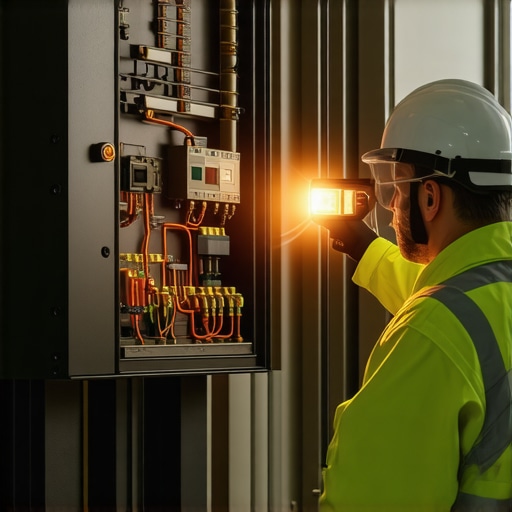
The Invisible Hum of a Looming Disaster
You don’t hear it at first, or maybe you’ve just become deaf to it over the decades. It is that low-frequency thrum vibrating through the concrete floor of the electrical room, a sound that tells a Master Electrician the gear is under stress. When I walk into a facility built in the late 70s or early 80s, I’m not just looking at metal cabinets; I’m looking at a forensic timeline of neglect. Older commercial switchgear is a mechanical beast, and like any beast, it gets cranky and unpredictable with age. An arc flash study isn’t just some bureaucratic paperwork requested by your insurance company; it is a diagnostic autopsy performed on a living system. It reveals exactly how much energy is waiting to liquefy your copper and the technician standing in front of it.
My journeyman used to smack my hand if I stripped a wire with a knife. ‘You nick the copper, you create a hot spot,’ he’d scream. He was right. That lesson applies tenfold to the massive bus bars inside your switchgear. A tiny nick, a bit of oxidation, or a loose bonding jumper service that wasn’t torqued to spec in 1984 can become the catalyst for an arc fault that releases temperatures hotter than the surface of the sun. When we perform electrical safety audits, we aren’t just looking for labels; we are looking for the thermal signatures of impending failure.
The Forensic Breakdown: Why Old Gear Fails the Test
The core of an arc flash study is determining the ‘incident energy’ at specific points in your system. In older gear, this number is almost always terrifyingly high. Why? Because of ‘clearing time.’ A modern circuit breaker is a precision instrument designed to trip in milliseconds. An old Westinghouse or Federal Pacific breaker from the disco era? It’s a slow-moving dinosaur. The internal lubricants have turned into something resembling dried molasses. This is what we call ‘stiction.’ When a fault occurs, the breaker hesitates. That extra tenth of a second of hesitation allows the arc to grow exponentially, dumping more energy into the air. This is why fuse box to breaker conversion or total gear modernization is often the only path to safety.
“Arc-flash hazard analysis shall be updated when a major modification or renovation takes place. It shall be accounted for in the design of the electrical system.” – NFPA 70E Standard for Electrical Safety
We see it all the time in ‘Mid-Century’ commercial builds. The physics of ‘Cold Creep’ is particularly nasty in these settings. Aluminum bus bars or conductors expand and contract at different rates than the steel lugs holding them. Over forty years of heating up during the day and cooling down at night, those connections wiggle themselves loose. A loose connection increases resistance. Resistance creates heat. Heat creates more oxidation. Eventually, the insulation on the adjacent phase breaks down, and you have a phase-to-phase arc. If you haven’t had after hours electrical repair to tighten these connections and apply monkey shit (duct seal) to keep out moisture, you are sitting on a time bomb.
The Anatomy of an Arc Flash: Component Zooming
Let’s talk about the physics of the ‘Bolted Fault’ versus the ‘Arcing Fault.’ A bolted fault is when a conductor solidifies a connection to another phase or ground. It’s bad, but it usually trips the breaker. An arcing fault is more insidious. It is a plasma discharge through the air. The air itself becomes conductive. In older switchgear, the clearances between bus bars were often tighter than modern standards, or the ‘insulating’ standoffs have become carbon-tracked. Carbon tracking happens when dust and moisture create a microscopic path for electricity to crawl across an insulator. Once that path is established, it’s only a matter of time before the voltage jumps the gap.
When we look at meter base replacement in a commercial setting, we often find that the service entrance cables are showing signs of ‘wicking.’ Moisture from the outside has traveled down the inside of the insulation, corroding the wire from the inside out. This increases the likelihood of a fault before the main breaker, where the incident energy is at its absolute peak. For those operating near the water, such as those needing specialized boat lift wiring, salt air accelerates this corrosion at a frightening pace. Salt bridges the gaps between phases, turning your switchgear into a giant heater until it finally explodes.
The Financial Reality of Modernization
I get it. Replacing a main switchgear section isn’t cheap. It’s a massive capital expense. But have you seen the cost of a catastrophic failure? We’re talking about weeks of downtime, destroyed equipment, and potential legal liabilities that make the cost of financing electrical upgrades look like pocket change. We offer a lifetime workmanship guarantee because we know that when we torque a bolt and apply the correct dielectric grease, it stays put. But we can’t fix physics. If the gear’s AIC (Ampere Interrupting Capacity) rating is lower than what the utility is now delivering to your building—which happens often when utilities upgrade their transformers—your breakers might not just fail to trip; they might explode when they try.
“Aluminum wire connections can overheat and cause a fire without tripping the circuit breaker.” – CPSC Safety Alert 516
Modern solutions involve more than just new metal. We’re talking about home automation setup principles applied to commercial settings—remote racking systems that allow a technician to trip a breaker from thirty feet away, outside the flash boundary. We’re talking about tiny home wiring precision applied to massive scales, ensuring every home run is perfectly isolated. If your switchgear is old enough to remember the moon landing, you need to stop crossing your fingers and start looking at the data. An arc flash study will tell you the truth, even if it’s a truth your budget doesn’t want to hear. Sleep at night knowing your gear is torqued, your bonding is solid, and your clearing times are measured in milliseconds, not seconds.