The Illusion of Electrical Stability
I have spent 35 years crawling through attics filled with itchy fiberglass and smelling the distinct, metallic tang of ozone before a house goes up in smoke. Most homeowners look at their breaker panel—the load center—and see a gray box that ‘just works.’ But as a forensic inspector, I see a ticking clock. When you decide to bolt a solar array to your roof, you aren’t just adding a green gadget; you are fundamentally changing the physics of your home’s electrical system. You are turning a passive consumer into an active power plant. If you try to push that power through a mid-century panel with pitted bus bars or outdated metallurgy, you aren’t saving the planet; you’re invitation a thermal event that no smoke detector can stop in time.
The Flipper Special: A Forensic Discovery
Before we dig into the electrical load calculations, let me tell you about a ‘fully renovated’ ranch I inspected last month. The flipper had spent a fortune on quartz countertops and subway tile, but he had buried three live junction boxes behind a kitchen backsplash. I found them with my tick tracer because the wall felt abnormally warm. When I used my dikes to pull the wire out, the Romex was charred to a crisp. The homeowner wanted to install a 7kW solar system, but they were feeding a 200-amp demand into a 100-amp service mast that was literally rotting from the inside out. This is the reality of modern electrical upgrades: you cannot build a skyscraper on a foundation of sand, and you cannot run a solar-powered smart home on a panel designed when the only heavy load was a toaster and a tube TV.
The Physics of Failure: Why Your Load Center Screams
Most panels from the 1960s to the 1980s, especially brands like Federal Pacific or Zinsco, are notorious for failure under the sustained loads that solar integration requires. The primary enemy is ‘Cold Creep.’ This isn’t some ghost story; it’s metallurgy. Aluminum conductors expand and contract at a much higher rate than copper. Over decades of rough-in and trim-out cycles, the screws holding those wires into the bus bar loosen. This creates an air gap. Electricity hates a gap. It will jump it, creating an arc that burns at thousands of degrees. This is why arc flash studies are mandatory in industrial settings; even in a residential load center, a backfed solar breaker can become a widow maker if the bus bar is compromised.
“Aluminum wire connections can overheat and cause a fire without tripping the circuit breaker.” – CPSC Safety Alert 516
The 120% Rule: Math That Saves Lives
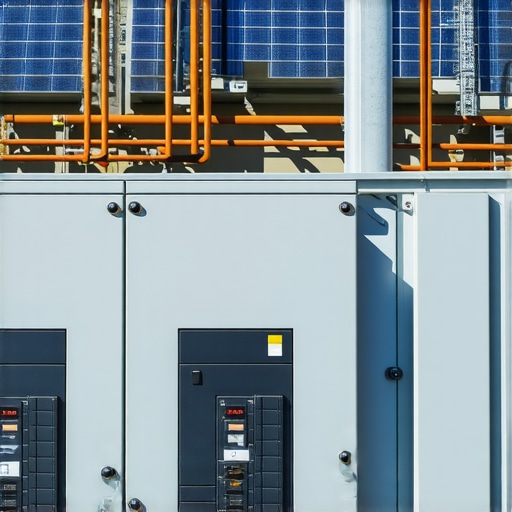
When we integrate solar, we have to respect the NEC 705.12(B)(2), commonly known as the 120% Rule. Your bus bar has a maximum current rating. If you have a 200-amp bus bar and a 200-amp main breaker, you cannot simply add a 40-amp solar breaker. Why? Because you could potentially have 240 amps flowing through a bar rated for 200, heating it up until the plastic insulators melt into monkey shit (duct seal) and the whole thing shorts out. To fix this, we do a ‘heavy-up.’ We might swap the 200-amp main breaker for a 150-amp unit to create ‘headroom’ for the solar, or we replace the entire load center with a 225-amp rated bus bar. This isn’t an upsell; it’s basic math and thermal dynamics.
Expanding the Load: From Pool Pumps to Industrial Motor Controls
Your load center doesn’t just manage the solar; it’s the heart of every secondary system. If you are doing a shed wiring install or upgrading your pool pump electrical, the demand on that bus bar increases exponentially. I’ve seen swimming pool bonding issues where the lack of a proper common ground caused stray voltage to travel back through the solar inverter, frying the control board. Even something as mundane as kitchen range hood wiring or ethernet wiring services can be compromised if the main panel’s grounding electrode system is corroded. We use vibration analysis services on larger residential installs to ensure that the harmonic frequencies from solar inverters aren’t loosening the mechanical lugs over time.
“The grounding electrode conductor shall be installed in one continuous length without splice or joint.” – National Electrical Code (NEC) 250.64
OSHA Compliance and the Professional Standard
When I’m looking at industrial motor controls or large-scale residential solar, I’m looking for OSHA compliance wiring standards. This means clear labeling, proper torque marks on every lug, and no ‘handyman’ shortcuts. If your electrician doesn’t pull out a Wiggy or a calibrated torque wrench, he isn’t finished. Electricity is a lazy, dangerous beast that always looks for the shortest path to ground. If that path is through your kitchen range hood wiring because of a bad neutral in the panel, you’re in trouble. Don’t treat your load center upgrade as an afterthought. It is the most critical safety component of your solar journey. Sleep at night knowing every lug is torqued to spec and your electrical load calculations aren’t just guesses scribbled on a piece of drywall.