The Ghost in the Enclosure: Why Your Fuse Box is a Silent Threat
I’ve spent three and a half decades inside the guts of residential electrical systems, and I can tell you exactly what a failing fuse box smells like. It isn’t just smoke; it’s a sickly-sweet, ozone-heavy stench of cooking Bakelite and oxidizing copper. If you walk into your basement and catch a whiff of something like a burnt marsh-mallow mixed with metallic tang, you aren’t looking at a minor repair; you’re looking at a thermal event in progress. Most homeowners view their electrical panel as a static box that just exists, but in reality, it is a dynamic, vibrating hub of thermal energy. In older homes, particularly those built between 1940 and 1970, these systems are no longer just obsolete—they are actively degrading under the weight of modern electrical demands.
The Forensic Breakdown: The Workshop of Horrors
I recall a specific electrical safety audit I performed for a homeowner who had just moved into a ‘charming’ mid-century ranch. He was setting up a workshop electrical setup in the garage and couldn’t understand why his table saw kept ‘killing the lights.’ I opened the main service panel, and what I saw still haunts my nights. The previous owner, a self-proclaimed ‘handyman,’ had grown tired of 15-amp fuses blowing every time he ran a heater. His solution? He had bypassed the fuse block entirely with a piece of heavy-gauge Romex, literally hard-wiring the circuit to the bus bar without any overcurrent protection. I pulled out my Tick Tracer, and the air around the wire was so ionized the tool was screaming from six inches away. The insulation had turned into a brittle, blackened husk. He was minutes away from a structural fire because the system couldn’t handle the EV charger he had also planned to install. This is the reality of ‘making it work’ in an old fuse-based system.
“Aluminum wire connections can overheat and cause a fire without tripping the circuit breaker.” – CPSC Safety Alert 516
When we talk about knob and tube removal or upgrading a fuse box, we are talking about the physics of resistance. Fuses work on a simple principle: a sacrificial piece of metal melts when current exceeds a specific limit. But fuses have a massive flaw—they don’t account for the modern ‘inrush’ current of high-efficiency motors or the sensitive electronics of access control wiring. Worse, people ‘over-fuse.’ When a 15-amp fuse blows, they screw in a 20 or 30-amp fuse. Now, the wire in the wall becomes the fuse. The copper heats up, the insulation cracks, and you’ve got a Widow Maker hiding behind your drywall.
The Mechanics of Failure: Cold Creep and Oxidation
Why do these old systems fail so spectacularly? It comes down to a phenomenon called Cold Creep. In the mid-century era, aluminum wiring was often used to save costs. Aluminum has a much higher coefficient of thermal expansion than copper. Every time you turn on a heavy load, the wire expands. When you turn it off, it contracts. This microscopic ‘walking’ of the wire eventually loosens the terminal screws. Once that connection is loose, you get micro-arcing. This arc creates an oxidation layer—a thin skin of non-conductive material—that increases resistance. More resistance equals more heat. It’s a death spiral that ends in a molten puddle at the bottom of your enclosure. If your meter base replacement hasn’t been done in 40 years, you are likely dealing with corroded lugs that have been hammered by decades of seasonal temperature swings.
The Modern Load Center: Safety Beyond the Fuse
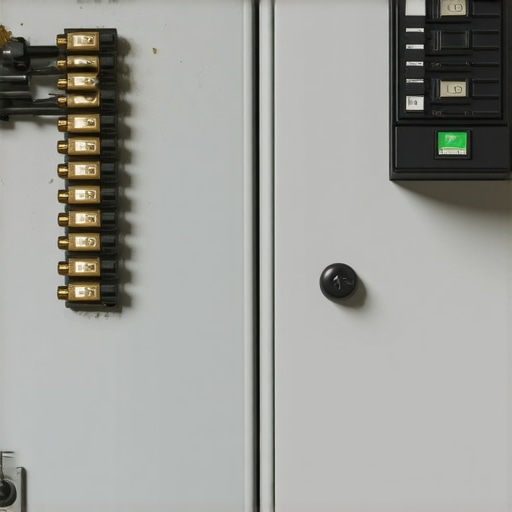
A modern load center upgrade isn’t just about more space; it’s about advanced protection. Modern breakers utilize both thermal and magnetic trip elements. A thermal trip handles the long-term overload, while the magnetic element handles the near-instantaneous short circuit. Even better, modern systems allow for AI fault detection through smart breakers that can identify the specific ‘signature’ of a dangerous arc before it even generates significant heat. This is crucial for holiday light installation or complex access control wiring where small nicks in the wire can lead to catastrophic failures. [image_placeholder_1] Replacing that old fuse box with a 200-amp service provides the headroom needed for modern life. You can’t safely run a 240V EV charger and a kitchen full of appliances on a 60-amp Edison-base fuse service. It’s like trying to run a fire hose through a soda straw.
“Overcurrent protection for conductors and equipment is provided to open the circuit if the current reaches a value that will cause an excessive or dangerous temperature in conductors or conductor insulation.” – National Electrical Code (NEC) Article 240.1
The Insurance and Liability Trap
If the technical danger doesn’t move you, the financial reality should. We are seeing a massive surge in insurance claim electrical work where providers are outright refusing to renew policies for homes with fuse boxes or certain ‘blacklisted’ brands like Federal Pacific or Zinsco. These panels are known as ‘No-Trip’ breakers; the internal pivots jam, and the breaker becomes a solid bus bar that refuses to disconnect under load. During an electrical safety audit, I often have to tell homeowners that their ‘working’ panel is the reason their premium just tripled. Upgrading to a modern load center with proper grounding—including two ground rods and a meter base replacement—is the only way to satisfy a modern underwriter. Don’t wait for a disaster to force a temporary power services call; be proactive.
The Anatomy of a Professional Upgrade
When I do a rough-in for a new panel, I don’t just swap the box. I look at the home run cables. I ensure every connection is torqued to the specific inch-pounds required by the manufacturer—because ‘hand-tight’ is how houses burn down. I use Monkey Shit (duct seal) to ensure no moisture from the service mast migrates into the lugs. I use Dikes to clean up the nesting of old wires and ensure every circuit is labeled. This isn’t just about functionality; it’s about forensic-level precision. Whether you are dealing with knob and tube removal or just a tired old 100-amp service, a modern load center is the heart of your home’s safety. Sleep at night knowing your protection is torqued, tested, and code-compliant.