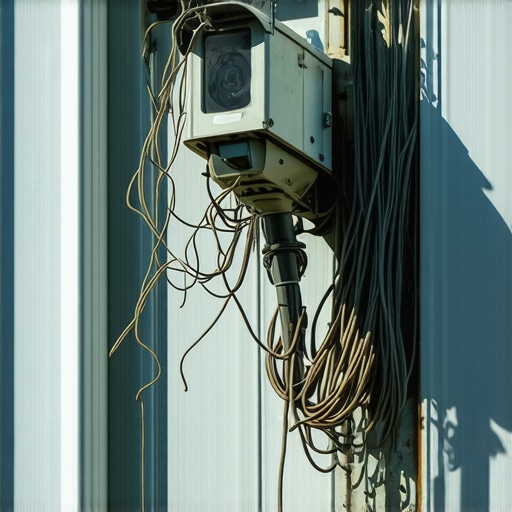
The Sensory Warning: When Your Security System Becomes a Fire Hazard
I’ve spent 35 years in the field, and I can tell you exactly what a failing security system smells like. It isn’t the smell of burnt plastic—it’s the sharp, metallic tang of ozone and the heavy scent of singed insulation wicking through a wall cavity. Most homeowners think a security camera is a low-voltage toy. They treat it like a phone charger. But when you’re pushing Power over Ethernet (PoE) through a 100-foot run of cheap cable, you aren’t just moving data; you’re moving heat. If that heat meets moisture or a nicked conductor, you’ve got a localized heater inside your soffit. I’ve seen cameras melt right off their mounts because a ‘handyman’ used the wrong gauge wire and ignored the physics of resistance. If you’re planning on running lines for your perimeter, you’d better listen up, or you’ll be calling me for an emergency outlet switch repair when your indoor circuits start tripping for no apparent reason.
The Old Timer’s Lesson: The Sin of the Nicked Conductor
My old journeyman used to smack my hand with a pair of dikes if he saw me stripping a wire with a pocketknife. ‘You nick that copper, kid, and you’ve just built a fuse where you don’t want one,’ he’d growl. He wasn’t being a jerk; he was teaching me about localized resistance. When you nick a conductor, you reduce its cross-sectional area. In the world of high-draw PoE cameras, that nick becomes a ‘hot spot’ through a process called thermal runaway. The thinner wire gets hotter, the heat increases resistance, and the resistance creates more heat. Eventually, the insulation fails, and you’ve got a widow maker scenario. Whether I’m working on a camper electrical panel or a complex overhead service drop, the principle is the same: copper is the lifeblood of the system, and if you wound it, it will bleed heat until something catches fire.
Mistake 1: Using Indoor-Rated Romex or CAT6 for Outdoor Runs
The most common crime I see in forensic inspections is the use of indoor-rated cable for outdoor ‘rough-in’ work. Sunlight is a slow-motion wrecking ball. The UV radiation breaks down the PVC jacket of standard Romex or indoor CAT6 until it becomes brittle and cracks. Once that jacket is breached, capillary action—what we call ‘wicking’—pulls rainwater directly into the cable. I’ve seen water travel 50 feet inside a cable jacket, right into the heart of a recording NVR or a sensitive AFCI breaker services panel. This moisture causes electrolysis, turning your copper conductors into a green, powdery mess of copper oxide. If you’re running lines for fence line lighting or cameras, you must use Direct Burial (DB) or UV-rated Gel-Filled cable. Anything else is just a delayed service call.
“Aluminum wire connections can overheat and cause a fire without tripping the circuit breaker.” – CPSC Safety Alert 516
Mistake 2: The Absence of the ‘Drip Loop’ and ‘Monkey Shit’
Gravity is an electrician’s worst enemy or best friend. When you run a cable from a camera into a house, water follows the wire. If the wire goes straight into the hole, you’ve essentially built a plumbing line for rainwater to enter your walls. You need a drip loop—a simple U-shaped dip in the wire before it enters the structure. This forces water to drop off the bottom of the loop rather than following the wire inside. Furthermore, if you aren’t using duct seal—we call it monkey shit in the trade—to plug the hole where the wire enters the building, you’re inviting ants and moisture to wreck your electrical boxes. It’s a five-cent solution to a five-thousand-dollar mold problem.
Mistake 3: Copper-Clad Aluminum (CCA) Deception
In my years of aluminum wiring repair, I’ve learned that aluminum has a nasty habit called ‘cold creep.’ It expands and contracts at a different rate than copper, loosening connections over time. Now, the market is flooded with ‘Copper-Clad Aluminum’ (CCA) CAT6 cables. They are cheaper, lighter, and absolutely dangerous for PoE applications. Aluminum has higher resistance than copper. When you push power through CCA over long distances, the voltage drop is massive, and the cable gets significantly hotter than pure copper. I’ve pulled out miles of CCA that had literally fused to the plastic hangers because the heat generated during a 24/7 camera stream was too much for the metal to handle. Stick to solid copper. If a deal looks too good to be true, your tick tracer will prove it later when the line is dead.
Mistake 4: Ignoring the NEC Code Updates on Grounding
People think low voltage means ‘no rules.’ That’s a lie that leads to blown-out equipment. The NEC code updates are very clear about the grounding of communication circuits. If you’re running a camera on a metal pole—say, near pool pump electrical equipment—and that pole isn’t properly bonded to the house grounding electrode system, a nearby lightning strike will use your camera cable as its primary path to ground. I’ve seen NVRs explode and take out the entire home’s internet because the installer didn’t understand equipotential bonding. You need surge protection at both ends of a long outdoor run, and you need to ensure your temporary power services or permanent installs are tied into the main ground bus.
“All electrical equipment shall be installed in a neat and workmanlike manner.” – NEC Article 110.12
Mistake 5: Over-Tensioning and Improper Bending Radius
I once did a forensic teardown on a system where the cameras would cut out every time the wind blew. The installer had used a staple gun to secure the cables, pinching the jacket and kinking the internal twists. In data cabling, the geometry of the wire is everything. If you pull the wire too hard (over 25 lbs of tension) or bend it too sharply, you change the impedance of the pair. This causes ‘crosstalk’ and signal reflection. It’s like trying to talk through a pipe that’s been crushed flat. Always use wide-radius bends and Velcro ties instead of zip ties. If you treat your cable like a garden hose, don’t be surprised when the data doesn’t flow.
The Forensic Conclusion: Do It Once, Torque It Right
At the end of the day, I don’t care if you’re setting up a camper electrical panel for a weekend trip or a 24-camera array for a warehouse; physics doesn’t take a day off. If you ignore voltage drop, UV degradation, and proper moisture seals, you aren’t just a bad installer—you’re a liability. We offer military discount wiring for those who’ve served because they understand the value of a standard operating procedure. Don’t let a ‘handyman’ touch your infrastructure. If you want to sleep at night, make sure your connections are torqued, your entries are sealed with monkey shit, and your cables are rated for the environment they’re in. Anything less is just waiting for a spark.