The Bitter Scent of Ozone and Regret
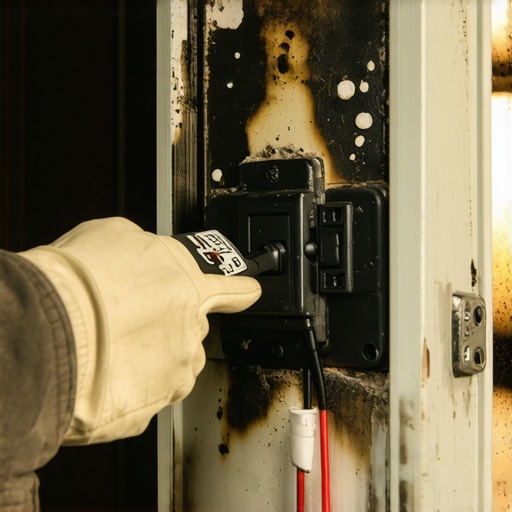
You think the fire department cleared the house, so you’re safe? Wrong. I’ve spent thirty-five years smelling the difference between a burnt pot roast and the acrid, metallic tang of a main service conductor liquefying inside a wall. After a house fire, the real threat isn’t the charred remains of your sofa; it’s the carbonized paths you can’t see. I walked into a ‘fully renovated’ kitchen last month where the flipper had buried three live junction boxes behind a designer backsplash. I found them with my tracer after the homeowner complained of a ‘humming’ wall. The fire had started elsewhere, but the heat had traveled, melting the wire nuts until they were a single glob of plastic and copper. If I hadn’t opened that wall, that family wouldn’t have made it through the night. This is the reality of code violation corrections after a thermal event.
The Forensic Breakdown: The Physics of the ‘Carbon Bridge’
When a house catches fire, even if the flames don’t touch your wiring, the heat does. Most residential Romex is insulated with Polyvinyl Chloride (PVC). At approximately 140°C, that PVC starts to soften. At 250°C, it begins to decompose, releasing hydrochloric acid gas. This gas doesn’t just vanish; it coats the copper, creating a layer of oxidation that increases resistance. This is where Component Zooming becomes vital. We need to talk about carbon tracking. When insulation chars, it stops being an insulator and starts being a semi-conductor. That charred soot creates a path—a bridge—between the hot and neutral wires. You might have 120 volts jumping across a gap that looks ‘off’ but not ‘burnt.’ This is how you get a secondary fire three weeks after the insurance company says you’re good to move back in.
“Electrical equipment that has been submerged or exposed to extreme heat should be evaluated by a qualified person before being energized.” – NFPA 70E Standard for Electrical Safety
The Attic Trap: Whole House Fan Wiring and Heat Sinks
Attics are heat collectors even on a good day. During a fire, they become blast furnaces. If your home has whole house fan wiring, that motor and its associated home run are the first things I inspect during electrical safety audits. The thermal expansion in an attic during a fire causes the copper to expand at a different rate than the steel of the fan housing. This lead to ‘Cold Creep’ at the terminals. Once the fire is out, the copper stays slightly deformed, leaving a loose connection. A loose connection is an arc waiting to happen. I’ve seen ceiling fan mounts that looked solid until I hit them with a Wiggy and realized the heat had brittle-ized the plastic wire nuts to the point they shattered upon touch. You cannot trust a circuit just because the light turns on.
Grounding and the Hidden Service Threat
Fire heat doesn’t just stay in the walls; it travels down your service mast. If the fire was near the exterior, your grounding electrode install might be compromised. Heat can dry out the soil surrounding your ground rods, increasing the resistance of the earth path. If your house takes a surge now, that energy has nowhere to go but through your new appliances. If we find the service entrance was cooked, we’re likely looking at trenching electrical conduit to move the service underground, away from the threat of falling limbs or future exterior heat exposure. While we’re at it, we assess the transformer installation on the pole or the pad. Utilities are notoriously slow to check their side of the meter after a residential fire, but a damaged transformer can feed ‘dirty’ power into your home, frying your electronics before you even unpack.
“Aluminum wire connections can overheat and cause a fire without tripping the circuit breaker, especially after exposure to extreme thermal cycles.” – CPSC Safety Alert 516
The Restoration Path: Beyond the ‘Handyman Special’
When rebuilding, you don’t just ‘patch’ the wire. You cut back to the last point of zero heat exposure. This often means a full rough-in of the affected zones. If you’re a veteran looking to rebuild, ask about military discount wiring programs that many master electricians offer to help get families back on their feet. We aren’t just looking at the big stuff. We check the low voltage lighting in the landscape, as those tree mounted lights often have their wires melted into the bark after a brush fire. Every single point of contact, from the dikes we use to snip the old charred Romex to the final trim-out of the receptacles, must be handled with the knowledge that electricity is looking for a reason to escape. Don’t let your home be its next path of least resistance. Ensure your code violation corrections are signed off by someone who knows the difference between ‘it works’ and ‘it’s safe.’ [IMAGE_PLACEHOLDER]