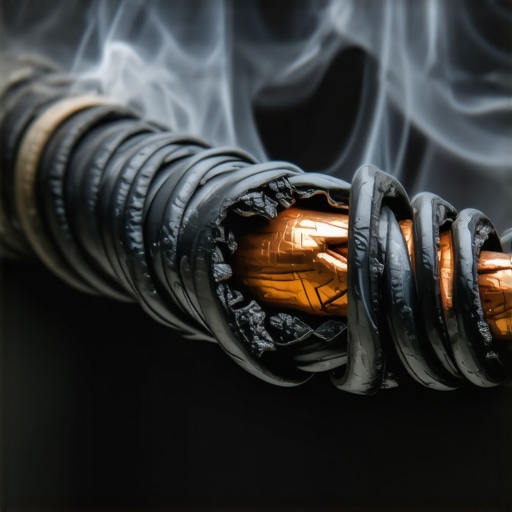
The Ghost in the Walls: Why ‘Looks Fine’ is a Dangerous Lie
You smell it before you see it—that sharp, acrid stench of burnt PVC that lingers long after the fire trucks have packed up their hoses. Most homeowners, and unfortunately some cut-rate contractors, think that if the lights still flick on, the electrical system survived the blaze. They couldn’t be more wrong. As a master electrician who has spent 35 years pulling scorched Romex out of 1970s split-levels, I can tell you that smoke is not just a cosmetic nuisance. It is a chemically aggressive, conductive, and corrosive silent killer that compromises your home’s infrastructure from the inside out. When we talk about smoke damage, we aren’t just talking about soot on the walls; we are talking about the molecular degradation of the very veins of your house.
The Old Timer’s Lesson: A Lesson in Invisible Damage
My journeyman used to smack my hand if I stripped a wire with a knife. ‘You nick the copper, you create a hot spot,’ he’d scream. He was right. That lesson stayed with me during every rough-in and trim-out. Fire and smoke do exactly what that nicked wire does, but on a massive, systemic scale. Heat doesn’t just melt insulation; it alters the crystalline structure of the copper, a process called annealing. This softening reduces the wire’s ability to handle the rated current, turning your 12-gauge wire into a high-resistance heater. If you are planning ADU electrical services or tiny home wiring after a fire, you cannot trust the existing ‘home runs.’ I have seen wires that looked pristine on the outside but snapped like dry spaghetti when bent with dikes because the plasticizers had been baked out of them by the ambient heat of a nearby room fire.
“Electrical equipment exposed to fire or water should be replaced. The thermal effects of a fire can result in internal damage to electrical components, which may not be visible on the exterior.” – NFPA 70: National Electrical Code Handbook
The Forensic Breakdown: The Chemistry of Carbon Tracking
To understand why you need a full replacement, we have to look at the physics of carbon. Smoke is essentially airborne carbon and unburned fuel. When this smoke enters your junction boxes—which it will, because those boxes act like little vacuum chambers during a fire—it deposits a layer of soot over the terminals of your outlets and switches. Carbon is conductive. This creates what we call ‘carbon tracking.’ Essentially, you have now provided a high-resistance path for electricity to crawl from the hot terminal to the ground. This won’t always trip a standard breaker immediately, especially those old Federal Pacific or Zinsco units that are notorious for jamming. Instead, it creates a slow, localized heat buildup. Eventually, that carbon track becomes a full-blown arc, and your wall is on fire again, only this time there is no external heat source to blame.
The Invisible Acid Factory
Most modern wiring uses Polyvinyl Chloride (PVC) insulation. When PVC is heated, even if it doesn’t melt, it undergoes a chemical transformation. It releases hydrogen chloride gas. When this gas meets the natural humidity in the air (or the water used by the fire department), it forms hydrochloric acid. This acid is then sucked into the copper strands via capillary action. It eats the wire from the inside, creating high-resistance junctions that a tick tracer will never find. You might see 120 volts on your Wiggy, but the moment you put a load on that circuit—like during a hot tub wiring services installation or when plugging in a space heater—the voltage drops and the heat rises at the point of corrosion. This is why flood water electrical safety and fire safety are two sides of the same coin; both involve chemical contamination that makes the wire’s original UL listing null and void.
Why GFCIs and Smoke Detectors Fail Post-Fire
If you think your safety devices will save you, think again. A GFCI outlet installation relies on a delicate balance of current; if the internal sensing coil is coated in microscopic soot, the mechanical trigger can stick. The same goes for your life safety systems. A smoke detector installation in a house that has already suffered a fire is often compromised if the existing pigtails are used. The residue acts as an insulator on the contacts, preventing the alarm from getting the 120V signal it needs to stay alive during a secondary event. We see this often in sign lighting installation and patio cover outlets where the exposure to the elements accelerates the decay of the already-damaged smoke residue, leading to a complete system failure within six months of the original incident.
“Aluminum wire connections can overheat and cause a fire without tripping the circuit breaker, especially when subjected to the thermal cycling and chemical degradation caused by fire or smoke exposure.” – CPSC Safety Alert 516
The Load Calculation Trap: Why Generators Make it Worse
Many homeowners think they can get by until they can afford a full rewire. Then, they decide to get a portable generator hookup for the next storm. This is a recipe for disaster. Generators produce ‘dirty’ power compared to the utility grid, with more harmonic distortion. If that power is pushed through smoke-damaged wires with compromised insulation, the higher peak voltages can punch right through the weakened dielectric layers. You aren’t just risking your appliances; you are risking a catastrophic arc-flash in your main panel. If your home has an equipotential grid—common in houses with pools or hot tubs—the smoke damage can compromise the bonding points. If those bonds fail due to acid corrosion, your pool deck could become energized, and your first hint of a problem will be a tingle in your feet that leads to a tragedy.
The Verdict: Replace, Don’t Refurbish
In 35 years, I have never seen a ‘cleaned’ wire pass the test of time. You cannot scrub the acid out of a copper strand. You cannot vacuum the carbon out of a molded-case circuit breaker. If the smoke was thick enough to leave a shadow on the wall, it was thick enough to ruin the electrical integrity of the home. When we perform a forensic inspection, we look for ‘ghosting’ on the wire jackets. If we see it, the wire is dead. Sleep is a lot easier when you know every home run is fresh copper and every terminal is torqued to spec without a layer of soot acting as a bridge to a house fire. Don’t let a ‘handyman’ tell you it’s fine. If it’s been smoked, it needs to be pulled.