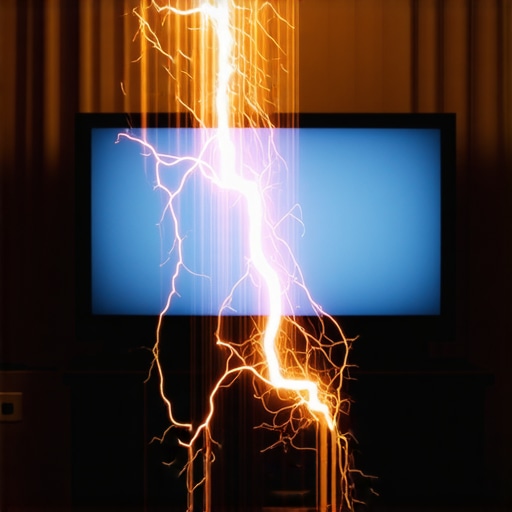
You sit down, dim the lights, and press play. But instead of being immersed in cinematic bliss, you are greeted by an annoying, high-pitched hum through your subwoofers and diagonal rolling static lines across your screen. No, your high-end projector isn’t broken, and your speakers aren’t blown. You are dealing with electromagnetic interference (EMI) and 60Hz ground loops—the silent killers of home theater performance. As a forensic electrical inspector who has spent over three decades diagnosing stubborn gremlins in residential systems, I can tell you that your pristine audio-visual signal is currently choking on dirty electrical noise.
The Flipper Special: A Lesson in Lazy Wiring
I walked into a ‘fully renovated’ kitchen where the flipper had buried live junction boxes behind the backsplash. I found them with my tracer, but what really caught my attention was that the home theater on the sharing wall was experiencing massive audio distortion. The kitchen’s cheap LED driver was dumping high-frequency noise right back into the branch circuit. The homeowner thought they had a bad receiver. In reality, they had a dangerous, hidden junction box and a shared neutral that was back-feeding electrical garbage directly into their expensive soundbar. When wires are thrown together without regard for separation, electromagnetic fields collide, and your movie night is the first casualty.
The Anatomy of Theater Wiring Interference: A Forensic Breakdown
To understand why your movie night is ruined, we have to look at the physics of how power and data interact inside your walls. Your home theater relies on two types of signals: low-voltage data (HDMI, RCA, speaker wire) and high-voltage AC power (120V). When these run parallel and too close to one another, they behave like an air-core transformer.
“Electromagnetic compatibility requires the structured segregation of power and data circuits to prevent hazardous or degrading inductive coupling.” – NFPA 70E Standard for Electrical Safety
When high-voltage AC current flows through a wire, it creates an expanding and collapsing magnetic field. If a low-voltage HDMI or speaker cable is running alongside that Romex, this magnetic field induces an unwanted voltage into your signal lines. This is called capacitive and inductive coupling. The result? Audio hum, video artifacts, and digital dropouts. If you have a massive home theater setup loaded with high-current amplifiers, a standard, aged residential electrical system simply cannot isolate this noise. If your main panel is decades old, struggling with oxidization on the bus bars, or lacks proper grounding, you likely need an electrical panel upgrade to establish a clean, dedicated power foundation for your sensitive electronics.
The Infrastructure Context: Mid-Century Aluminum and Jammed Ground Paths
In homes built between 1960 and 1980, theater interference is often exacerbated by systemic material failures. During this era, aluminum branch circuit wiring was common. Aluminum exhibits a high rate of thermal expansion and contraction—a phenomenon known as cold creep. Over time, aluminum wire under terminal screws backs out, creating micro-gaps. These loose connections form resistive oxidization layers that act as tiny transmitters of electrical arcing. This micro-arcing doesn’t always trip a standard breaker, but it floods your home’s electrical grid with high-frequency noise that easily bypasses the power supplies of your media gear. Furthermore, older systems often lack a true copper grounding path, forcing stray currents to find alternative routes through your HDMI shields and RCA ground rings, resulting in that notorious 60Hz hum.
“Aluminum wire connections can overheat and cause a fire without tripping the circuit breaker.” – CPSC Safety Alert 516
The Autopsy of a Hum: Why Cheap Fixes Fail
Many homeowners try to solve this by purchasing expensive “audiophile” power strips or buying thick HDMI cables. This is like putting a band-aid on a compound fracture. If your home theater shares a neutral wire with a vacuum cleaner, a refrigerator, or a noisy bathroom exhaust fan, the electrical noise will bypass any basic strip protector. To eliminate the noise, you must physically isolate the paths. When we perform a rough-in for high-end AV spaces, we enforce a strict 12-inch separation rule between power and data lines. If they must cross, they must do so at a perfect 90-degree angle to minimize the surface area of the magnetic field overlap. Furthermore, we install dedicated circuits directly from the panel to the media closet using shielded MC cable or running Romex through metal conduit to act as a Faraday cage.
How to Cure the Interference and Reclaim Your System
Fixing theater interference requires a methodical, step-by-step approach to diagnostic isolation:
- Identify Ground Loops: Disconnect all inputs from your receiver except one speaker. If the hum disappears, your issue is a ground loop created by multiple interconnected devices plugged into different outlets.
- Install Dedicated Circuits: Run a dedicated 20-amp circuit with an isolated ground back to the main panel. This ensures no other appliances are dumping harmonic distortion onto your AV line.
- Upgrade Your Grounding system: Ensure your home’s grounding electrode system (ground rods and water pipe connections) is free of corrosion. A high-resistance ground path prevents noise from draining safely into the earth.
- Proper Cable Management: Use zip ties to separate power cords from HDMI and speaker cables. Never coil excess power cords next to signal processors.
If you’re already upgrading your home’s electrical backbone, consider addressing other high-draw or specialized areas. From ensuring safe outdoor entertainment spaces with professional deck lighting services to installing robust RV hookup installation ports or robust commercial-grade setups like a data center power setup, clean, stable power is the foundation of all modern technology. Do not let lazy wiring ruin your investment. Get a qualified electrician to inspect, torque, and isolate your system so you can enjoy your films in peace.