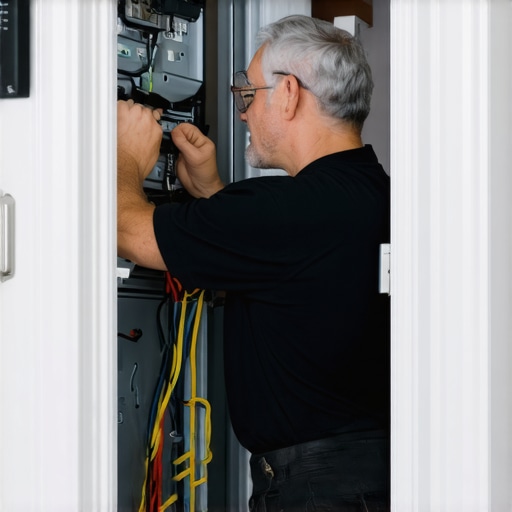
The Invisible Arsonist: Living with Mid-Century Metallurgy
If your home was built between 1965 and 1973, you aren’t just living in a piece of architectural history; you are likely living inside a slow-motion chemistry experiment that the laws of physics are trying to conclude. I have spent over three decades pulling Romex through spider-infested crawlspaces and tracing circuits that would make a code inspector weep, and nothing gets my Tick Tracer screaming quite like the sight of silver-colored wire terminated at a standard 15-amp receptacle. Most homeowners see a light flicker and think it’s a ghost or a ‘quirk’ of an old house. I see the Widow Maker preparing to strike. We need to talk about why that aluminum wiring in your walls is a ticking time bomb and why a ‘handyman’ fix is often worse than doing nothing at all.
The Old Timer’s Lesson: The Nick that Levels a House
When I was a green apprentice, my journeyman—a man whose lungs were 40% drywall dust—stopped me as I was using a pocket knife to strip the jacket off a conductor. He didn’t just correct me; he slapped the tool out of my hand. ‘You nick that aluminum, kid, and you’ve just built a heater,’ he barked. He was right. Aluminum is a soft, temperamental metal. When you create a microscopic score mark in the wire, you create a localized point of high resistance. Because aluminum has a different coefficient of thermal expansion than the brass screws on your outlets, it undergoes a process we call Cold Creep. Every time you turn on a toaster, the wire heats up and expands. When you turn it off, it contracts. But it never quite goes back to where it started. Over hundreds of cycles, that wire backs itself right out from under the screw. Now you have a gap. That gap creates an arc. That arc is 3,000 degrees Fahrenheit. It doesn’t trip the breaker because the current isn’t technically exceeding the limit—it’s just jumping a gap. That is how houses disappear while the family is sleeping.
“Aluminum wire connections can overheat and cause a fire without tripping the circuit breaker.” – CPSC Safety Alert 516
The Physics of Failure: Cold Creep and Oxidation
To understand why preventative electrical maintenance is non-negotiable for these homes, we have to look at the molecular level. Aluminum oxidizes almost instantly when exposed to air. Unlike copper oxide, which is relatively conductive, aluminum oxide is an insulator. Imagine putting a thin layer of glass between your wire and your outlet. To get the electricity across that insulating layer, the system has to work harder, generating heat. This is a recursive loop: heat causes more oxidation, which causes more resistance, which causes more heat. Eventually, you reach the ignition temperature of the plastic junction box. If you have data closet organization issues or overloaded circuits from modern tech, you are accelerating this process ten-fold. Modern loads—like charging an EV or running a high-end gaming rig—put a continuous stress on these old three phase power services or single-phase residential drops that they were never engineered to handle.
The ‘Flipper Special’ vs. Code-Compliant Remediation
I’ve walked into ‘renovated’ homes where a flipper simply twisted copper onto the aluminum and threw a standard wire nut on it. This is a death sentence. When you mix copper and aluminum, you create a galvanic cell. Add a little humidity, and the two metals start eating each other through electrolysis. To fix this properly, we don’t just use Dikes and electrical tape. We use specialized connectors like AlumiConn or COPALUM crimps. These are the only methods recognized by the NEC as permanent fixes. I often use augmented reality troubleshooting tools—thermal imaging cameras that show me exactly where the heat is building up behind a wall before the smoke starts. We look for ‘hot spots’ at every home run and every junction. If your main disconnect services are still sporting an old Federal Pacific or Zinsco panel, you have a double-jeopardy situation where the wiring is failing and the safety shut-off is jammed.
“The integrity of the electrical system depends on the weakest connection in the circuit.” – NFPA 70E Standard for Electrical Safety
Infrastructure Context: Why Modern Upgrades Demand Better Wiring
If you are looking into smart meter installation or microgrid integration, your foundation must be rock solid. You cannot build a high-tech energy-sharing system on top of 1970s aluminum branch circuits. It’s like putting a Ferrari engine in a cardboard box. We also have to consider flood water electrical safety; if your aluminum connections have ever been submerged or exposed to high moisture, the corrosion process is on fast-forward. I’ve seen parking lot lighting systems and overhead service drop lines fail because someone used ‘Monkey Shit‘ (duct seal) to try and hide a bad connection instead of properly cleaning and treating the conductors with antioxidant paste. When we do a Rough-in or a Trim-out on a remediation project, we are meticulous. Every screw is torqued to the inch-pound specified on the device. We don’t ‘feel’ the tightness; we measure it. Because 1/16th of a turn could be the difference between a cool circuit and a house fire.
Conclusion: Sleep Better with Torqued Terminations
Electricity isn’t a hobby, and it isn’t a place to save a few bucks on a ‘handyman.’ If you suspect your home has aluminum wiring, stop waiting for the smell of fish (the scent of burning bakelite) to alert you to a problem. Get a forensic inspection. Check your main disconnect services. Ensure your overhead service drop is secure and that your internal circuits are either replaced or properly pigtailed with AlumiConn connectors. When I leave a job site, I want to know that if I put my Wiggy on a circuit, it’s going to read true and stay cool for the next fifty years. Don’t let your home become a footnote in a CPSC safety report. Treat the electricity with the paranoia it deserves, and it will keep your lights on without burning your world down.
Comments are closed.