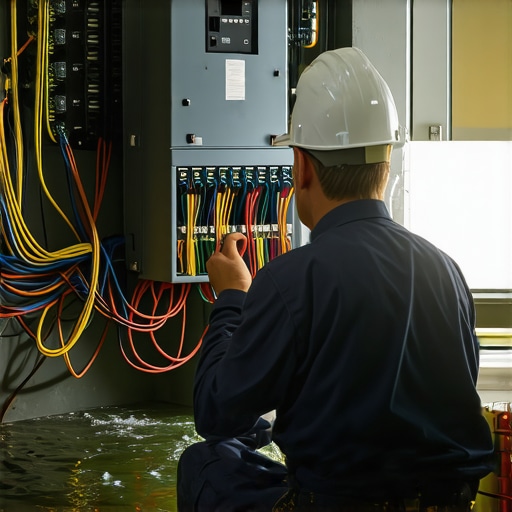
The Widow Maker Under Your Feet: The Reality of Flooded Basements
You walk down the stairs, and the squelch of soaked carpet is the first thing you notice. Then, that smell—a mix of stagnant river water and the sharp, metallic tang of ozone. Most homeowners think the danger is the mold or the ruined furnace. They’re wrong. The real killer is the silent, invisible voltage lurking in every inch of that standing water. As a forensic inspector, I’ve seen what happens when water turns a basement into a massive, live conductor. If you haven’t pulled the main disconnect yet, you aren’t just standing in a puddle; you’re standing in a 240-volt trap waiting for a ground path. That path could be you.
The Old Timer’s Lesson: Water is a Scavenger
My old journeyman used to carry a beat-up Wiggy and a healthy dose of fear. He once grabbed my shoulder as I started toward a damp service panel and barked, ‘Water doesn’t just sit there, kid. It’s a scavenger. It finds every nick in the insulation and every loose terminal, and it starts a fire before the water even drains.’ He was right. People assume that once the water is pumped out, the danger vanishes. The reality is that the forensic autopsy of a flooded home often shows the real damage starts days later. Silt and contaminants settle into the guts of your devices, creating resistive paths that a standard breaker won’t even notice until the wall is on fire. That is why same day service appointments for a professional assessment aren’t a luxury; they are a survival requirement.
“Equipment that has been submerged in water, especially equipment that contains internal insulating materials or electronic components, should be replaced.” – NEMA Guidelines for Handling Water-Damaged Electrical Equipment
The Forensic Anatomy of a Soaked Circuit: Component Zooming
When we talk about electrical wiring services after a flood, we aren’t just swapping out outlets. We are fighting physics. In older homes—those built between 1900 and 1950—the wiring often consists of rubber-and-cloth insulation or early Romex. This stuff is porous. It acts like a wick. Capillary action pulls water inside the jacket, miles away from the flood line. This is what we call ‘wicking,’ and it’s a death sentence for your home’s infrastructure.
Inside that wire, the water introduces minerals and salts that trigger electrolysis. This isn’t just a bit of rust. It is a molecular-level degradation of the copper. The copper thins, resistance increases, and heat builds. If you have a home run (the main line from the panel to the first device) that stayed submerged for more than a few hours, the insulation’s dielectric strength is compromised. You might get the lights to turn back on, but you’ve effectively installed a heater inside your walls. This is why NEC code updates mandate the replacement of any non-metallic sheathed cable that has been exposed to floodwaters.
The Myth of ‘Drying It Out’ and the Death of the GFCI
I hear it every time: ‘But I put a dehumidifier down there for a week!’ A dehumidifier won’t touch the silt inside a GFCI outlet installation. GFCIs are precision instruments. They use a differential transformer to sense current leaks as small as 5 milliamps. When floodwater—which is basically a soup of dirt, sewage, and chemicals—gets inside that housing, it coats the sensing coil. Even if it dries, that residue creates a bridge. The mechanism jams. Now, you have an outlet that looks like it works but offers zero protection against a lethal shock. If your basement flooded, every single device below the water line needs to be cut out with a pair of dikes and tossed. No exceptions.
“Aluminum wire connections can overheat and cause a fire without tripping the circuit breaker.” – CPSC Safety Alert 516
The Service Panel: Where the Time Bomb Ticks
The panel is the brain of your house. If the water reached your breakers, you are looking at mandatory circuit breaker replacement. Breakers are mechanical devices. They rely on internal springs and pivots that are lubricated with specific greases. Floodwater washes that grease away and replaces it with grit. A jammed breaker won’t trip during a short circuit. Instead, it will weld itself to the bus bar while the wire in your attic glows cherry red. During my inspections, I use a Tick Tracer to find phantom voltages in the enclosure, but the only real fix is a total gut. We also look for evidence of arc flash hazards where the water may have bridged the main lugs.
Infrastructure Context: The 1920s-1950s Home
In mid-century and older homes, we deal with ungrounded systems. If you don’t have a solid bonded insured electrical system, the floodwater doesn’t even need to touch the wires to be dangerous. It can energize the gas lines, the water pipes, or even the floor joists if they are damp enough. This is where arc flash studies and grounding inspections become critical. We often have to set up temporary power services—a ‘spider box’—so the drying crews can work without using the compromised house wiring. This keeps the blowers and dehumidifiers from drawing 15 amps through a circuit that’s been marinating in pond water.
The Restoration Path: Beyond the Mop
Once the water is gone, the real rough-in begins. We don’t just patch; we upgrade. This is the time for emergency exit lighting if you’re planning a finished space, and it’s the perfect window for home automation setup while the walls are open. But the priority is safety. Every connection must be torqued to spec. Loose connections are the primary cause of electrical fires, second only to damaged insulation. I don’t care if the handyman says it’s fine; if he didn’t use a torque screwdriver on those lugs, he’s a liability. You want to sleep at night? You want to know that when you plug in a heater, your house isn’t going to turn into a Roman candle? Then you treat the post-flood restoration as a forensic project, not a weekend DIY task. Electricity isn’t a hobby, and water doesn’t forgive mistakes. Check your grounding, replace your breakers, and ensure your system is bonded. That’s the only way you turn a disaster back into a home.
Comments are closed.