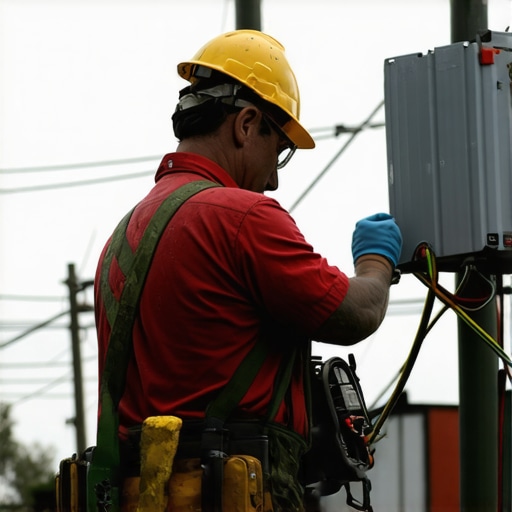
The Smell of Sizzling Insulation: A Master Electrician’s Perspective on Storm Aftermath
I remember walking into a basement in a house that had just survived a Category 2 hurricane. The water had receded, but the air was thick with the scent of ozone and something far more sinister—the smell of slow-cooking PVC. I pulled out my Tick Tracer, and the thing started screaming before I even touched the panel cover. The ‘handyman’ the homeowner hired had tried to jump a flooded main breaker using a set of jumper cables and some Monkey Shit to seal the conduit. It wasn’t a repair; it was a fuse waiting to ignite. This is why I treat storm-damaged systems with the same respect you’d give a coiled rattlesnake. When Mother Nature throws a branch through your service drop or floods your pool pump electrical, physics doesn’t care about your DIY ambitions.
Step 1: The Visual Forensic Audit (Without Touching a Single Wire)
The first thing you do after the wind stops howling isn’t grabbing your Dikes and heading for the panel. It’s a visual triage. You need to look at your service mast—that pipe sticking out of your roof. If it’s leaning even five degrees, or if the weatherhead (the ‘hat’ on top) is cracked, you have a mechanical failure that leads directly to an electrical catastrophe. Water tracks down the inside of the service entrance cable through capillary action. It’s like a straw; the water doesn’t just sit there; it wicks directly into the lugs of your main breaker. Once that water hits the bus bar, you’ve started a process of galvanic corrosion that can’t be reversed. You might be tempted to ignore it if the lights are still on, but inside that panel, the copper is turning green and the resistance is climbing. High resistance equals heat. Heat equals fire damage wiring restoration becoming a mandatory part of your future.
“Electrical equipment that has been submerged in water must be replaced, as its safety and reliability cannot be guaranteed.” – NEMA Guidelines for Handling Water-Damaged Electrical Equipment
If you see a downed line, do not assume the utility company has de-energized it. Even if the whole block is dark, a neighbor’s back-feeding generator can turn a dead line into a Widow Maker in a heartbeat. Check your electric gate opener and outdoor lighting; if they are standing in water, they are potential conduits for ground faults. I’ve seen access control wiring for security gates become energized and turn a simple metal fence into a 240-volt cage.
Step 2: Isolation and the Reality of Arc-Faults
If you can safely reach your panel without standing in water, your goal is isolation. But here is the catch: storm surges often jam the internal mechanics of older breakers, especially those old Zinsco or Federal Pacific units. You might flip the switch, but the internal contacts stay welded shut. This is where remote electrical diagnostics come into play for pros—we use thermal imaging to see the heat signatures of breakers that are drawing current even when ‘off.’ If you’ve had a surge, the insulation on your Romex may have undergone ‘cold creep’ or dielectric breakdown. This is a microscopic failure where the plastic insulation becomes brittle and conductive. This is why we insist on the installation of AFCI (Arc-Fault Circuit Interrupter) breakers during any fire damage wiring restoration. They see the ‘spark’ before it becomes a flame.
Think about your workshop electrical setup or your PA system installation. These are high-draw or sensitive electronics. If the storm caused a neutral to break—known as an ‘open neutral’—you might be sending 240 volts through a 120-volt circuit. I’ve seen entire homes’ worth of appliances fried in seconds because the homeowner didn’t check the voltage balance at the home run before flipping the main. If your lights are dimming and then getting unnaturally bright, you have an open neutral. Shut it down immediately.
Step 3: Component Zooming – The Physics of the Repair
When we talk about financing electrical upgrades after a storm, people think we’re just trying to upsell. They don’t understand the physics of the oxidation layer. When water and electricity mix, they create an oxide layer on copper or aluminum wires. This oxide is an insulator, not a conductor. So, if you just ‘tighten the screw’ on a wet lug, you’re creating a high-resistance point. This is why a rough-in for a storm repair often requires cutting back the wire until we find shiny, un-pitted copper. If the wire is ‘black’ or ‘burnt’ three feet back, we keep cutting. If you don’t, that wire will heat up like a toaster element every time you turn on your AC. This is especially critical for ethernet wiring services and low-voltage systems like holiday light installation; even a tiny bit of corrosion will kill the data signal or cause a ground fault in your festive display.
“All conductors shall be installed so that the completed system will be free from short circuits, ground faults, or connections to ground other than as required or permitted in this Code.” – National Electrical Code (NEC) Section 110.7
During the trim-out phase of a storm recovery, we don’t just put the outlets back. We verify the integrity of the grounding electrode system. Storms often involve heavy rain that can erode the soil around your ground rods. A ground rod in dry or eroded soil is about as useful as a screen door on a submarine. We use a Wiggy or a high-end multimeter to ensure your system has a path of least resistance back to the earth, not through your body when you touch the kitchen faucet.
Why You Can’t ‘DIY’ the Recovery
Electricity isn’t a hobby, and storm damage makes it a forensic puzzle. From the electric gate opener at the curb to the PA system installation in your media room, every circuit must be megger-tested to ensure the insulation hasn’t failed. If you’re worried about the cost, look into financing electrical upgrades. Many insurance policies cover code upgrades after a catastrophic event, and it is the only way to sleep soundly knowing your lugs are torqued to spec and your home isn’t one arc-flash away from a 911 call. Don’t be the homeowner who thinks a roll of electrical tape and some Romex from a big-box store is a substitute for 35 years of seeing what happens when things go wrong. Get it inspected, get it tested, and get it done right.
Comments are closed.