The Autopsy of a Coastal Disaster
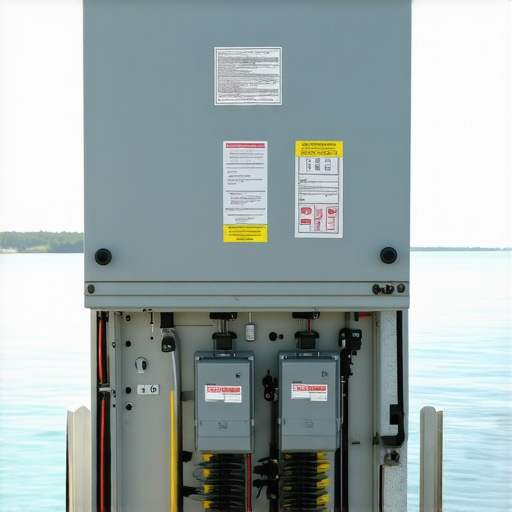
I can still smell it if I close my eyes: that acrid, metallic tang of ozone mixing with salt spray. It was a 2025 inspection on a private pier that had just ‘passed’ a general contractor’s walkthrough. I pulled the cover off the disconnect, and my Wiggy didn’t just vibrate; it screamed. The grounding bus was a green, fuzzy mess of copper oxide, and the neutral was so hot it had started to liquefy the plastic housing. This wasn’t just a failure; it was a forensic case study in what happens when you ignore the physics of the shoreline. My journeyman used to smack my hand if I stripped a wire with a knife. ‘You nick the copper, you create a hot spot,’ he’d scream. He was right. Those tiny nicks become the site of localized resistance, and in a high-moisture environment, resistance is the first step toward a fire or, worse, Electric Shock Drowning (ESD). When we talk about a 200 amp panel install for a modern dock, we aren’t just talking about more power for your boat lift; we are talking about managing a lethal force in a conductive environment.
1. The Bonding Revolution: Beyond Simple Grounding
Most people use ‘grounding’ and ‘bonding’ interchangeably, but in a dock environment, that mistake can be fatal. Bonding is the process of connecting all metal parts—cleats, ladders, lift frames—into a continuous path. We are seeing a massive shift toward swimming pool bonding standards being applied to docks. This isn’t just bureaucratic red tape. The physics of stray voltage in saltwater is relentless. Saltwater acts as a massive resistor; when current leaks from a faulty submersible pump or a degraded sign lighting installation, it seeks the path of least resistance. If your dock isn’t properly bonded, that path is often a swimmer’s body. We’re now looking at 400 amp service entrance upgrades for large residential docks just to handle the segregated grounding systems required to keep ‘dirty’ power from the shore away from the water’s edge.
“The grounding and bonding of docking facilities must be maintained to prevent the risk of electric shock drowning by ensuring all metallic parts are at the same potential.” – NFPA 70: National Electrical Code (NEC)
By zooming into the molecular level of these connections, we see galvanic corrosion. When two dissimilar metals meet in the presence of salt air, they create a battery. This eats away at the integrity of your safety ground. We combat this by using Monkey Shit (duct seal) to block salt-laden air from entering conduits and using bronze or stainless-steel connectors that won’t turn into a pile of white powder after three seasons.
2. Replacing the ‘Time Bombs’: Legacy Wiring and Panels
I’ve walked onto docks where I found cloth insulated wiring replacement was forty years overdue. That old rag-wrapped copper is a literal wick for moisture. Capillary action pulls brine up into the insulation, rotting the core from the inside out. If you’re still running on a 1970s-era subpanel, you’re sitting on a bomb. Many of these older setups lack GFCI protection at the source, which is a violation of every safety principle I’ve learned in 35 years. An electrical panel upgrade for 2026 isn’t a luxury; it’s a forensic necessity. We’re moving away from standard breakers to smart AFCI/GFCI combos that can detect the signature of a carbonized path before a spark even occurs. When we perform a 200 amp panel install, we focus on the torque specs of the lugs. If you don’t use a torque wrench, thermal expansion—what we call ‘Cold Creep’—will loosen that connection every time the sun hits the enclosure. A loose lug creates an air gap, the air gap creates an arc, and the arc creates a 3,000-degree plasma fire. I’ve used my Tick Tracer to find live voltage bleeding through ‘dead’ circuits because the cloth insulated wiring had failed so completely it turned the entire conduit into a live conductor.
3. The Infrastructure Spine: High-Capacity Service Entrances
Modern docks are no longer just a place to tie a rope; they are data center power setup environments. With high-speed internet, data closet organization for marine security cameras, and high-voltage boat chargers, the old 60-amp feeder is dead. A 400 amp service entrance is becoming the standard for waterfront estates. This requires Component Zooming into the service mast and the grounding electrodes. You can’t just slap a bigger breaker in the house. We’re talking about 3/0 copper Home Runs and heavy-wall rigid conduit that can withstand a hurricane’s debris.
“Aluminum wire connections can overheat and cause a fire without tripping the circuit breaker.” – CPSC Safety Alert 516
This is why we insist on copper for everything seaward of the main disconnect. We also look at pathway lighting install strategies. Low voltage (12V or 24V) is the only way to go for safety, but even then, the transformers need to be housed in NEMA 4X enclosures. If I see a ‘handyman’ Rough-in using Romex on a dock, I’ll pull the permit myself to get it shut down. Romex has no place in a wet location; you need THWN-2 inside schedule 80 PVC, or you’re just building a Widow Maker.
4. Advanced Diagnostics: Augmented Reality and Thermal Imaging
The future of dock safety is augmented reality troubleshooting. In 2026, I don’t just look at a panel; I use an AR overlay that shows me the thermal signature and the historical load data of every circuit. We can see the ‘ghost’ of a failing sign lighting installation before the LEDs even flicker. This tech allows us to visualize the magnetic fields around a 400 amp service entrance, identifying phase imbalances that lead to wasted energy and overheated neutrals. We’re also integrating this into data closet organization for the dock’s smart systems. When a breaker trips at 2 AM, the AR system can pinpoint if it was a surge, a ground fault, or a mechanical failure in the boat lift motor. This isn’t ‘game-changing’ fluff; it’s the difference between a five-minute reset and a $10,000 forensic reconstruction after a fire. During the Trim-out phase, we use these tools to ensure every single screw is torqued to the manufacturer’s footprint. I’ve spent too many hours with my Dikes cutting out charred copper to ever trust ‘hand-tight’ again. Your dock is an extension of your home’s electrical heart; treat it with the same respect you’d give a data center power setup, because in the water, there are no second chances.
Comments are closed.