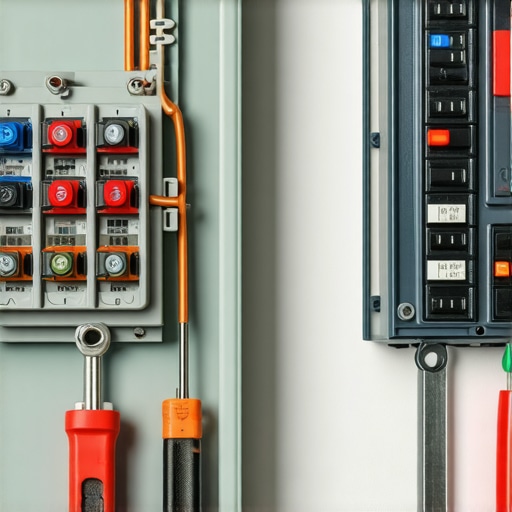
The Ghost in the Porcelain: Why Your Fused Service is a Fire Waiting to Happen
I can smell a 1940s electrical system before I even pull the dead front. It’s a mix of decaying rubber insulation, scorched dust, and that faint, metallic tang of ozone that tells me a bus bar is gasping for its last breath. If you’re still living with a fused service entrance, you’re not just living in the past; you’re living in a tinderbox. My old journeyman, a man who had more scars on his knuckles than a prize fighter, used to smack my hand with a pair of dikes if I ever used a knife to strip a wire. ‘You nick that copper, kid, you’ve just built a heater,’ he’d growl. He wasn’t being mean; he understood the physics of resistance. He knew that a single microscopic gouge creates a hot spot that, under the load of a modern refrigerator or a workshop electrical setup, will eventually crystallize the copper and start a structural fire. That’s the reality of these old systems—they were built for a world of three lightbulbs and a radio, not for home rewiring services that need to handle 200 amps of contemporary life.
“Fuses and circuit breakers are designed to protect the wire from overheating. When a fuse is replaced with one of a higher rating or ‘slugged’ with a penny, the protection is lost and the house is at extreme risk of fire.” – CPSC Safety Alert 501
The Forensic Breakdown of Fused Failure
Why do we demand an upgrade? Let’s talk about component zooming. Inside that old porcelain fuse block, you have a mechanical connection that relies on a spring-tensioned screw shell. Over seventy years, that copper alloy undergoes what we call thermal cycling. Every time you turn on a heavy load, the metal expands. When you turn it off, it contracts. This microscopic dance eventually leads to ‘cold creep,’ where the physical pressure on the connection point diminishes. Resistance goes up. Heat goes up. Eventually, the porcelain cracks, and you have an energized component vibrating against a grounded metal enclosure. This is where a 24 hour emergency electrician usually enters the picture, finding a charred mess where a main disconnect used to be. Modern circuit breakers use a bimetallic strip and a magnetic solenoid to trip in milliseconds. A fuse? It just sits there until the internal element melts, which can take far too long if the fault current is just below the ‘blow’ threshold but high enough to ignite the dry-rotted cloth insulation on your Romex.
Phase 1: The Load Calculation and the Service Mast
We don’t just swap boxes. We perform a surgical overhaul. First, I’m running a load calculation. If you’re planning on an RV hookup installation or adding smart lighting installation throughout the house, a 60-amp or even a 100-amp service won’t cut it. We’re talking a ‘heavy-up’ to 200 amps. This starts at the weatherhead. We inspect the service entrance cables. In these old 1920s-1950s homes, the outer braid on the SEC is often frayed, allowing water to wick down inside the jacket directly into the meter socket. It’s like a straw for rain. I’ve opened meter cans and had a quart of water dump out on my boots—water that was sitting right on the energized lugs. We replace that with a new mast, a properly sealed weatherhead, and high-temperature THHN conductors.
Phase 2: Grounding, Bonding, and Trenching
Grounding is the most misunderstood part of the trade. Your old fuse box likely relies on a single wire clamped to a galvanized water pipe that’s probably been replaced with PEX by a plumber who didn’t realize he just disconnected the house’s safety path. When we do a panel swap, we drive two eight-foot copper-clad ground rods at least six feet apart. If the soil is rocky, we’re trenching electrical conduit to ensure those rods hit the water table. This isn’t optional. Without a low-impedance path to the earth, a lightning strike or a transformer failure on the utility pole will use your security camera wiring or your flat-screen TV as the primary ground path. I’ve seen security cameras literally melted into the siding because the house lacked a proper grounding electrode system.
“All electrical systems must be grounded in a manner that limits the voltage imposed by lightning, line surges, or unintentional contact with higher-voltage lines.” – National Electrical Code (NEC) Article 250
Phase 3: The Rough-In and the Home Run Cleanup
The hardest part of any service upgrade is the ‘nest’ inside the old panel. You’ll find ‘bootleg grounds’ where someone tied the neutral to the ground screw because they didn’t have a three-wire circuit. You’ll find wires with insulation so brittle it flakes off if you look at it wrong. This is where electrical inspections are vital. We identify every ‘home run’—that’s the primary cable returning to the panel—and we label them. If we’re doing pendant light hanging or installing emergency exit lighting for a home business, we ensure those circuits are isolated. We use AFCI (Arc-Fault Circuit Interrupter) breakers for all bedroom and living area circuits. These are smart breakers; they use a microprocessor to ‘listen’ to the sine wave of the electricity. If they detect the signature ‘crackling’ of an arc from a loose wire nut or a damaged cord, they shut down before the wood reaches its flashpoint. Your old fuses couldn’t even dream of that level of protection.
The Verdict: Sleeping Through the Night
When I finish a job, I don’t just flip the main breaker and walk away. I use my Wiggy to check voltage drop under load and my tick tracer to ensure no stray voltage is leaking through the enclosures. I torque every lug to the manufacturer’s inch-pound specifications—not ‘hand tight,’ but calibrated tight. Because I know that a loose neutral is a demon that will destroy every appliance in your house. Upgrading from a fused service to a breaker panel isn’t about convenience; it’s about eliminating a thermal time bomb. It’s the difference between wondering if that fishy smell in the basement is a dead mouse or a melting bus bar. Don’t wait for the flicker. Get the inspection, do the heavy-up, and let that old porcelain relic go to the scrap yard where it belongs.