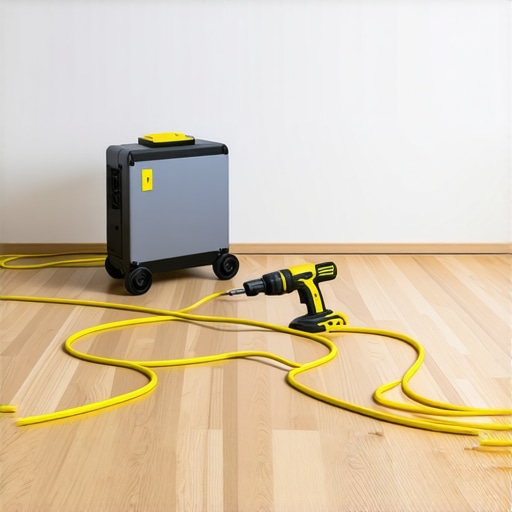
The Sound of a House Under Stress
You hear it before you see it. It’s that low-frequency hum vibrating through the studs, or the rhythmic click-snap of a thermal element in a breaker struggling to hold onto a 15-amp load that’s being asked to give 20. When you start a remodel, most people think about floor plans and backsplash tile. Me? I’m looking at your service entrance and thinking about how that 1974 split-bus panel is going to handle a crew of three guys running table saws, chargers, and a temporary HVAC unit without turning your investment into a pile of ash. My old journeyman used to smack my hand with a pair of dikes if I ever got sloppy with a wire stripper. ‘You nick that copper, kid, and you’ve just created a hot spot that’ll cook a house twenty years from now,’ he’d growl. He wasn’t being mean; he was being honest. Electricity doesn’t forgive, and it definitely doesn’t care about your project timeline.
The Anatomy of Failure: Why Temporary Power Kills
Temporary power isn’t just an extension cord run through a window. That’s a recipe for a structural fire. When we talk about powering a remodel, we’re talking about managing the physics of resistance. Most mid-century homes are riddled with aluminum wiring, a material that’s the bane of my existence. Aluminum has a high coefficient of thermal expansion. It undergoes something called ‘Cold Creep.’ Every time you run a high-draw tool, that wire heats up and expands. When the tool stops, it cools and contracts. Over time, the wire literally crawls out from under the terminal screw. This creates a gap. That gap leads to micro-arcing. That arcing creates aluminum oxide—which, conveniently for disaster, is a terrible conductor and an amazing insulator. Now you have massive resistance in a tiny space. That’s how a ‘simple’ remodel turns into a forensic investigation.
“Aluminum wire connections can overheat and cause a fire without tripping the circuit breaker.” – CPSC Safety Alert 516
The Blueprint: Load Calculations and the 80% Rule
Before you even think about architectural lighting or that fancy speaker system setup, we have to look at the ‘Home Run’—the main line from the street to your panel. Most older homes are sitting on 100-amp or even 60-amp services. You plug in a modern compressor and a microwave for the crew, and you’re at the limit. I always tell my clients that if they’re doing a major overhaul, they need a smart meter installation and a service ‘heavy-up’ to at least 200 amps. This isn’t an upsell; it’s a necessity for demand response systems and modern life. We use a Wiggy or a Tick Tracer to map out exactly what’s live and what’s dead before the first sledgehammer swings. If we find code violation corrections that need to happen—like buried junction boxes or ‘bootleg grounds’ where someone tied the neutral to the ground screw—we fix them now, or we don’t start.
The Temporary Power Pole vs. The Spider Box
During a heavy remodel, I often pull the plug on the house’s internal grid entirely. We set up a temporary power pole or use a ‘Spider Box’ fed directly from a 50-amp 240V outlet. This keeps the construction load off the old, brittle Romex inside the walls. It also allows us to implement lockout tagout training protocols. When a circuit is off, it stays off. I’ve seen too many ‘weekend warriors’ get lit up because someone flipped a breaker back on while they were installing up lighting services in the soffits. It’s about physical isolation of the hazard. This is especially critical if you are taking advantage of senior discount services; older homeowners deserve a site that isn’t a trip hazard or a fire trap.
From Rough-In to Trim-Out: The Path to Permanence
Once the dust settles and the temporary poles come down, the real work begins. We transition from the ‘temp’ mindset to the ‘forever’ mindset. This means aluminum wiring repair using COPALUM crimps or AlumiConn connectors—none of those cheap purple wire nuts that the big-box stores sell. We look at the architectural lighting layout to ensure the dimmers aren’t overloaded and that the speaker system setup is shielded from EM interference. Every screw in that panel is torqued to spec. I don’t care if you think it’s tight; I want to see the torque wrench click. Because at 3 AM, when the demand response system kicks in or the HVAC starts its cycle, I want you sleeping, not sniffing the air for the smell of ozone.
“All circuit conductors of the same circuit… shall be contained within the same raceway, auxiliary gutter, cable tray, cable armor, enclosure, or cord.” – NEC Article 300.3(B)
The Professional Difference: Weekend Electrician Services
I know the temptation. You want to save a buck, so you look for weekend electrician services on an app. But ask yourself: does that guy know the difference between a neutral and a ground in a sub-panel? Does he understand why a shared neutral on a multi-wire branch circuit can fry your $4,000 smart fridge? Dealing with code violation corrections requires a forensic eye. It’s not just about making the light turn on; it’s about making sure the electricity has a safe path back to the transformer. Whether it’s up lighting services for the curb appeal or a complex smart meter installation, the physics remains the same. Respect the arc, torque your lugs, and never, ever trust a ‘renovated’ house until you’ve seen behind the drywall with a thermal camera. If you’re doing a remodel, do it right. Get the temporary power sorted by a pro, or you might find yourself needing a lot more than just a new kitchen. You’ll need a new house.