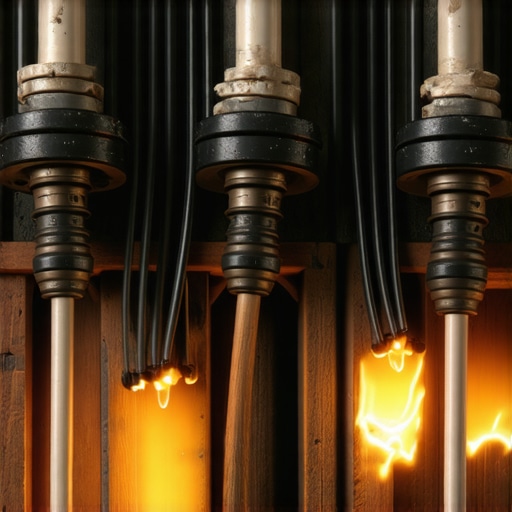
The Scorched Ghost of 1920: Why Your Walls Are Hiding a Firestorm
I remember the first time I saw a real ‘widow maker.’ It wasn’t a downed high-voltage line or a flooded transformer. It was a simple porcelain knob in a crawlspace, hidden behind a stack of old newspapers and fifty years of dust. My journeyman, a man who had more scars on his knuckles than I had years on this earth, grabbed my hand before I could reach for my dikes. He didn’t say a word; he just pointed his Wiggy at the wire. The tester hummed with a vibration that felt like a death rattle. The insulation wasn’t rubber anymore; it was a charred, carbonized husk that crumbled into black powder the moment the air hit it. ‘You nick that copper, you create a hot spot,’ he’d scream at me during my first rough-in. ‘And in a house this old, a hot spot is a funeral invitation.’ He was right then, and he’s right now. When you see those ceramic cleats and cloth-wrapped strands, you aren’t looking at ‘vintage charm’—you’re looking at a thermal time bomb.
The Physics of Thermal Degradation and ‘Cold Creep’
To understand why patching into knob and tube (K&T) is a recipe for disaster, you have to understand the physics of heat dissipation. K&T was designed as an open-air system. The conductors were spaced four to six inches apart, suspended by porcelain knobs so that heat could radiate freely into the joist bays. It was efficient for the load of 1930—maybe a few 60-watt light bulbs and a radio. But today’s homeowners want a home automation setup, high-draw appliances, and office lighting upgrades that pull more amps than those old rags were ever meant to handle. When you bury that K&T in modern cellulose or fiberglass insulation, you are effectively putting a parka on a marathon runner in the middle of July. The heat has nowhere to go. This leads to what we call accelerated thermal degradation. The rubberized cloth becomes brittle, the copper expands and contracts, and eventually, the conductor loses its structural integrity.
“Aluminum wire connections can overheat and cause a fire without tripping the circuit breaker.” – CPSC Safety Alert 516
While K&T is copper, the principle of thermal expansion remains. In fact, the CPSC has long warned about the dangers of archaic wiring systems that lack a grounding conductor.
The ‘Handyman Special’ and the Danger of the Bootleg Ground
The most dangerous thing in a house isn’t the old wiring; it’s the person who thinks they can ‘fix’ it with a roll of electrical tape and a YouTube video. I’ve performed hundreds of electrical safety audits where I’ve found Romex spliced directly into K&T inside a junction box that was then plastered over—a direct violation of the National Electrical Code (NEC). This creates a ‘bootleg ground.’ Since K&T has no dedicated ground wire, the ‘handyman’ often ties the neutral wire to the grounding screw of a modern three-prong outlet. This might fool your cheap plug-in tester, but it creates a lethal situation where the metal frame of your toaster or lamp could become energized. If you touch it while standing on a damp floor, you become the path to ground. This is why we use thermal imaging inspections to look through the lath and plaster. A tick tracer might tell you there’s power, but only a thermal scan reveals the 140-degree connection hidden behind your bedroom wall.
Modern Loads on Ancient Infrastructure
We live in a world of high-demand electrical needs. People are asking for underground wiring services to power detached garages or swimming pool bonding for new backyard installs. But if the core of your home—the home run back to the panel—is still supported by porcelain knobs, you are building a mansion on a foundation of sand. Adding a pool pump electrical circuit or landscape lighting install to a house with K&T often requires a service heavy-up. You can’t just slap a 200-amp panel on 1940s feeders. The resistance in those old wires leads to voltage drops that fry the sensitive electronics in your smart fridge or your expensive bollard light installation.
“The use of knob-and-tube wiring is not permitted to be covered by thermal insulation.” – NEC Article 394.12
This rule exists because of the ‘chimney effect.’ In an open wall, heat rises. In an insulated wall, heat builds until the flashpoint of the wood studs is reached.
The Solution: Forensic Inspection and Total Remediation
The only real fix isn’t a patch; it’s a full trim-out of the old system. When we go in, we use drone thermography scans for larger estates to identify where the service mast might be failing or where the weather head is letting in moisture, turning the interior of your panel into a corroded mess of ‘monkey shit’ (duct seal) and rust. If you’re planning on office lighting upgrades or any significant renovation, the K&T has to go. It’s not about an upsell; it’s about the fact that I want you to wake up in the morning. A modern system with AFCI (Arc-Fault Circuit Interrupter) breakers is designed to sense the tiny sparks of a loose connection—the kind of sparks K&T produces for years before it finally catches fire. Don’t trust a patch. Don’t trust ‘it’s worked for 80 years.’ The physics of electricity don’t care about your nostalgia. They only care about the path of least resistance, and I’ve seen enough charred joists to know that the path usually leads through your living room ceiling. Torque your lugs, ground your circuits, and for the love of God, rip out that knob and tube before it rips the heart out of your home.