The Attic as a Thermal Pressure Cooker
Walk into an attic in the dead of July and you aren’t just walking into a room; you’re walking into a kiln. As a forensic inspector, I’ve spent decades documenting what happens when that heat has nowhere to go. It’s not just about a high utility bill; it’s about the slow-motion destruction of your home’s electrical and structural integrity. Most homeowners think of attic ventilation as a ‘comfort’ issue. I think of it as a life-support system for your wiring. When temperatures up there hit 150 degrees, the plasticizers in your Romex insulation begin to leach out. It’s a process called outgassing, and it turns flexible wire jackets into brittle glass. One bump, one shifted box, and you have exposed conductors ready to arc.
“Continuous attic temperatures above 120°F can lead to the premature failure of asphalt shingles and the embrittlement of electrical wiring jackets.” – CPSC Safety Bulletin
The Journeyman’s Lesson on Resistance
My old journeyman, a man who smelled exclusively of solder and black coffee, once caught me stripping a 12-gauge wire with a pocket knife because I couldn’t find my dikes. He didn’t just yell; he took my hand and pointed at a microscopic nick I’d made in the copper. ‘You think that’s just a scratch?’ he growled. ‘That’s a bottleneck. You’ve just increased the resistance at that one point. In a hot attic, that nick becomes a glowing heater.’ He was right. Heat and resistance are in a toxic marriage. As the temperature rises, the resistance of the copper increases, which in turn generates more heat. This is why properly cooling an attic with something like a solar fan isn’t a luxury—it’s a way to keep your electrical system from eating itself alive. If you’re already looking at fire damage wiring restoration, you’ve seen the endgame of this cycle.
Component Zooming: The Physics of Solar Ventilation
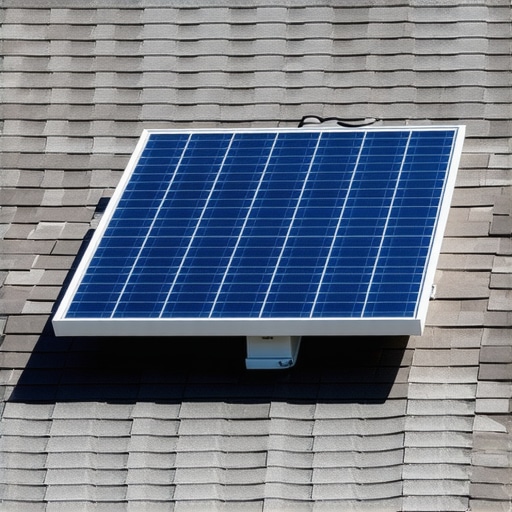
Let’s get into the guts of the hardware. A solar attic fan consists of a high-efficiency monocrystalline PV (photovoltaic) panel and a brushless DC motor. Unlike the AC motors used in whole house fan wiring, these DC motors are designed to operate on the variable voltage provided by the sun. There are no brushes to create friction or sparks, which is a major win for longevity. The physics of energy savings here isn’t just about ‘blowing air.’ It’s about managing the Delta T—the temperature difference between the attic and the outside air. Static vents rely on thermal buoyancy, which is a fancy way of saying ‘heat rises.’ But when the sun is beating down on dark shingles, heat rises slower than it accumulates. A solar fan creates active airflow, physically stripping the heat from the underside of the roof deck before it can radiate down into your living space and force your AC to run until the compressor dies. It’s a similar logic to parking lot lighting heat sinks; you have to move the thermal load away from the sensitive components—in this case, your home’s insulation and wiring.
The Trap: Why Your Old Panel Can’t Handle the Heat
If you are still operating on an old 60-amp or 100-amp service, you are living on borrowed time. I often see people trying to add modern luxuries like a sauna heater installation or heavy-duty patio cover outlets while their main service is a relic. If you haven’t performed a fuse box to breaker conversion, you’re missing the critical protection of Arc-Fault Circuit Interrupters (AFCI). In a sweltering attic, an old fuse won’t detect a high-resistance ground fault caused by heat-damaged insulation. It will just keep feeding the fire. This is why code violation corrections often start with the attic. When I perform insurance claim electrical work, the first thing the adjusters look for is whether the homeowner ignored signs of thermal stress. A solar attic fan reduces that stress, but it must be part of a larger strategy that includes checking the ‘Home Run’—the main line from the panel to the attic—to ensure it isn’t already compromised.
“The insulation on conductors shall be suitable for the voltage, operating temperature, and location.” – NEC Article 310.10
Practical Application and Real-World Installation
When installing these units, you can’t just slap them on the roof and call it a day. You have to consider the intake. If you don’t have enough soffit vents, that solar fan is going to pull conditioned air right out of your house through the recessed light cans. I’ve seen it happen with my smoke pen; the fan starts, and suddenly the ‘cool’ air you paid for is being sucked into the attic. That’s not energy savings; that’s a vacuum. You also need to be careful with the roof penetration. I use what we call ‘Monkey Shit’—high-grade duct seal—to ensure that any conduit entries are vapor-tight. Whether I’m doing underground wiring services for bollard light installation or mounting a fan on a 30-degree pitch, the goal is the same: mechanical integrity. You want your connections torqued to spec. A loose terminal in a hot environment is a recipe for a ‘widow maker’—a hot wire just waiting for an unsuspecting hand.
The Verdict: Is It Worth It?
From the perspective of a forensic inspector, the energy savings are secondary to the preservation of the structure. Yes, you might save 15% on your cooling costs, but the real value is in not having to redo your entire upper-floor electrical grid because the wires turned to beef jerky. When you’re looking at your home’s electrical health, don’t just look at the shiny stuff. You can have the best bollard light installation in the neighborhood, but if your attic is a 150-degree death trap, you’re just decorating a bonfire. Get the ventilation right, fix the code violation corrections, and sleep at night knowing your conductors aren’t cooking. Electricity isn’t a hobby; it’s a force of nature that’s always looking for a way out. Don’t give it one through a heat-cracked wire jacket.