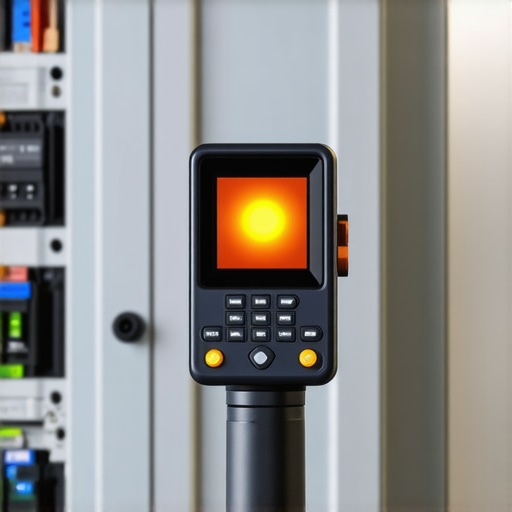
The Invisible Killer in Your Electrical Room
If you have ever stood in a high-voltage vault and felt that primal, hair-on-the-back-of-the-neck prickle, it is usually not ghosts—it is the smell of scorched phenolic resin and ozone. Most people think industrial fires start with a massive explosion or a lightning strike. The truth is much more boring and far more dangerous. They start with a loose nut, a bit of vibration, and a process called thermal runaway. As a forensic inspector who has spent three decades digging through the charred remains of ‘state-of-the-art’ facilities, I can tell you that the most valuable tool in my bag is not my Wiggy or my dikes; it is my infrared camera. Without it, you are just guessing, and in an industrial setting, guessing gets people killed.
The Flipper Special: A Forensic Reality Check
I walked into a ‘fully renovated’ commercial kitchen last year that was supposedly ready for a high-volume restaurant. The owner was complaining about a phantom ‘fishy smell’ near the main distribution section. The flipper had hired a ‘guy’ to do the wiring, and they had buried three high-voltage junction boxes behind the stainless steel backsplash to save on Romex and conduit runs. They thought they were clever. I pulled out my thermal imager and found a heat signature through the steel that looked like a miniature sun. One of the lugs on a circuit breaker replacement they’d botched was vibrating at 240 degrees Fahrenheit. If I had not found it with my tracer and IR scan, that building would have been a smoking hole in the ground by midnight. This is the reality of modern electrical work: vanity projects and ‘budget’ installs are literal time bombs.
The Physics of the Failure: Component Zooming into Resistance
To understand why an infrared scan is non-negotiable, you have to understand the physics of a connection. When an electrician terminates a heavy-gauge wire into a lug, they are fighting against oxygen and physics. Over time, the metal undergoes ‘thermal cycling’—it expands when it’s under load and contracts when the shift ends. In industrial environments, where vibration analysis services are often neglected, these cycles loosen the mechanical pressure of the lug.
“Aluminum wire connections can overheat and cause a fire without tripping the circuit breaker.” – CPSC Safety Alert 516
This creates a microscopic gap. In that gap, an oxidation layer forms. Oxygen hits the heated metal and creates a high-resistance skin. Now, the electricity has to fight to jump that gap. Resistance creates heat. Heat creates more oxidation. More oxidation creates more resistance. This is the ‘death spiral’ of electrical components. By the time a standard breaker trips, the bus bar is often already molten. A standard 100 amp service upgrade or even a massive industrial switchgear install can fail within months if the torque settings were not checked with a calibrated wrench and verified with thermography.
Why Vibration Analysis and IR Go Hand-in-Hand
In a heavy industrial setting, electricity does not live in a vacuum. It lives next to motors, compressors, and massive HVAC units. This is where vibration analysis services become the silent partner of the infrared scan. Constant harmonic vibration can back out a set screw faster than you can imagine. I have seen ceiling fan installs in commercial warehouses vibrate their way through the mounting bracket, but that is peanuts compared to what happens in a main panel. When we perform an IR scan, we are looking for ‘Delta T’—the difference in temperature between phases. If Phase A is 30 degrees hotter than Phase B under the same load, you have a disaster in the making. We often find that the source of the heat is not even electrical; it is mechanical vibration causing the conductor to fatigue and crack inside the insulation, a phenomenon known as ‘cold work’ that eventually leads to a catastrophic arc flash.
Modern Hazards: From Doorbell Cameras to Structured Wiring
You might think your facility is safe because you just did a recessed lighting installation or updated your structured wiring panels. But every time a new system is integrated—be it a doorbell camera install on a side entrance or a complex kitchen range hood wiring job in the cafeteria—you are adding load to an aging infrastructure. Most industrial fires start at the points of transition. The NEC code updates are constantly trying to keep up with these loads, but the code is a minimum standard, not a maximum safety guarantee. I have seen ‘compliant’ systems melt because the installer didn’t account for the harmonic distortion caused by non-linear loads like LED drivers and variable frequency drives. An infrared scan catches the ‘ghost voltage’ and harmonic heat that a standard multimeter will miss every single time.
“Failure of electrical components is often preceded by a change in the temperature profile of the equipment.” – NFPA 70B Recommended Practice for Electrical Equipment Maintenance
The Forensic Verdict
Stop looking at electrical maintenance as an ‘extra’ cost. If you are running an industrial plant without an annual infrared scan, you are essentially playing Russian Roulette with a six-chambered revolver and five bullets. You need a Master Electrician who knows how to read a thermal map, not just someone who can pull wire. Whether you are dealing with a simple circuit breaker replacement or a massive 100 amp service upgrade, the final step must always be a thermal verification under load. Do not let your facility become the subject of my next autopsy. Torque those lugs, scan those bus bars, and for heaven’s sake, keep the monkey shit (duct seal) out of the conduits where it doesn’t belong. Sleep better knowing your connections are cold, tight, and right.