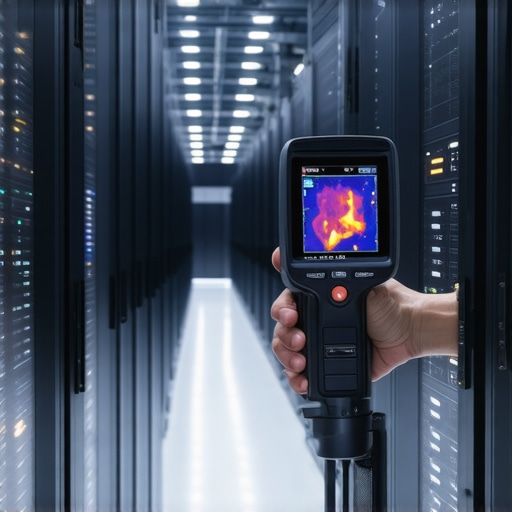
I remember my first year as a green apprentice, shivering in a crawlspace while my journeyman, a guy who smelled like stale coffee and electrical tape, watched me strip a feeder. I took my pocket knife to the insulation like I was whittling a stick. SMACK. He hit my knuckles so hard I dropped my dikes. ‘You nick that copper, kid, and you’ve just built a modern heater,’ he growled. ‘A nick is a bottleneck. Bottlenecks create resistance. Resistance makes heat. Heat makes fires. You want to be the reason a family loses everything?’ I didn’t get it then. I thought a tiny scratch didn’t matter in a 400 amp service entrance. I was dead wrong. Thirty-five years later, I spend my days hunting for those ‘heaters’ with an infrared camera because the human eye is a lying piece of equipment. In a data center, that lie can cost millions.
The Physics of the Invisible Fire
Electricity is lazy and violent. It wants to go home to the transformer, and it’ll destroy anything in its path to get there. When we talk about data center maintenance, we aren’t just talking about dusting servers; we are talking about managing the thermal load of thousands of connections. Every lug, every bus bar, and every breaker is a potential failure point. This is where Infrared Thermography (IR) becomes the forensic investigator’s best friend. It detects the infrared radiation emitted by an object, converting that heat signature into a visual map. In a high-density environment, heat is the first symptom of a terminal illness.
“A bad electrical connection under load will always dissipate energy as heat. If left uncorrected, this heat will lead to the failure of the connection and potentially a fire.” – NFPA 70B: Recommended Practice for Electrical Equipment Maintenance
Why does heat happen? It usually boils down to resistance. Resistance is the friction of the electrical world. When you have a loose connection—maybe a lug that wasn’t torqued to spec or a wire that has suffered from ‘cold creep’—the electrons have to fight to jump the gap. That fight generates heat. In a 400 amp service entrance, even a fraction of an ohm of resistance can turn a bolt into a glowing heating element. By the time you smell the ozone or see the smoke, the equipment is already toast. IR cameras catch the ‘hot spot’ when it’s only five degrees above ambient, long before it reaches the melting point of copper.
Component Zooming: The Anatomy of a High-Resistance Connection
Let’s zoom into a single breaker in a data center’s distribution panel. Inside that breaker, there are mechanical pivots and contact points. If those contacts are pitted or if the spring tension has weakened over a decade of service, the contact surface area decreases. This is where the physics of Current Density kicks in. You’re trying to shove the same amount of current through a smaller physical space. The IR camera sees this as a bright white flare against the cool blue of the surrounding wires. It’s a ‘thermal anomaly.’ If I’m doing a home rewiring service, I might see this in a bedroom circuit, but in a data center, that flare is sitting next to 200 other circuits. The heat bleeds. It degrades the insulation of the neighboring wires, turning a single point of failure into a catastrophic meltdown.
The Role of Standby Systems and Load Fluctuations
Data centers are dynamic. They aren’t static loads. When a standby generator install kicks in during a power failure, the sudden surge of current through the transfer switch can reveal weaknesses that weren’t visible under normal utility load. This is why we perform IR scans during load bank testing. We want to see those lugs under stress. We want to see how the demand response systems are cycling the power and if the rapid expansion and contraction of the metal (thermal cycling) is loosening the hardware. It’s the same reason I tell homeowners that a level 2 EV charger needs its own dedicated, torqued-to-spec circuit; the constant high-amperage draw for eight hours straight will find the weakest link in your system and melt it. In a data center, that ‘weak link’ might be the main bus bar feeding the entire rack.
Beyond the Panel: Integrated Systems
We often think of electrical maintenance as just the big gear, but the forensic eye looks at everything. I’ve seen security camera wiring that was run too close to high-voltage lines, causing induction heating that showed up on the IR scan as a faint, glowing ghost in the cable tray. I’ve seen electric gate opener controllers in outdoor enclosures that were failing because salt-air corrosion had increased the resistance of the terminal blocks. Even a smart meter installation can have thermal issues if the jaws of the meter socket are worn out. The IR camera doesn’t care what the device is; it only cares about the heat. If you’re performing spa grounding services or installing a subpanel, the same rules apply: clean connections, proper torque, and no nicks.
“Aluminum wire connections can overheat and cause a fire without tripping the circuit breaker.” – CPSC Safety Alert 516
This quote is a haunting reminder for those dealing with older infrastructure or mid-century buildings. While most data centers use copper, the principle remains: the breaker is a dumb device. It only trips if the current exceeds its rating. It does not trip because a connection is getting hot enough to start a fire. A connection can be glowing cherry red, drawing only 20 amps on a 30-amp breaker, and that breaker will sit there fat, dumb, and happy until the wall is on fire. This is why a fuse box to breaker conversion is often the first thing I recommend for older facilities; you need modern protection, but even then, the breaker isn’t a magic wand. It requires the ‘tick tracer’ of the 21st century—the thermal imager—to verify integrity.
The Forensic Inspection Process
When I walk into a facility with my thermal imager, I’m not just looking for ‘hot.’ I’m looking for patterns. Is one phase significantly hotter than the others? That’s an unbalanced load, which can lead to neutral failure. Is the heat localized at the lug? That’s a loose connection. Is the entire conductor hot from the breaker to the point where it disappears into the conduit? That’s an overload. I’ve used my Wiggy to check voltage and my dikes to trim out a panel, but nothing beats the non-destructive testing of IR. It’s like an X-ray for the electrical system. We scan the standby generator, the UPS batteries, the 400 amp service entrance, and even the demand response systems controllers. We look for ‘monkey shit’ (duct seal) that’s been pushed into places it shouldn’t be, trapping heat, or ‘rough-in’ mistakes that are finally coming home to roost.
Conclusion: Sleep Better When It’s Torqued
Electricity doesn’t give second chances. In the world of high-stakes data maintenance, ‘good enough’ is a death sentence for your hardware. Whether you are managing a server farm or just looking into home rewiring services for your own peace of mind, remember that heat is the enemy. Don’t wait for the smell of burning plastic to tell you there’s a problem. Use the tools that see the invisible. Get the thermal scan. Ensure every lug is torqued, every wire is un-nicked, and every system is balanced. Because at the end of the day, I want to sleep knowing the only thing glowing in that building is the ‘on’ light, not the copper. It’s not just about code; it’s about survival. Don’t let a $0.50 loose screw be the reason your $5,000,000 facility goes dark.
{“@context”:”https://schema.org”,”@type”:”HowTo”,”name”:”How to Perform a Thermal Inspection on a Data Center Panel”,”step”:[{“@type”:”HowToStep”,”text”:”Ensure the electrical system is under at least 40% load to generate detectable heat at resistance points.”},{“@type”:”HowToStep”,”text”:”Remove panel covers using insulated tools and following all NFPA 70E safety protocols and PPE requirements.”},{“@type”:”HowToStep”,”text”:”Scan all main lugs, breaker connections, and bus bar joins with a calibrated infrared camera.”},{“@type”:”HowToStep”,”text”:”Identify thermal anomalies by comparing phase temperatures; a 3-degree Celsius difference between phases warrants further investigation.”},{“@type”:”HowToStep”,”text”:”Document all hot spots and schedule immediate torque-down or component replacement during a planned maintenance window.”}]}