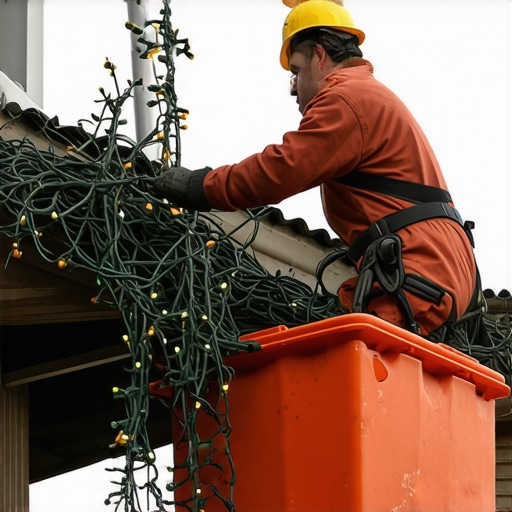
The Ghost in the Circuit: Why Post-Holiday Removal is a Forensic Operation
I’ve spent three and a half decades in the trade, most of it fixing what homeowners and weekend warriors thought was ‘good enough.’ There is a specific scent that greets you on a rainy Tuesday in January—the smell of wet ozone and scorched pine. It’s the smell of a Christmas light removal gone wrong, or more accurately, not done at all. Most folks think once the ‘Ho-Ho-Ho’ is over, you just yank the strings down and toss them in a plastic bin. They’re wrong. In fact, they’re dangerously wrong. I’ve seen more house fires and fried service panels in January than in December, and it usually starts with a ‘near miss’ that nobody noticed because they were too busy watching the ball drop.
My old journeyman used to smack my hand if I even looked like I was going to pull a wire through a tight hole without checking the edges. ‘You nick that copper, you’re creating a hot spot that’ll wait six months to kill someone,’ he’d growl. He wasn’t just being a cranky old-timer; he understood the physics of Current Crowding. When you yank a string of tree-mounted lights that have been wrapped for six weeks, you aren’t just moving plastic; you’re stressing every physical connection back to the home run. If you don’t have a certified journeyman checking those exterior points during removal, you’re leaving a ticking time bomb attached to your siding.
The Physics of Failure: Why Yanking is a Death Sentence for Your Exterior Circuits
Let’s talk about Cold Creep and thermal cycling. Throughout December, those tiny bulbs and the wires connecting them go through hundreds of expansion and contraction cycles. If you’re in a coastal area, you’ve got salt air acting as a catalyst. Salt is hygroscopic; it pulls moisture out of the air and holds it against the metal. When you leave lights up too long—or worse, remove them carelessly—you’re disturbing a layer of oxidation that has formed on the plug blades and inside your receptacles. I’ve used a Wiggy to test outlets after a DIY removal and found phantom voltages that would make your hair stand up. This isn’t magic; it’s a failure of the sacrificial layer of the metal.
“Aluminum wire connections can overheat and cause a fire without tripping the circuit breaker.” — CPSC Safety Alert 516
When you pull on a string of lights caught on a gutter or a branch, you aren’t just stretching the wire. You are often pulling on the interior connections of the outlet itself. I’ve performed forensic inspections where the Rough-in box was pulled loose from the stud because some guy decided to ‘un-decorate’ by pulling from the ground. This creates a loose neutral. A loose neutral in a load center upgrade scenario is bad; on an old 100-amp service, it’s a house-fire invitation. The heat generated by a high-resistance connection can easily reach 1,100 degrees Fahrenheit, which is more than enough to ignite the wood framing behind your siding.
The ‘Widow Maker’ and the Danger of Tree-Mounted Systems
Tree-mounted lights are the most abused electrical systems in the residential sector. People use staples, nails, and zip-ties, then they leave them through the freeze-thaw cycles of winter. Trees grow. They expand. If you don’t have a pro using drone thermography scans to check for hot spots in those high-reach areas during removal, you might miss where the bark has literally swallowed the wire. This is what we call a Widow Maker. You go to take the lights down next year, touch a section of energized tree, and your heart stops before you hit the grass.
During a professional removal, we don’t just take the lights down; we perform a mini-audit of your exterior electrical health. We look for ‘Monkey Shit’ (that’s duct seal for the uninitiated) that has dried out and cracked around your service mast or exterior boxes. If water gets into that conduit via capillary action, it’ll travel all the way down into your main panel. I’ve opened electrical panel upgrade jobs where the bottom of the bus bar was a pile of green crust because of a leaky outdoor outlet ten feet away. This is why certified journeyman services are non-negotiable. We see the path of the water; you just see a string of lights.
Modern Protection: Why AFCI and Load Calculations Matter
If your home hasn’t had AFCI breaker services installed recently, your exterior lights are likely protected by old-school thermal breakers. Those breakers only trip if the wire gets hot enough to melt or if there’s a dead short. They won’t see a ‘sparking’ or arcing connection caused by a nicked wire from a pair of dikes during a rushed removal. An Arc-Fault Circuit Interrupter (AFCI) is designed to detect that specific signature of an arc—that ‘crackle’ you hear sometimes—and shut the power down before the wood catches fire. During a professional removal, we test these systems to ensure that the holiday load didn’t fry the sensitive electronics inside the breaker.
“Arc-fault circuit-interrupters shall be installed in a readily accessible location.” — National Electrical Code (NEC) Section 210.12
Furthermore, consider your power factor correction and harmonic distortion. Modern LED displays use switching power supplies that can throw a lot of ‘noise’ back onto your home’s electrical system. If you have a tiny home wiring setup or a house with an older load center, this ‘harmonic filth’ can cause other electronics in your house to fail prematurely. A professional removal includes a quick check of your system’s ‘health’ to ensure those expensive LEDs didn’t leave behind a legacy of damaged circuitry.
The Coastal Curse: Docks and Salt Bridges
For my clients with dock electrical services, the removal process is even more critical. Salt spray creates a ‘bridge’ between the hot and ground. If you leave those lights up until February, the salt buildup on the plugs can create a tracking path. I’ve seen dock pedestals that looked fine on the outside but were completely hollowed out by galvanic reaction on the inside because a holiday plug wasn’t seated correctly or was pulled out with too much force, damaging the gasket. We use dielectric grease and stainless steel enclosures to fight this, but if the removal isn’t handled by someone who knows how to spot a failing seal, the ocean will win every time.
Conclusion: Don’t Trade Safety for 30 Minutes of Convenience
At the end of the day, your electrical system is a closed loop. Every time you plug something into an exterior outlet, you are extending that loop into the elements. Professional removal isn’t just about packing boxes; it’s about harmonic filter services, checking for AFCI breaker health, and ensuring that your load center upgrades are actually performing as intended. You wouldn’t perform surgery on yourself with a pair of kitchen scissors; don’t treat your home’s lifeblood like a DIY project. Get it torqued, get it tested, and sleep at night knowing your house isn’t the next 3:00 AM siren call. If you’re worried about your panel’s ability to handle the strain, it’s time to stop looking at the lights and start looking at the breakers. Electricity isn’t a hobby—it’s a force of nature that we’ve temporarily convinced to stay inside the copper. Respect it, or it’ll remind you why you shouldn’t have been so casual about that removal.