The Sensory Autopsy: Why Your Outdoor Power Failed Before the Party Started
The call usually comes in around 2:30 PM on a Friday. The homeowner is frantic because the string lights are dead, the smoker lost power mid-brisket, and half the kitchen outlets have mysteriously quit. They expect a simple fuse swap. I show up with a Wiggy and a sense of dread, knowing I’m about to perform a forensic autopsy on a $20 device that was murdered by a combination of physics, laziness, and the relentless pressure of the local atmosphere.
My old journeyman once gave me a lesson I’ll never forget during my first year of rough-in work. He watched me strip a piece of Romex with a pocket knife instead of proper wire strippers. He didn’t yell; he just pointed at the microscopic nick I’d made in the copper. ‘You see that, kid? That’s a stress riser. You’ve just built a heater. In five years, that nick will become a fracture from thermal expansion, and the resulting arc will burn this house down while you’re home sleeping.’ He was right. Electricity doesn’t forgive ‘good enough,’ and nowhere is that more evident than the outdoor receptacle.
“Where a weather-resistant type receptacle is required, it shall be identified as such by the ‘WR’ marking on the face of the device.” – National Electrical Code (NEC) Article 406.9
The Forensic Breakdown: Why the GFCI Died
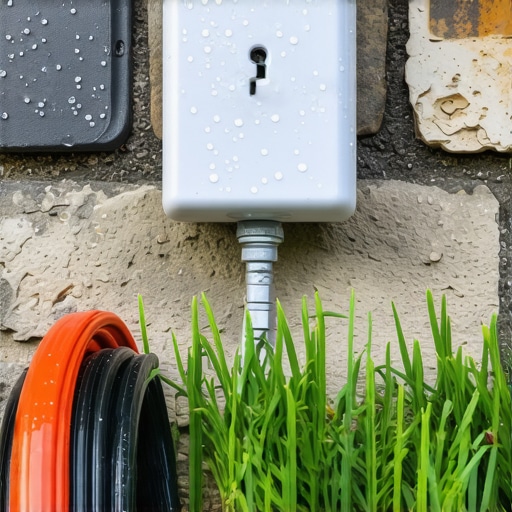
When I crack open a dead outdoor outlet, I’m rarely looking at a factory defect. I’m looking at capillary action. Most ‘handymen’ slap a box against the siding and call it a day. But moisture is a patient thief. It enters through the screw holes of the mounting plate, travels along the outer jacket of the cable, and pools inside the junction box. Inside that box, we have a literal chemistry experiment. The humidity creates a thin film of moisture across the GFCI’s circuit board. This leads to ‘tracking,’ where the current finds a path between traces where it shouldn’t be.
Then there’s the physics of contact resistance. In older homes from the mid-century era, we often see a mix of copper and aluminum. If you haven’t performed an electrical panel upgrade to handle modern loads, your outdoor circuits are likely being pushed to their limit. When you plug in a heavy load, like a camper electrical panel or high-wattage sign lighting installation, the terminal screws on that outlet heat up. If they weren’t torqued to the specific inch-pounds required by the manufacturer, that thermal cycling causes the wire to ‘creep.’ A loose wire creates an air gap; an air gap creates an arc; an arc creates 3,000 degrees of heat that melts the plastic housing before the breaker even thinks about tripping.
The False Security of the ‘Flap’ Cover
I often find that the culprit is the old-style ‘flap’ cover. These were code-compliant twenty years ago, but they’re a death sentence for modern electronics. The moment you plug in a home automation setup or a doorbell camera install, that flap is propped open. Rain hits the cord, runs down the wire, and goes straight into the guts of the outlet. This is why we insist on ‘In-Use’ covers (those big bubble covers). But even then, people forget the Monkey Shit. That’s trade talk for duct seal. If you don’t seal the hole where the wire enters the back of the box from the house, the warm air from your basement hits the cold air in the outlet box, creating condensation. You aren’t just fighting rain; you’re fighting the dew point.
“Ground-fault circuit-interrupters (GFCIs) should be tested monthly to ensure they are providing protection against electrocution.” – CPSC Safety Alert 516
Beyond the Outlet: The Grid and the Ground
Sometimes the outlet isn’t the problem—it’s the symptom. If I pull out my tick tracer and find weird phantom voltages, we start looking at the equipotential grid around the property. In many same-day calls, the outdoor outlet failure is actually tied to a surge that originated from a poorly grounded pool pump or a solar panel electrical hookup that wasn’t bonded correctly. Without a solid path to ground, your outdoor outlets become the lightning rod for every piece of EMI (electromagnetic interference) in the neighborhood. For high-end clients, we use drone thermography scans to find these hot spots before they become ‘fire spots.’ It’s not just about getting the lights back on; it’s about ensuring the power factor correction isn’t being trashed by a leaky neutral somewhere in the yard.
The Lifetime Workmanship Guarantee: Why Torque Matters
When we do a trim-out, every single connection is checked with a torque screwdriver. It sounds like overkill until you realize that 90% of electrical fires start at a loose connection. Our lifetime workmanship guarantee isn’t just a marketing slogan; it’s a statement that we understand the metallurgy of the wires we’re installing. We use dielectric grease to prevent oxidation in coastal environments and ensure that every home run back to the panel is secured and labeled. We don’t just ‘fix’ the outlet; we harden the system against the environment. Don’t trust a guy who just carries dikes and a roll of electrical tape. Trust the inspector who knows how to read the ‘autopsy’ of a failed circuit.