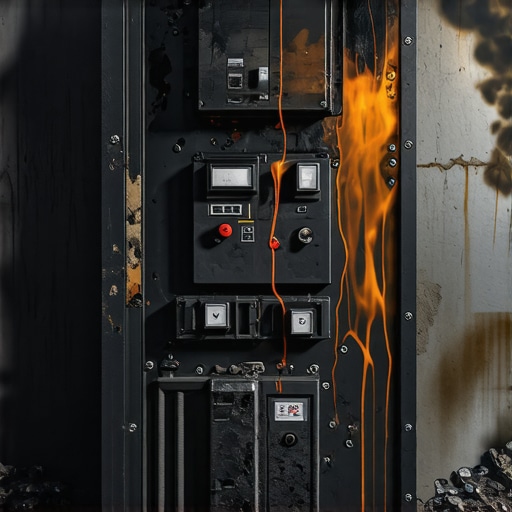
The Scent of Ionized Air and the Hum of a Looming Disaster
You never forget the smell. It is a sharp, metallic tang that sticks to the back of your throat—the scent of ozone and vaporized copper. In my 35 years as an electrician and forensic inspector, I have walked into hundreds of facilities where that smell was the only warning before a catastrophic failure. Managers often see an arc flash study as just another piece of bureaucratic paper, a box to tick for insurance. They are wrong. It is a survival map. When you ignore the engineering behind your power distribution, you aren’t just risking a blown fuse; you are sitting on a pressurized bomb of thermal energy waiting for a catalyst.
The Old Timer’s Lesson: The Cost of a Nick
My journeyman, a grizzly old-timer named Sully, used to smack my hand with a pair of dikes if he saw me stripping a conductor with a pocketknife. ‘You nick that copper, kid, and you create a hot spot. A hot spot is a heater you didn’t ask for,’ he’d bark. He wasn’t just being a crank. He understood the physics of resistance. That tiny nick reduces the cross-sectional area of the wire, forcing the current through a smaller space. In a high-voltage industrial environment, that resistance generates heat, which leads to thermal expansion, which loosens the lug, which eventually leads to the dreaded ‘widow maker’ disconnect. Sully knew that electricity doesn’t forgive laziness, and it certainly doesn’t care about your quarterly budget.
“The flash protection boundary shall be the distance from the exposed live part within which a person could receive a second-degree burn.” – National Electrical Code (NEC) 110.16
The Forensic Breakdown: The Physics of an Arc Flash
To understand the ‘hidden cost,’ you have to understand the violence of the event. An arc flash isn’t just a spark; it is a localized explosion. When a phase-to-phase or phase-to-ground fault occurs through the air, the air itself ionizes and becomes a conductor. At this point, the resistance drops to near zero, and the available fault current surges. We are talking about temperatures reaching 35,000 degrees Fahrenheit—four times hotter than the surface of the sun. When copper vaporizes, it expands at a ratio of 67,000 to 1. That means the solid copper bus bars in your load center upgrades don’t just melt; they turn into a pressurized gas that blows the doors off the cabinet and sends shrapnel through anyone standing nearby. This is why a circuit breaker replacement based on ‘it looks old’ isn’t enough; you need the math from an arc flash study to know if that breaker can actually interrupt the fault before the cabinet turns into a claymore mine.
The Component Zoom: Cold Creep and Mechanical Failure
Why do these failures happen in the first place? Let’s look at the mechanics of a 1970s-era industrial panel. Many facilities are running on 50-year-old service entrance upgrade gear that was never designed for modern nonlinear loads. Over decades, you deal with ‘Cold Creep.’ Every time your machinery cycles on, the conductors heat up and expand. When they cycle off, they cool and contract. If the lugs weren’t torqued with a calibrated wrench, that expansion eventually pushes the wire out of the terminal. This creates a microscopic gap. Now, you have arcing. This arcing carbonizes the surrounding insulation, turning it into a semi-conductor. Eventually, the insulation fails entirely, and you have a full-blown arc flash. Without a proper study, your electrician is flying blind, guessing at the PPE required to even open the door. You might think a GFCI outlet installation or pendant light hanging in the office is the extent of your electrical needs, but the real danger is in the switchgear room where the service entrance upgrade was skipped to save a few bucks.
The Trap: Insurance, OSHA, and the Real Bottom Line
Ignoring an arc flash study is a financial gamble with terrible odds. If an event occurs and you haven’t performed a study within the last five years (as mandated by NFPA 70E), OSHA will not be kind. The fines are the least of your worries. Your insurance provider will likely deny the claim, citing a failure to maintain a safe work environment. Then there is the downtime. When a main distribution section vaporizes, you aren’t looking at a few hours of repair. You are looking at a lead time of 16 to 24 weeks for new switchgear in the current supply chain. How much does your facility lose in six months of zero production? Suddenly, the cost of the study looks like pocket change. We are seeing more facilities move toward smart meter installation and demand response systems to monitor load, but these systems only work if the underlying infrastructure is sound. You can’t put a high-tech brain on a skeletal system that is rotting from corrosion.
“Aluminum wire connections can overheat and cause a fire without tripping the circuit breaker.” – CPSC Safety Alert 516
The Solution: Beyond the Sticker
A real arc flash study gives you more than just warning labels. It provides a roadmap for load center upgrades and circuit breaker replacement. It tells you exactly where your system is over-dutied. If your available fault current exceeds the Interrupting Rating (IR) of your breakers, those breakers will explode instead of tripping. I’ve used my Tick Tracer and Wiggy on panels that were so poorly coordinated that a fault in a branch circuit would take out the entire main breaker, plunging the whole plant into darkness. A proper study allows for selective coordination, ensuring only the local device trips. Furthermore, integrating a portable generator hookup or a smart meter installation without recalculating your fault current is a recipe for a ‘widow maker’ scenario. You need to know the ‘Monkey Shit’ (duct seal) isn’t the only thing holding your system together.
Conclusion: Sleep Better When It’s Torqued
Electricity isn’t a hobby, and facility management isn’t just about keeping the lights on. It’s about kinetic energy management. When you invest in arc flash studies, you are buying the ability to sleep at night knowing that if a fault occurs, the system will behave exactly as engineered. You are ensuring that when your team goes to perform a rough-in or a trim-out, they aren’t stepping into a death trap. Don’t wait for the smell of ozone to tell you that you should have done the math. Get the study, do the service entrance upgrade, and make sure every lug is torqued to spec. Because in this trade, you don’t get participation trophies; you get to go home with all your fingers.