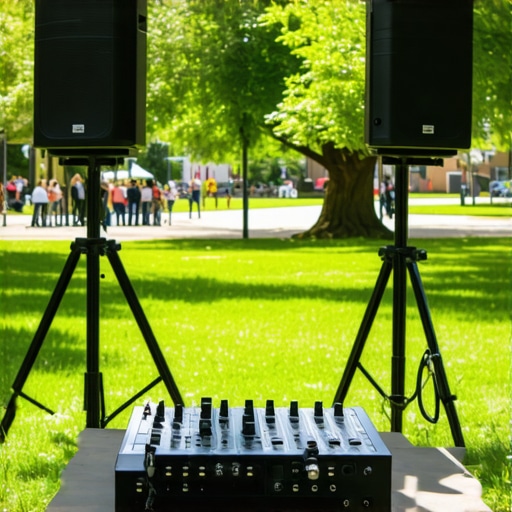
The Hum of Impending Disaster
You hear it before you see it. That low-frequency 60-cycle hum bleeding through the subwoofers isn’t just a nuisance for the sound engineer; to a forensic inspector, it is the siren song of a potential electrical fire. When setting up a clear PA system for outdoor community events, most people worry about the playlist. I worry about the impedance of the grounding path and the thermal threshold of the insulation on those temporary runs. Most ‘event planners’ treat power like a magic utility that just happens when you plug into a socket. But when you are pulling 50 amps for a stage rig through a series of daisy-chained power strips, you aren’t just making music—you’re testing the fire department’s response time.
“Temporary electrical power and lighting installations shall be permitted for a period not to exceed 90 days for holiday decorative lighting and similar purposes.” – NEC Article 590.3(B)
My journeyman used to smack my hand if I stripped a wire with a knife. ‘You nick the copper, you create a hot spot,’ he’d scream. He was right. That tiny notch reduces the cross-sectional area of the conductor, increasing resistance. In a high-draw environment like an outdoor concert, that resistance translates directly into heat. I have seen ‘pro’ setups where a single nicked 12-gauge wire in a home run became a literal glow-plug, melting the Romex jacket and nearly igniting a plywood stage. You treat every connection with the same precision as a surgeon, or you shouldn’t be touching the rough-in.
The Load Calculation: Why Your 100-Amp Panel is Crying
The biggest mistake in temporary event power is ignoring the math. People think that because they are in a modern area—perhaps a site featuring ADU electrical services or tiny home wiring—that the local grid can handle anything. It can’t. When you start adding three phase power services to support a massive LED wall and a line array, you are entering the realm of industrial load management. If you don’t balance your phases, you’ll end up with a ‘floating neutral.’ I’ve seen a neutral failure send 208 volts through a 120-volt circuit, instantly frying every piece of sensitive electronics in a mobile microgrid. This is why microgrid integration requires a forensic level of planning, not just ‘plug and play.’
Component Zooming: The Physics of Voltage Drop
Let’s talk about Voltage Drop. When you run 200 feet of cable across a park for fence line lighting or a remote speaker stack, you aren’t getting 120V at the end of that line. You’re getting maybe 105V if you’re lucky. This is due to the inherent resistance of the copper atoms. As voltage drops, amperage must increase to maintain the same wattage (P=VI). This increase in amperage generates heat. If you’re using tree mounted lights for ambiance, and you’ve used the wrong gauge, that heat can actually bake the cambium layer of the tree or, worse, ignite the dry bark. This isn’t just ‘bad audio’; it’s professional negligence. You need to use a Wiggy or a high-end multimeter to check your voltage under load, not just when the system is idling.
The Enemy Below: Grounding and Moisture
Outdoor events are high-stakes environments for flood water electrical safety. A sudden downpour turns your stage into a giant conductive plate. If your spa grounding services logic hasn’t been applied to your outdoor distribution—meaning you don’t have proper bonding between your metallic structures and the ground—you’ve created a widow maker. I’ve seen ‘event techs’ use monkey shit (duct seal) to try and waterproof a junction box that wasn’t rated for the rain. It doesn’t work. Water finds a way. It creates a bridge between the hot leg and the chassis of your equipment.
“Aluminum wire connections can overheat and cause a fire without tripping the circuit breaker.” – CPSC Safety Alert 516
Even if you’re using copper, the same principle of thermal expansion applies. In the heat of a summer afternoon, those lugs in your temporary panel are expanding. As the sun sets and the pool pump electrical loads in the neighborhood kick in, the equipment cools. This cycle, known as Cold Creep, loosens the screws. A loose connection is a high-resistance connection. High resistance equals arcing. Arcing equals fire. I always carry my dikes and a torque screwdriver to every gig because if it isn’t torqued to spec, it isn’t safe.
Forensic Breakdown: The Legacy of Failure
In older community centers, we often run into knob and tube removal projects that were never finished. Trying to run a modern PA system off a 1940s-era ungrounded circuit is a recipe for a ‘hot skin’ shock. I once used my tick tracer on a microphone stand at a local park gazebo and it lit up like a Christmas tree. The ‘electrician’ had tapped into an old lighting circuit and used a bootleg ground. If the singer had touched that mic while standing on the damp grass, it would have been their last performance. This is why we don’t ‘just make it work.’ We do it right, or we don’t turn it on. Whether it’s fence line lighting or a full-scale festival, the laws of physics don’t give you a pass because you have a deadline.
The Final Trim-Out: Ensuring a Safe Show
When you reach the trim-out phase of your event setup, do a final sweep. Check your home runs for trip hazards and moisture ingress. Ensure your three phase power services are balanced within 10% across all legs. Use a thermal imager if you have one; it’ll show you a hot breaker long before you smell the ozone. Electricity is a tool, but it’s also a predator. It’s always looking for the easiest path to ground, and if you haven’t provided a safe one, it will use you. When I leave a site, I sleep at night because I know every lug is torqued, every Romex is protected, and the grounding electrode system is solid. Anything less is just waiting for the forensic inspector to show up with a camera and a clipboard to document your failure.