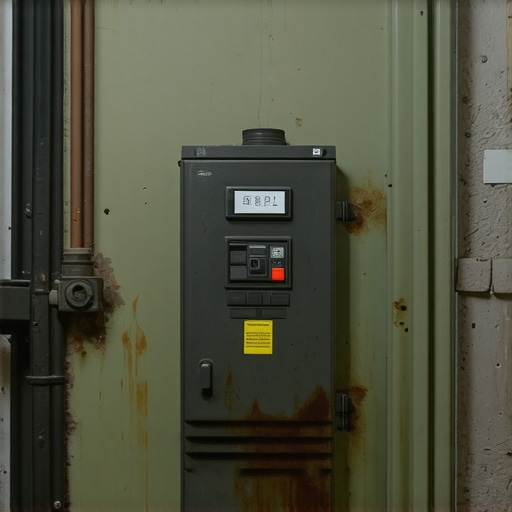
The Hum of an Imminent Failure: The 60-Amp Reality
If you live in a home built before the space race, there’s a high probability you’re relying on a 60-amp electrical service. Back in the day, that was plenty for a few incandescent bulbs, a radio, and maybe a toaster that worked half the time. But today? You’re trying to shove a mountain of demand through a molehill of capacity. My old journeyman used to say that electricity is like water, but when the pipe is too small, it doesn’t just leak—it turns into a blowtorch. He once sat me down after I’d roughly stripped some cloth-insulated wire with a pair of rusty dikes. He didn’t just yell; he made me feel the heat coming off a circuit under load. ‘You see that vibration?’ he asked, pointing at a lead wire. ‘That’s the atoms screaming because they’re being squeezed too tight.’ He was right. That 60-amp panel in your basement isn’t just an antique; it’s a bottleneck that’s likely cooking itself from the inside out.
The Sensory Forensics of an Overloaded Service
You don’t need to pull the dead front off a panel to know it’s failing. In fact, if you aren’t a pro, stay away from those screws. A 60-amp service is often the heart of an un-grounded system, and one slip could make you the shortest path to earth. Instead, use your senses. Start with your ears. An overloaded panel won’t just sit there silently. When you have the bathroom exhaust fan running, the microwave hummed up, and the AC kicks in, listen for a distinct, low-frequency buzz. This is often harmonic vibration. It happens when the magnetic fields around the bus bars become so intense from the current draw that the metal components literally rattle at 60 hertz. If that buzz turns into a sizzle, you’re looking at active arcing. That’s the sound of electricity jumping a gap because a connection is loose or the bus bar is pitted.
“Aluminum wire connections can overheat and cause a fire without tripping the circuit breaker.” – CPSC Safety Alert 516
Next, use your nose. An overloaded 60-amp panel has a very specific scent. It’s not just ‘smoke.’ It’s the smell of fishy, acrid Bakelite—the old-school plastic used in early breakers and fuse blocks. When that material reaches its thermal limit, it off-gasses. If you catch a whiff of that near your service entrance, your panel is already in a state of ‘thermal runaway.’ This is why circuit breaker replacement on an ancient 60-amp Federal Pacific or Zinsco frame is often a fool’s errand; the underlying bus bar is likely already charred beyond recovery.
The Physics of the 60-Amp Squeeze
Let’s talk numbers. A 60-amp service at 240 volts gives you roughly 14,400 watts of total capacity. That sounds like a lot until you realize a modern electric dryer pulls 5,000 watts, a water heater pulls 4,500, and your kitchen circuit is pulling another 1,500 for the coffee maker. You’re already at the redline before you even think about smart home wiring, high-end server racks, or an electric gate opener at the end of the driveway. When you exceed 80% of your rated capacity for more than three hours—what we call a ‘continuous load’—the heat starts to build up due to resistance heating. Copper is a great conductor, but it isn’t perfect. As it gets hot, its resistance increases, which generates more heat. It’s a vicious cycle that leads to ‘cold creep,’ where the metal expands and contracts so much that the lugs holding the main conductors begin to loosen. Once those lugs are loose, the air gap creates a high-resistance bridge, and that’s where the ‘cherry red’ glow starts.
Visible Signs Outside the Box
Look at your lights. If they dim every time the refrigerator compressor engages, that’s a massive voltage drop. In a 60-amp system, this isn’t just a nuisance; it’s a sign that your main service conductors are struggling to pull enough juice from the utility transformer. You might also notice that your ethernet wiring services are flaky; electromagnetic interference (EMI) from a struggling electrical panel can wreak havoc on unshielded data cables nearby. If you’ve recently added tree mounted lights for your landscaping or installed sign lighting installation for a home business, you’ve likely pushed the system over the edge. These ‘small’ additions add up. Even something as simple as emergency exit lighting in a home office can be the final straw when your baseline load is already at 90% capacity.
“Overcurrent protection devices shall be selected and coordinated to permit under-load operation while providing protection against short circuits and ground faults.” – NFPA 70 (National Electrical Code)
The problem with these old panels is that the breakers often ‘weld’ shut. They become ‘frozen’ in the ON position due to internal corrosion. So, while you think you’re safe because the breaker hasn’t tripped, the reality is that the wire is melting inside your walls. This is why same day service appointments for a panel inspection are critical if you see scorching on the outside of the cabinet or if the metal feels hot to the touch. I’ve seen 60-amp panels that were so overloaded they acted like space heaters for the entire utility room.
The Infrastructure Crisis: Beyond the Panel
An overloaded 60-amp service rarely exists in a vacuum. It’s usually the tip of the iceberg for an aging infrastructure. If you’re pushing this much power, you likely have old cloth-jacketed Romex or even the remnants of knob-and-tube buried in your attic insulation. When you try to modernize with three phase power services for a home workshop or heavy-duty machinery, a total service ‘heavy-up’ is the only path forward. You can’t just slap a new breaker in and call it a day. You need to look at the service mast, the meter can, and the grounding electrode system. Many 60-amp homes are still grounded to a galvanized water pipe that’s been replaced with PEX, meaning your house effectively has no path to ground. That is a recipe for a ‘widow maker’ scenario where the chassis of your appliances become live. Don’t wait for the ‘monkey shit’ (duct seal) around your service entrance to start bubbling from the heat. If you’re seeing these signs, the time for ‘upgrading later’ has passed. Your house is telling you it’s tired; listen before it starts screaming.