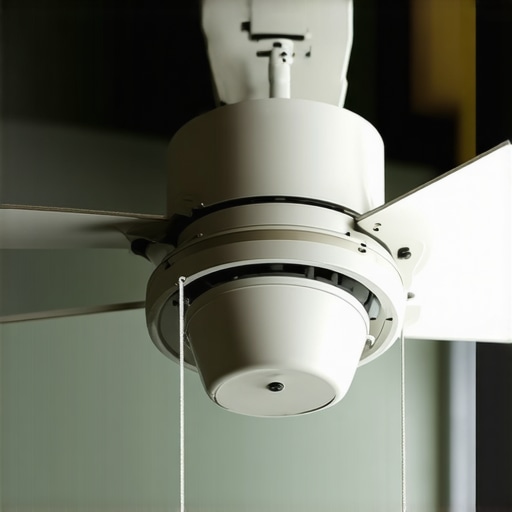
If you hear a sound like a coffee grinder coming from your ceiling, you aren’t just dealing with an annoyance; you’re hearing the mechanical death rattle of an electrical appliance that is either fundamentally defective or, more likely, dangerously installed. I’ve spent 35 years in this trade, and I can tell you that a grinding fan isn’t just a nuisance—it’s a warning. In the high-stakes environment of residential electrical work, noise is usually the precursor to heat, and heat is the precursor to a 3:00 AM visit from the fire department.
I walked into a ‘fully renovated’ 1970s kitchen last month where the homeowner was complaining about a grinding noise in his brand-new fan. I pulled the canopy down and found the ‘flipper’ had buried live junction boxes behind the backsplash and used a standard plastic rough-in box meant for a 2-ounce light fixture to hang a 25-pound fan. I found the hidden junctions with my tracer, but the fan box was the real horror. The plastic ears were shearing off under the torque. The fan was wobbling so violently that the internal rotor was physically slapping the stator. I’ve seen enough of these ‘handyman specials’ to know that if I hadn’t been there for a routine electrical safety audit, that fan would have been a ceiling-mounted projectile within a week.
1. Bearing Race Degradation and the Physics of Friction
The most common culprit for a grinding noise in a new fan is the failure of the internal ball bearings. People think a new fan means a perfect fan, but that’s a rookie mistake. Component zooming reveals that these bearings are packed with a specific viscosity of synthetic lubricant designed to create a hydro-dynamic film. However, if the fan was dropped during shipping or if it’s a cheap big-box store unit, the ‘race’—the track the ball bearings sit in—can be pitted. This is known as brinelling. Once that race is pitted, the balls no longer glide; they bounce. This creates a mechanical grind that resonates through the metal motor housing and up into the joists of your house.
In mid-century homes, this problem is exacerbated by old-school mounting. If the fan isn’t perfectly level, the centrifugal loading becomes eccentric. Think of a truck tire out of balance; it doesn’t just wear the rubber, it eats the wheel bearings. In a ceiling fan, an unbalanced load creates side-loading on the motor shaft. This wears down the bushings and causes the rotor to drift from its center. Eventually, the magnetic gap between the rotor and the stator—which is often less than a millimeter—is breached. When those metal components touch while spinning at 200 RPM, the sound is unmistakable. It’s the sound of the motor literally eating itself alive.
“Aluminum wire connections can overheat and cause a fire without tripping the circuit breaker.” – CPSC Safety Alert 516
2. Box Compliance and the ‘Cold Creep’ Phenomenon
The second reason for that grinding noise is structural instability. Many homeowners try to swap a light fixture for a fan without performing a service entrance upgrade or even checking if the box is rated for the load. If the fan is vibrating, it’s often because the box is loose. In homes built between 1960 and 1980, we often run into aluminum wiring. This is where the physics of ‘Cold Creep’ becomes a nightmare. Aluminum expands and contracts at a different rate than the steel screws in your fan’s mounting bracket. Every time you turn that fan on, the heat from the current causes the wire to expand; when you turn it off, it contracts. Over time, the connection becomes loose. This loose connection creates resistance, resistance creates heat, and heat causes the metal to warp.
This thermal cycling can loosen the mounting bolts, causing the entire assembly to shift. If you’re living in a mid-century home and haven’t had a 60 amp panel upgrade to something more modern, you likely have bigger issues, but the fan is your canary in the coal mine. A grinding noise can actually be the sound of the mounting bracket vibrating against the ceiling joist because the screws have backed out due to Cold Creep. I’ve seen cases where the vibration was so intense it began to strip the threads right out of the plastic box. If I pull out my Wiggy and see voltage fluctuations while that fan is grinding, I know I’m looking at a high-resistance connection that’s a hair’s breadth away from arcing.
3. Harmonic Distortion and the Capacitor’s Role
The third reason is often misdiagnosed as a mechanical grind when it’s actually an electrical hum caused by harmonic distortion. Cheap solid-state dimmers are the enemy here. A standard light dimmer works by ‘chopping’ the AC sine wave. While this works for an incandescent bulb, it’s a disaster for an induction motor. When you chop the wave, you create ‘dirty power.’ This causes the motor windings to vibrate at a high frequency. This vibration can sound like a mechanical grind, especially if the fan’s internal capacitor is starting to leak or fail.
The capacitor’s job is to create a phase shift to get the motor spinning and keep it stable. If the capacitor is failing, the motor will struggle to maintain its magnetic field, leading to a physical ‘stutter’ in the rotation. This stuttering causes the blade irons to flex and the motor to growl. This is why I always check the home run during an inspection. If you’re trying to run a high-end fan, an EV charger installation, and a garage wiring services project all off an overloaded panel, the voltage drop is going to kill your sensitive electronics. You’re essentially starving the fan motor, and it’s screaming at you in the only way it knows how.
“Outlet boxes or outlet box systems used as the sole support of a ceiling-suspended (paddle) fan shall be listed, shall be marked by their manufacturer as suitable for this purpose.” – NEC 314.27(C)
Don’t be the person who ignores the grind. Whether you’re looking into smart meter installation or just setting up a holiday light installation, your home’s electrical integrity is a single system. A grinding fan in the bedroom is often a symptom of a larger problem, like a panel that needs a service entrance upgrade or old Romex that’s been nicked by a ‘handyman’ with a utility knife. I’ve spent my life cleaning up these messes. I don’t care about the aesthetic of your fan; I care about the torque on your lugs and the integrity of your ground. If that fan is grinding, grab your dikes, clip the power, and call someone who knows how to use a Tick Tracer. It’s better to pay for a professional electrical safety audit now than to pay a restoration company later. Sleep at night knowing your connections are torqued and your home isn’t a ticking time bomb. This isn’t a hobby—it’s physics, and physics doesn’t take days off.