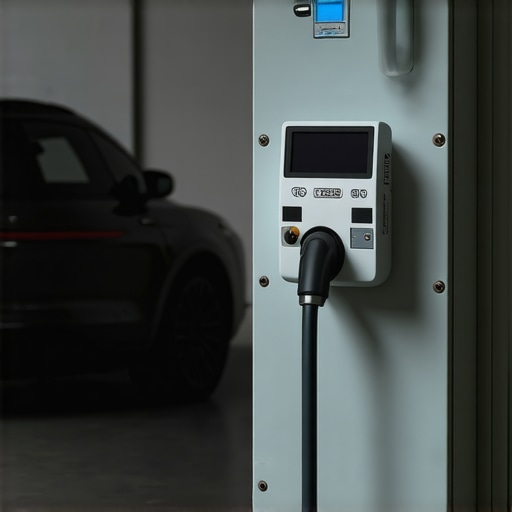
The Sound of a House Under Siege
If you stand near an old 60-amp electrical panel when a modern Electric Vehicle (EV) starts its charge cycle, you won’t hear the hum of progress. You’ll hear the death rattle of a mid-century infrastructure pushed past its breaking point. It’s a subtle, high-pitched sizzle, a sound I’ve learned to fear over 35 years in the trade. It’s the sound of resistance turning into heat, and heat turning into a structure fire. Most homeowners think of electricity like water—if you need more, you just open the tap wider. But electricity is more like a high-speed train; if the tracks aren’t rated for the speed, the whole thing derails in a shower of sparks. As a licensed master electrician, I’ve seen what happens when people ignore the math of their homes. My journeyman, a grizzly old-timer who could smell a short from the driveway, used to smack my hand if I stripped a wire with a pocket knife instead of a proper pair of dikes. ‘You nick that copper, you create a hot spot,’ he’d scream over the sound of his Wiggy tester. ‘That tiny notch is where the heat starts, and the heat is what kills the family sleeping upstairs.’ He was right. Every connection in your home is a potential point of failure, and the massive continuous load of an EV charger is the ultimate stress test.
The Forensic Breakdown: Why 60 Amps Isn’t Enough
In the 1950s and 60s, a 60-amp service was the gold standard. You had a refrigerator, some incandescent lights, and maybe a black-and-white television that took five minutes to warm up. Today, you’re asking that same service to handle a Level 2 EV charger, which pulls 40 to 48 amps on its own. Use your Tick Tracer on that service entrance wire while the car is charging, and you’ll see it light up like a Christmas tree, but the real story is in the physics of Joule Heating. When you run 48 amps through a service rated for 60, you are operating at 80% capacity. This wouldn’t be a problem for a few minutes, but an EV charger is a ‘continuous load,’ meaning it runs for three hours or more. The National Electrical Code (NEC) is very clear about this.
“The service disconnecting means shall have a rating not less than the load to be carried, and for continuous loads, the service shall be sized at 125 percent of the demand.” – NEC Section 230.79
This means for a 48-amp charger, you actually need a 60-amp circuit dedicated just to the car. If your entire house only has 60 amps, you are mathematically guaranteed to fail. You can’t run the AC, the dryer, or even a microwave while that car is plugged in without the main breaker—or worse, the service lugs—beginning to cook. I’ve seen Monkey Shit (duct seal) used to plug service masts that had literally melted and run down the side of the house because the conductors got so hot they liquefied the sealant. That’s not a ‘glitch’; that’s the physics of resistance.
The Cold Creep and Mechanical Failure
One of the most dangerous phenomena in older panels is ‘Cold Creep.’ This is especially prevalent in homes that haven’t had preventative electrical maintenance in decades. Over years of heating up and cooling down, the metal in your terminals expands and contracts. Eventually, the screws holding your Romex or service entrance cables loosen. A loose connection creates an air gap, which creates an arc. This arc is hotter than the surface of the sun. It carbonizes the bakelite or plastic housing of the breaker, turning it into a conductor rather than an insulator. By the time you notice your lights flickering, the bus bar behind the breaker is likely pitted and scarred. If you have an old Federal Pacific or Zinsco panel, the situation is even more dire. Those breakers are notorious for ‘jamming’—they won’t trip even when the wire is glowing.
“Older electrical systems were not designed to handle the continuous high-current demands of modern appliances and vehicle charging, increasing the risk of fire.” – CPSC Safety Alert
This is why a smart meter installation can sometimes be a blessing in disguise; the technicians often spot the charred meter jaws that indicate your 60-amp service is failing under the weight of modern life.
The Solution: The 200-Amp Heavy Up
You don’t put a jet engine on a tricycle, and you don’t put a Tesla charger on a 60-amp fuse box. The only safe way forward is a full service upgrade. This isn’t an upsell; it’s a survival strategy. We start at the street, bringing in new, thicker conductors. We replace the old, rotted meter can with a modern 200-amp unit and run a new home run to a fresh panel. During the rough-in, we ensure every circuit is balanced. This is also the time to consider knob and tube removal if any of that ancient, brittle insulation is still lurking in your walls. Once the new panel is in, we can safely perform a shed wiring install or a landscape lighting install without worrying about the house catching fire. We also include a surge protector installation at the main panel to protect your car’s sensitive electronics and your network cable installation from the surges that are common on our aging grid. For our older neighbors, we offer senior discount services because we know that fixed incomes and safety shouldn’t be at odds. We also provide financing electrical upgrades to make sure that the cost of safety doesn’t keep you awake at night. When the trim-out is done, and I torque those main lugs to spec, I sleep better knowing that your car is charging on a system designed for the 21st century, not the 19th. Don’t let a ‘handyman’ with a roll of tape and a lack of respect for Ohm’s Law touch your service. Electricity isn’t a hobby; it’s a force of nature that’s looking for the easiest path to ground, and you don’t want that path to be through your living room wall. Call a professional who knows the difference between a job done and a job done right. “