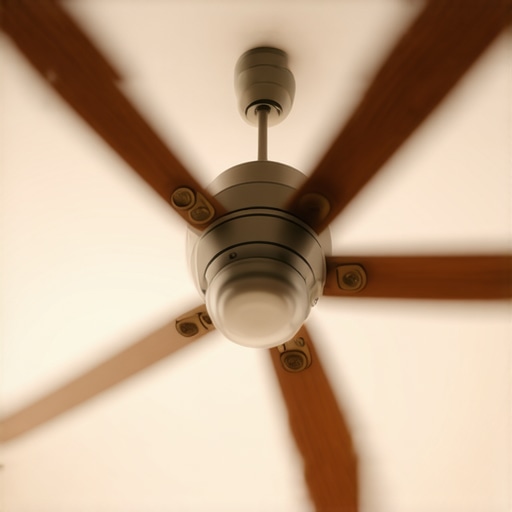
The Rhythmic Thump of Impending Doom
You are lying in bed at 2:00 AM, and all you can hear is that rhythmic, mechanical thump-thump-thump. The ceiling fan is swaying like a ship in a Category 4 hurricane. You’ve already spent three hours on a ladder with those little plastic balance clips, moving them from blade to blade like a fool playing a shell game. You’ve tightened the screws. You’ve dusted the blades. Yet, the wobble persists. As a master electrician who has seen the inside of more junction boxes than I’ve had hot meals, let me tell you the hard truth: your blades aren’t the problem. You are looking at a mechanical failure buried in the electrical infrastructure of your home.
The Old Timer’s Lesson: The Nick that Fires
My journeyman used to smack my hand if I stripped a wire with a knife. ‘You nick the copper, you create a hot spot,’ he’d scream. He was right. That lesson applies to everything in this trade—precision isn’t a suggestion; it’s the law of physics. When I see a fan wobbling, I don’t think about the weight of the blades. I think about the 8-32 screws holding the mounting bracket to a box that was never rated for a dynamic load. I think about the ‘rough-in’ where some guy in a hurry used a standard plastic nail-on box instead of a fan-rated brace. If you nicked the structural integrity of the mount during installation, no amount of balancing clips will save you from the eventual ‘widow maker’ scenario where that fan comes down.
“Outlet boxes shall not be used as the sole support for ceiling-suspended (paddle) fans unless the outlet box is listed and marked as being suitable for the purpose.” – National Electrical Code (NEC) 314.27(C)
The Forensic Breakdown: Why Balancing Fails
When we perform lighting installation services, we aren’t just looking at the aesthetics; we are looking at the shear strength of the fasteners. Most homeowners suffer from ‘Component Blindness.’ You see the fan; I see the hickey, the downrod, and the ball-and-socket joint. If your fan continues to wobble after balancing, the autopsy usually reveals one of three structural failures. First, there is the ‘Saddle Deformation.’ The mounting bracket, often made of cheap stamped steel, has warped under the torque of the motor. Every time that motor starts, it kickbacks. Over five years, that metal undergoes microscopic fatigue. Second, we look at the ‘Bearing Race Eccentricity.’ Inside the motor housing, the bearings themselves might be seated poorly. This isn’t a balance issue; it’s a manufacturing defect that creates a harmonic vibration. Third, and most dangerous, is the ‘Box Deflection.’ In older homes, specifically those built between 1900 and 1950, you might be dealing with crumbling plaster or a junction box held in by a single rusty flathead screw. The box itself is moving inside the ceiling. You can’t balance a fan if the foundation is floating.
Component Zooming: The Physics of Torque and Cold Creep
Let’s talk about the physics of the ‘Home Run’—the wire path from the breaker to the device. When a fan wobbles, it puts physical stress on the wire connections. If you have 12/2 Romex fed into that box, and the fan is vibrating, you are subject to a phenomenon called Cold Creep. While usually associated with aluminum wiring, even copper connections can loosen under constant mechanical vibration. As the connection loosens, resistance increases. Resistance generates heat. I’ve opened canopies where the wire nuts were melted into a single glob of plastic because the fan’s wobble had slowly backed the wires out of their seat. This is why a licensed master electrician doesn’t just ‘hang a light’; we ensure the mechanical vibration doesn’t translate into an electrical fire. If you’re integrating a home automation setup or smart thermostat wiring, you’re adding sensitive electronics to the mix that don’t play well with the electrical noise generated by an arcing, wobbling motor.
[image placeholder: Cross-section diagram of a ceiling fan mounting bracket showing failed screws and structural wood fatigue]
The Infrastructure Context: Old Joists and Salt Air
In mid-century homes, we often find that the wood joists have become ‘punky’ or brittle. When you screw a fan brace into a 60-year-old Douglas Fir joist, the wood fibers can strip out over time due to the constant oscillating weight. If you’re in a coastal area, salt air corrosion acts as a catalyst. I’ve pulled down fans where the mounting screws had rusted to half their original diameter. The ‘Monkey Shit’ (duct seal) some previous owner used to stop a draft didn’t help; it just trapped the moisture against the metal. This is the same reason why bollard light installation or hot tub wiring services in coastal zones require stainless steel or heavy-duty galvanized hardware—the environment wants to eat your electrical system alive.
“Aluminum wire connections can overheat and cause a fire without tripping the circuit breaker.” – CPSC Safety Alert 516
The Fix: Beyond the Balancing Kit
If you’ve checked the blades and you’re still vibrating, it’s time to pull the canopy. Get your Tick Tracer out and verify the power is dead, then grab your Wiggy to check for phantom voltage. You need to inspect the box. Is it a UL-listed fan box? If it’s plastic and you can see it flexing when you tug it, it’s a fire hazard. The solution isn’t more clips; it’s a circuit breaker replacement if the motor has been overdrawing, followed by a structural ‘heavy-up’ of the mounting point. We often use drone light inspections for commercial sites to find heat signatures in high-ceiling fans, but in your living room, your nose is the best tool. If you smell ozone, that wobble has already compromised the wiring. Whether you are doing battery backup wiring or pendant light hanging, the rule is the same: the mount must be able to support four times the weight of the fixture. Most fans weigh 25-50 pounds, but the dynamic load of a wobbling fan can spike much higher. Don’t let a $200 fan ruin a $500,000 house. Torque it down, or call someone who knows how.