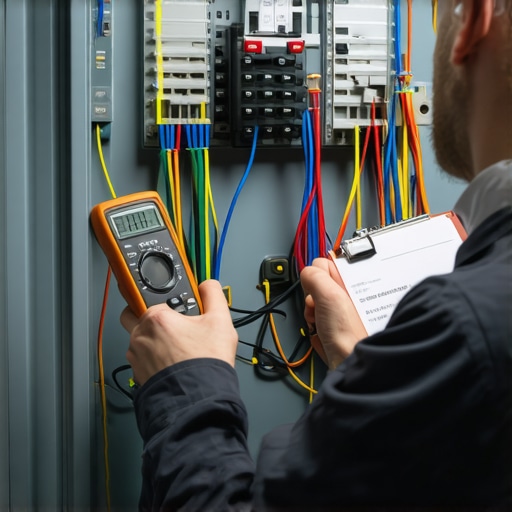
The Sleeping Giant: The Invisible Threat in Your Walls
Most homeowners treat electricity like plumbing; they assume if nothing is leaking, everything is fine. But electricity doesn’t leak—it waits. It waits for a loose connection, an oxidized terminal, or a nicked conductor to turn a simple convenience into a localized inferno. As a forensic inspector who has spent decades digging through the charred remains of ‘renovated’ homes, I can tell you that the difference between a safe home and a tragedy is often a fraction of an inch of insulation or a few inch-pounds of torque on a breaker lug. The checklist we use for annual maintenance isn’t a suggestion; it is an autopsy of potential failures before they happen.
“Overcurrent protection devices must be properly maintained; a jammed breaker or an oxidized contact can fail to trip, leading to catastrophic thermal runaway in the branch circuit.” – NFPA 70E Standard for Electrical Safety
My journeyman used to smack my hand if I stripped a wire with a knife. ‘You nick the copper, you create a hot spot,’ he’d scream. He was right. That microscopic indentation creates a point of high resistance. In the world of high-load appliances, like a level 2 EV charger, that tiny nick becomes a thermal fuse. When you’re pulling 48 amps continuously for eight hours, the physics of expansion and contraction—what we call thermal cycling—begins to fatigue the metal at that exact point. Eventually, the copper crystallizes, the resistance climbs, and the wire starts to glow. By the time you smell the ozone, the damage is already structural.
The Coastal Curse: Salt Air and Galvanic Ruin
If you live near the water, your home is under constant chemical attack. In my years performing boat lift wiring inspections, I’ve seen 200-amp service masts that look solid from the street but crumble like dry crackers when I touch them with my Wiggy. The salt air creates a conductive bridge between phases, especially in meter cans and exterior disconnects. This isn’t just simple rust; it is a galvanic reaction where the salt acts as an electrolyte. We see this specifically in the RV hookup installation on coastal properties—the constant exposure to salt spray leads to ‘pitting’ on the receptacle contacts. This pitting creates micro-arcing every time you plug in your coach, eventually welding the plug to the socket or melting the Romex feeding it.
We use ‘Monkey Shit’ (duct seal) religiously in these environments to plug the conduits. If you don’t seal those pipes, the temperature differential between the air-conditioned house and the humid exterior pulls salt-laden air directly into your main distribution panel. I’ve opened panels where the bus bars were covered in green ‘fur’—cupric carbonate. This green crust is an insulator. When it forms between your breaker and the bus bar, it creates a high-resistance connection that can’t be seen until the breaker housing begins to deform from the heat. This is why troubleshooting in coastal areas requires a forensic eye, not just a voltage meter.
The Modern Load: EV Chargers and Harmonic Distortions
The 100-amp or even 200-amp panel that was ‘standard’ twenty years ago was never designed for the continuous duty cycles of modern life. When we perform level 2 EV charger installations, we aren’t just adding a circuit; we are performing a load calculation that often reveals a system on the brink of failure. A home run for an EV charger isn’t just another wire; it is a massive thermal load. If your panel has any existing issues, like a loose neutral or ‘cold creep’ in older aluminum conductors, the EV charger will find them. Cold creep is the phenomenon where aluminum expands at a different rate than the steel or brass lugs holding it. Over time, the wire literally ‘crawls’ out from under the screw, loosening the connection and inviting an arc.
Furthermore, we now have to deal with the ‘trash’ on the line. Modern LED lighting installation services and high-efficiency HVAC systems use switch-mode power supplies that create non-linear loads. This results in harmonic distortion—electrical noise that causes the neutral wire to heat up even if the circuit isn’t overloaded. This is where harmonic filter services come into play. Without these filters, the cumulative heat from these harmonics can degrade the insulation on your wires from the inside out, leading to mysterious ‘ghost’ trips and premature equipment failure. It’s why insurance claim electrical work has skyrocketed; the tech is advancing faster than the infrastructure.
The Mandatory Forensic Checklist
Every annual maintenance visit must cover these specific, non-negotiable points:
- Torque Verification: We don’t just ‘feel’ if a screw is tight. We use a torque screwdriver to meet the manufacturer’s specs. A lug that is too tight is just as dangerous as one that is too loose, as it crushes the wire strands and leads to ‘hot spots.’
- Infrared Thermography: We scan the panel under load. If a breaker is 15 degrees hotter than its neighbor, we have a problem.
- Smoke Detector Installation & Testing: We check the date codes. Smoke detector installation isn’t a ‘set it and forget it’ task. Ionization and photoelectric sensors have a 10-year shelf life. After that, they are just plastic wall decorations.
- GFCI and AFCI Testing: We use a dedicated tester to ensure these life-saving devices trip at the correct milliamp threshold.
- Bonding and Grounding: Especially for boat lift wiring and tiny home wiring, we verify that the grounding electrode system is intact. In tiny homes, the vibration from road travel can loosen grounding bonds, turning the metal chassis into a live conductor.
“Aluminum wire connections can overheat and cause a fire without tripping the circuit breaker.” – CPSC Safety Alert 516
Liability and the Professional Standard
Working with a bonded insured electrical contractor isn’t about paying for a name; it’s about risk mitigation. When I’m called in for insurance claim electrical work, the first thing the adjuster looks for is a history of professional maintenance. If a fire starts in a tiny home wiring setup and it’s discovered that the owner did their own rough-in without a permit or a professional trim-out, the claim is dead on arrival. Electricity is a merciless judge. It follows the laws of physics, not the laws of convenience. Whether it’s an RV hookup installation or a complex harmonic filter setup, the goal is the same: ensuring that the energy stays inside the copper where it belongs. Don’t wait for the smell of burning plastic to call a pro. If you can hear your lights humming or see your dimmers flickering, the ‘Time Bomb’ is already ticking.