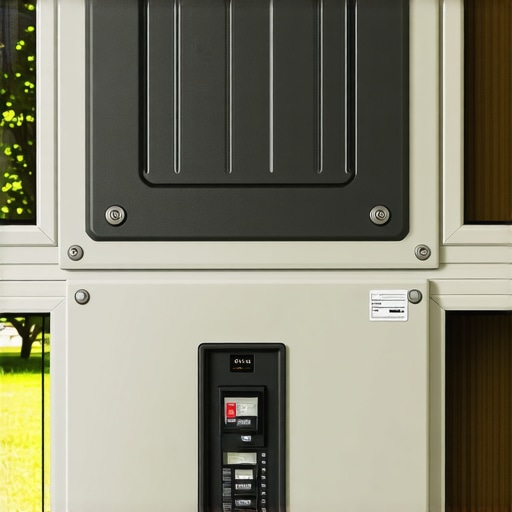
The Thud of Reality: When Green Energy Meets 1970s Copper
You spent fifteen thousand dollars on a high-efficiency, multi-stage heat pump to lower your carbon footprint and your utility bill. It’s a marvel of modern engineering, right up until the moment the thermostat clicks, the compressor ramps up, and you hear that ominous, metallic thunk from the garage. Your lights don’t just flicker; they dip into a sepia-toned brownout that lasts a full two seconds. That isn’t just a ‘quirk’ of living in an older home. That is the sound of your electrical load center—your home’s nervous system—screaming in agony because it’s being asked to push more amperage than its bus bars were ever designed to handle.
My journeyman, a man who had lost half an eyebrow to a 480-volt arc flash in 1982, used to smack my hand if he saw me using a utility knife to strip insulation. ‘You nick that copper, kid, and you’ve just built a bottleneck for every electron trying to get home,’ he’d growl. ‘You create a hot spot, and heat is the only thing that wins in the end.’ He was right. Electricity isn’t some magical fluid; it’s a physical force that generates heat through every millimeter of resistance. When you add a heat pump to a mid-century panel, you aren’t just adding a circuit; you are testing the structural integrity of every connection from the weather head to the meter socket replacement you probably should have done a decade ago.
The Forensic Breakdown: Why Heat Pumps Are Different
Most homeowners think a heat pump is just an air conditioner that works in reverse. From a load perspective, that’s a dangerous oversimplification. An A/C unit runs in the summer when the ambient air is already thin. A heat pump, specifically one with auxiliary heat strips, is a different animal. When the temperature drops below the ‘balance point,’ those electric resistive strips kick in. We’re talking about an instantaneous draw that can exceed 60 to 100 amps depending on the kilowatt rating of the heat kit. If you’re running a 100-amp or even an aging 150-amp service, that heat pump is now consuming 60-80% of your total available capacity the moment it gets cold outside.
“Aluminum wire connections can overheat and cause a fire without tripping the circuit breaker.” – CPSC Safety Alert 516
In many mid-century homes, we find the ‘Time Bomb’ scenario. These homes were built with Federal Pacific or Zinsco panels—brands we ‘shame’ in the industry because they are fundamentally flawed. The bus bars in these units often used inferior aluminum alloys that are prone to ‘Cold Creep.’ As the heat pump cycles on and off, the lugs expand and contract. Over time, the physical connection between the wire and the breaker becomes microscopic. This creates an air gap, and electricity, being the impatient force it is, will jump that gap. That’s arcing. Arcing creates carbon tracking, and carbon is a conductor. Before you know it, your panel isn’t just a distribution point; it’s a slow-burning heater hidden inside your wall.
Component Zooming: The Physics of Thermal Runaway
Let’s talk about the Wiggy—that old-school solenoid tester we use to check for real-world voltage. When I put a load on a struggling panel, I watch the voltage drop. If your 240-volt circuit for the heat pump reads 238V at the breaker but only 212V at the compressor, you are losing that energy to heat somewhere in the line. Usually, it’s at the main lug. We call it thermal runaway. As the resistance at a loose lug increases, the temperature rises. As the temperature rises, the metal expands more, further loosening the connection, which increases resistance again. It’s a feedback loop that ends in a molten pile of ‘Monkey Shit’ (duct seal) and charred plastic.
If you’re seeing remote electrical diagnostics flagging frequent undervoltage events, your load center is likely experiencing bus bar pitting. This is where the physical surface of the copper or aluminum has been eaten away by micro-arcs. Once a bus bar is pitted, it’s garbage. You can’t just slap a new breaker on it. It’s like putting a new tire on a bent rim. This is why electrical inspections are non-negotiable after a major HVAC install. We aren’t just looking for Romex that’s been poorly pulled; we’re looking for the metallurgical signature of failure.
The Infrastructure Context: Beyond the Breaker
Your heat pump’s struggle doesn’t stop at the panel. We have to look at the meter socket replacement requirements. Often, the utility side of the house is the forgotten child. An old meter base designed for a 60-amp ‘glass fuse’ era cannot handle a 40-amp continuous draw from a modern inverter-driven compressor plus a 60-amp auxiliary hit. I’ve seen meter jaws so charred they looked like they’d been in a kiln. If you smell ozone—that sharp, metallic, electric scent—near your outdoor meter, you aren’t smelling ‘power’; you’re smelling the oxygen in the air being ionized by a failing connection.
For those in retail store wiring or commercial environments, the stakes are even higher. You might be dealing with PA system installation interference or bollard light installation loads that further complicate the harmonic distortion on the line. This is where power factor correction comes into play. If your heat pump is causing your power factor to tank, you’re paying for ‘reactive power’—electricity that does no work but still heats up your wires. It’s inefficient, and it’s a sign that your system is poorly tuned for its load.
“Overloaded circuits are the leading cause of electrical fires in residential buildings, often due to the installation of high-draw appliances on antiquated infrastructure.” – NFPA 70 Research Foundation
The Fix: Professional Intervention vs. The Handyman Special
You’ll see some guys try to ‘save’ a panel by double-tapping breakers or using ‘cheater’ slimline breakers to make room. Don’t let them. That’s a Widow Maker move. When a system is struggling, the only safe path is a service ‘heavy-up.’ This involves a full meter socket replacement, a new home run for the high-draw appliance, and a modern load center with AFCI and GFCI protection that actually works. We use dikes to clean up the ‘rough-in’ mess and ensure every single lug is torqued to the specific inch-pounds required by the manufacturer. It’s not just about getting the lights to stay on; it’s about ensuring that when you’re sleeping, the 200 amps of potential energy behind your drywall stays exactly where it belongs.
We offer a lifetime workmanship guarantee because we know that a properly torqued, de-oxidized connection doesn’t just ‘wear out.’ It lasts as long as the house. If you’re worried about the downtime, we provide temporary power services to keep your refrigerators running while we perform the surgery. And for those who want to stay ahead of the curve, our priority service membership includes annual thermal imaging of your panel. We can see the heat before you can smell the smoke, identifying a failing breaker before it has the chance to weld itself to the bus bar.
Conclusion: Sleep Better When It’s Torqued
Electricity isn’t a hobby, and a heat pump isn’t a toaster. It is a sustained, high-amperage industrial load that has been dropped into a residential setting. If your lights are dimming, if your panel is warm to the touch, or if you haven’t had an inspection since the Reagan administration, you are gambling with your home’s safety. Get the remote electrical diagnostics, invest in a proper service upgrade, and treat your load center with the respect a 240-volt system demands. You’ll sleep a lot better knowing that the only thing getting hot in your house is the air coming out of the vents.