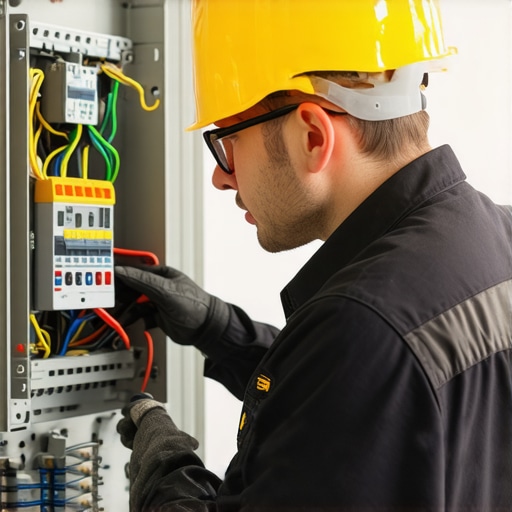
The Ghost in the Walls: Why Your Mid-Century Home is a Waiting Inferno
I’ve spent thirty-five years smelling things homeowners shouldn’t have to recognize. It’s that sharp, metallic tang of ozone or the cloying, fishy scent of melting PVC insulation. Usually, it’s coming from behind a drywall patch where a DIYer or a cut-rate ‘handyman’ thought they’d save a few hundred bucks. Most people look at their walls and see paint and pictures; I see a complex, aging nervous system that is currently being asked to do things it was never designed for. If your home was built between 1960 and 1980, you aren’t just living in a house; you’re living inside a ticking clock. My journeyman used to smack my hand if I stripped a wire with a knife. ‘You nick the copper, you create a hot spot,’ he’d scream. He was right. That tiny notch creates a point of high resistance, a localized bottleneck where electrons struggle to pass, generating heat that eventually carbonizes the surrounding material. That’s the difference between a certified journeyman and someone who just owns a pair of dikes.
“Aluminum wire connections can overheat and cause a fire without tripping the circuit breaker.” – CPSC Safety Alert 516
The Physics of Failure: Cold Creep and Aluminum Wiring Repair
When we talk about aluminum wiring repair, we aren’t just talking about swapping out an outlet. We are dealing with the physics of ‘Cold Creep.’ Back in the 70s, aluminum was the darling of the industry because copper prices spiked. But aluminum has a different thermal expansion coefficient than the brass screws on your standard devices. Every time you turn on a space heater or a toaster, that aluminum wire heats up and expands. When it cools, it contracts. Over thousands of cycles, the wire literally ‘creeps’ out from under the screw. This creates a gap. Once you have a gap, you have an arc. Once you have an arc, you have a fire. A certified journeyman doesn’t just ‘tighten the screw.’ We use specific methods, like AlumiConn connectors or COPALUM crimping, which involve sacrificial metals and anti-oxidation paste—often called ‘monkey shit’ in the field—to ensure the connection remains gas-tight and stable for decades. If you try to fix aluminum wiring with standard Romex wire nuts, you’re effectively building a fuse that won’t blow until your attic is engulfed.
The Heavy-Up: Why Electrical Load Calculations Matter
Modern life is heavy on the grid. We’re installing smart home wiring, security camera wiring, and high-draw appliances in kitchens that were originally wired for a toaster and a single-bulb fridge. This is where electrical load calculations become the difference between safety and a catastrophic failure. I see it all the time in restaurant kitchen electrical jobs: a chef adds a new commercial combi-oven to a circuit already strained by a walk-in cooler. Without a proper load calc, you’re risking a ‘brown-phase’ where voltage drops, amperage spikes, and your expensive equipment fries itself from the inside out. A 100-amp service from 1965 cannot handle a 50-amp EV charger, a 30-amp hot tub, and a 40-amp double oven simultaneously. We perform a ‘Heavy-Up’—a fuse box to breaker conversion that brings your service to 200 or 400 amps. We’re not just changing the box; we’re upgrading the service mast, the grounding electrode conductor, and the grounding rods to ensure the path of least resistance is back to the transformer, not through your body.
“All mechanical elements used to terminate conductors shall be torqued to the values specified on the equipment or in the installation instructions.” – NEC 110.14(D)
The Hidden Dangers: From Pool Pumps to Deck Lighting
Electricity and water are the ultimate enemies, yet everyone wants pool pump electrical work done by the ‘pool guy’ instead of a sparky. A pool pump is a massive inductive load. If the bonding—not just the grounding, but the bonding—isn’t perfect, you can develop a voltage gradient in the water. I’ve seen cases where a stray 2 volts in a pool was enough to paralyze a swimmer. The same goes for deck lighting services. People think low-voltage means low-risk. But a 12-volt system pulling 20 amps through an undersized wire will still melt the insulation and start a fire in the mulch. A certified journeyman ensures every outdoor circuit is protected by a Class A GFCI that trips at 5 milliamps of leakage. We use a ‘Wiggy’ or a high-end multimeter to verify that your surge protector installation isn’t just a green light on a plastic box, but a true shunt to a solid earth ground.
The Future of the Trade: Augmented Reality Troubleshooting
We are moving into an era where augmented reality troubleshooting allows us to overlay circuit maps and load data onto the physical world. While I’ll always trust my tick tracer and my years of experience, these tools help us visualize the heat signatures of a failing bus bar before the panel starts buzzing. Whether we are doing a fuse box to breaker conversion or a complex smart home wiring integration, the goal is always the same: code compliance. Code isn’t a suggestion; it’s the bare minimum required to keep you alive. When a journeyman finishes a job, we don’t just flip the breaker and hope for the best. We test the loop impedance, we verify the neutral-to-ground bond, and we ensure every home run is properly labeled. Don’t trust your family’s safety to someone who doesn’t know the difference between a grounded conductor and a grounding conductor. Get it done right the first time.