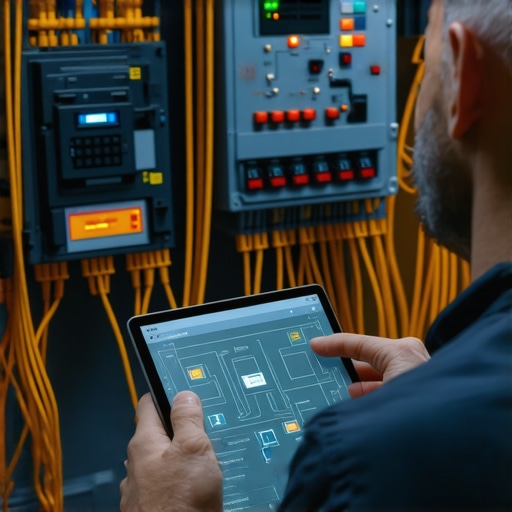
The Forensic Breakdown of a Silent Killer
I walked into a ‘fully renovated’ 1974 ranch house last Tuesday where the new owners were complaining about a phantom ‘clicking’ sound behind the kitchen pantry. The flipper had installed high-end quartz countertops and a fancy smart thermostat, but when I pulled my tracer and started sniffing for signals, I found a nightmare. Behind that pristine backsplash, the flipper had buried three live junction boxes, spliced with nothing but electrical tape and hope. A standard thermal-magnetic breaker is a blunt instrument; it only trips when heat builds up enough to bend a bimetallic strip or a massive short-circuit creates a magnetic field. By the time that happens, your wall studs are already charring. This is where AI fault detection flips the script. Instead of waiting for a fire, these systems analyze the ‘signature’ of the electricity itself, identifying the microscopic arcing of a loose wire nut before the first whiff of ozone hits the air.
The Physics of the Arc: Why Your Old Breaker is Blind
In my 35 years of crawling through spider-infested crawlspaces, I’ve seen enough melted plastic to know that most people don’t understand Cold Creep or thermal expansion. When electricity flows through a conductor, it generates heat. In older mid-century homes, especially those requiring home rewiring services, the connection points at the bus bar or the terminal screws of a subpanel installation eventually loosen. This creates high resistance. As the copper expands and contracts, a tiny gap forms. Electricity jumps that gap—this is an arc. A standard breaker sees this as just another load, like a toaster or a vacuum. But AI-enabled panels use high-speed digital signal processing to monitor the waveform. They look for the ‘noise’ of an arc—a jagged, high-frequency distortion that shouldn’t be there. It’s the difference between hearing a crowd roar and hearing one person whisper a specific secret.
“Aluminum wire connections can overheat and cause a fire without tripping the circuit breaker.” – CPSC Safety Alert 516
Component Zooming: The Anatomy of AI Fault Detection
To understand how this changes troubleshooting, we have to look at the micro-physics of the circuit. In a traditional rough-in, we pull Romex, strip it with dikes, and land it on a breaker. We hope the torque is right. If it’s not, you get carbon tracking. Carbon tracking is the process where the heat from micro-arcs turns the surrounding wire insulation into conductive carbon. This creates a permanent path for electricity to leak, eventually leading to a full-blown structural fire. AI panels monitor the ‘leakage current’ with surgical precision. If you’re doing a solar panel electrical hookup or an electric gate opener installation, the AI can distinguish between the normal startup surge of a heavy motor and the erratic ‘signature’ of a failing insulation layer. When I’m out in the field with my Wiggy or a tick tracer, I’m looking for symptoms. An AI panel is looking at the DNA of the fault.
The Infrastructure Backbone: Fiber Optics and Data
Modern homes aren’t just electrical grids; they are data centers. Integrating fiber optic cabling alongside traditional power lines requires a different mindset. You can’t just slap monkey shit (duct seal) in a hole and call it a day. The AI panel needs a data backbone to communicate its findings to the cloud or your smartphone. This is critical for emergency exit lighting and bollard light installation in commercial settings where a failure isn’t just an inconvenience—it’s a liability. When we perform trenching electrical conduit for outdoor lighting or gate systems, we aren’t just burying pipe; we are extending the reach of the home’s ‘nervous system.’ If that conduit fills with water and the wire insulation starts to degrade, the AI detects the change in impedance immediately, long before the homeowner notices the lights flickering.
“Arc-fault circuit-interrupters (AFCIs) are necessary for the protection of the entire branch circuit and are a significant step forward in electrical safety.” – NFPA 70, National Electrical Code
From Rough-in to Trim-out: A Master’s Advice
If you are considering a smart thermostat wiring upgrade or adding a subpanel installation for an EV charger, do not settle for the cheapest bid. The ‘handyman special’ usually involves ‘bootleg grounds’—a shortcut where the neutral is tied to the ground screw to trick a tester. It’s a widow-maker. AI panels make these cheats impossible to hide. They verify the integrity of the ground-fault path and ensure that every home run back to the panel is clean. When we do a trim-out, we use torque screwdrivers to meet the specific inch-pounds required by the manufacturer, because even a quarter-turn of looseness is a potential fire. Electricity is a relentless force that wants to return to its source, and it will burn your house down to find the shortest path. Using AI fault detection is like having a forensic inspector like me sitting inside your walls 24/7, watching for the first sign of a loose lug or a nicked wire. It turns a reactive ‘wait for the smoke’ approach into a proactive ‘kill the power’ solution. Don’t treat your home’s electrical system as a hobby; treat it like the life-support system it is. Ensure your next upgrade includes the intelligence to stop a disaster before it starts.