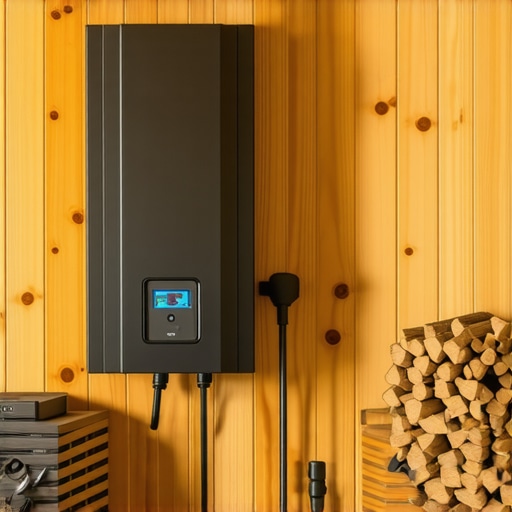
The Scent of Cedar and the Stench of Ozone
I walked into a basement last November where the owner had ‘renovated’ a corner into a Nordic retreat. My tick tracer started screaming before I even touched the cedar paneling. I pulled one board back and found what I call the ‘Flipper Special’: he had buried a live junction box behind the tongue-and-groove, and the wire nuts were melting because he’d used 14-gauge Romex for a 6kW heater. That heater was pulling 25 amps through a wire rated for 15. The copper was so hot it had started to char the wood from the inside out. In another hour, that family wouldn’t have been sweating out toxins; they would have been running for their lives. This isn’t a hobby; it’s high-voltage engineering in a room designed to be wet and hot. When you’re adding a sauna, you aren’t just plugging in a toaster. You are installing a continuous-load industrial appliance into a residential environment. If you don’t respect the physics of resistance and thermal expansion, the house wins every time.
1. The Fatal Load Calculation Error
The most common sin I see is homeowners trying to squeeze a 6,000-watt or 9,000-watt heater onto an existing 100-amp service that is already gasping for air. Every time that heater kicks on, the voltage drops across the entire house. This isn’t just about dimming lights; it’s about the physics of heat. When voltage drops, the amperage must increase to satisfy the load, causing thermal runaway in older, fatigued breakers. If you have an old Federal Pacific or Zinsco panel, you’re essentially playing Russian roulette with a jammed safety. You cannot simply ‘add a breaker.’ You need a meter socket replacement and a service ‘heavy-up’ to 200 amps to ensure that the home run back to the panel doesn’t become a heating element itself. In many cases, adding a sauna, an EV charger, and modern HVAC requires a total rethink of your home’s capacity. Neglecting this leads to bus bar pitting and eventually, a catastrophic failure at the main lugs.
“Fixed electric space-heating equipment shall be rated for not more than 50 amperes and shall be protected by an overcurrent device rated at not more than 125 percent of the total load of the motors and the heaters.” – NEC Section 424.3(B)
2. Ignoring the Physics of Bonding and Grounding
People confuse ‘grounding’ with ‘bonding’ constantly. In a sauna, your skin is damp, and the floor is often wet. This reduces your body’s natural resistance to electricity to almost zero. If the heater’s metal chassis isn’t properly bonded, a minor internal insulation failure can turn the entire heater—and any metal touchpoints—into a 240-volt ‘widow maker.’ This is where swimming pool bonding logic applies. Every piece of metal in that damp environment must be at the same electrical potential. I’ve seen DIYers skip the equipment grounding conductor because ‘it was too hard to pull through the flex.’ That’s a death sentence. Without a solid path for fault current, the breaker won’t trip during a short, and the metal heater jacket will just sit there, energized and waiting for you to touch it while you’re dripping with sweat.
3. Using the Wrong Wire Type in High-Heat Zones
Copper is a living thing when it comes to temperature. As it heats up, it expands; as it cools, it contracts. In a sauna, you have extreme temperature swings. If you use standard NM-B (Romex) inside the sauna wall cavity, the jacket will eventually go brittle and crack like an eggshell. You need THHN or THWN-2 conductors inside a proper raceway, rated for the ambient temperature of the room. I’ve seen tiny home wiring projects where people used automotive wire or thin-gauge extension cords for heaters. It’s sickening. When the insulation fails due to heat, you get carbon tracking—a tiny, invisible path of electricity that slowly burns its way through the wood until it reaches the point of ignition. This is why fire alarm system install professionals often find that the fire started hours after the sauna was turned off; the embers were smoldering deep in the wall where the wire gave up the ghost.
4. Bypassing the GFCI and High-Limit Safety
I’ve heard it all: ‘The GFCI keeps tripping, so I put it on a regular breaker.’ A GFCI trips for a reason. Usually, it’s because the heating element in the sauna is starting to leak current to the outer sheath. By replacing it with a standard breaker, you’ve removed the only thing standing between you and a lethal shock. This is non-negotiable. Furthermore, many modern saunas require structured wiring panels to manage the digital controls. Homeowners often bypass the high-limit safety switch because they want the room ‘extra hot.’ That safety is there to prevent the wood from reaching its auto-ignition temperature. Without it, you aren’t in a sauna; you’re in an oven, and the house is the fuel.
“Aluminum wire connections can overheat and cause a fire without tripping the circuit breaker.” – CPSC Safety Alert 516
5. Poor Torque and the Danger of Cold Creep
Even if you get the wire gauge right, if you don’t use a torque wrench on those lugs, you’re failing. Cold Creep is a phenomenon where the metal wire actually moves and reshapes itself under the pressure of the screw over time, especially with the thermal cycling of a heater. A loose connection creates resistance. Resistance creates heat. Heat causes more expansion and contraction, which makes the connection even looser. It’s a vicious cycle that ends in a molten puddle of copper and a house fire. This is why we insist on bonded insured electrical professionals who understand the OSHA compliance wiring standards for torque. We don’t just ‘make it tight’; we calibrate it. Whether we are doing office lighting upgrades or a residential sauna, the physics of a loose neutral or a high-resistance hot leg remain the same. If it’s not torqued to spec, it’s a time bomb. Before you step into that steam, ensure your harmonic filter services and panel upgrades were done by someone who carries a Wiggy and knows how to use it. Your life depends on the integrity of the invisible current behind those cedar walls. If you’re unsure about your current setup, getting a professional rough-in inspection is the only way to sleep soundly.