
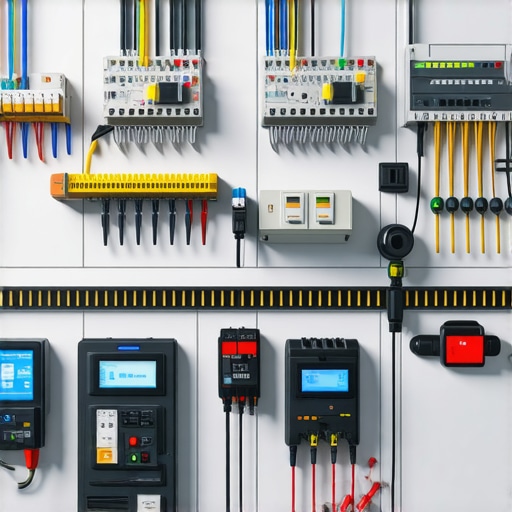
The Hum of Impending Failure: Why Your Workshop Is a Fire Hazard
You step into your garage, flip the toggle on your 3HP cabinet saw, and for a split second, the lights dim. That’s not just a quirk of an old house; that’s the sound of your electrical infrastructure screaming for help. As a licensed master electrician, I’ve spent decades diagnosing the aftermath of ‘good enough.’ I’ve smelled the sickly-sweet scent of melting PVC insulation and seen the carbon tracking on bus bars that looks like a roadmap to a house fire. In 2026, a pro workshop isn’t just about having enough outlets; it’s about managing the massive inrush currents of modern induction motors and the sensitive logic boards of CNC machines without burning the place down.
“Aluminum wire connections can overheat and cause a fire without tripping the circuit breaker.” – CPSC Safety Alert 516
My old mentor once cracked my knuckles with a wooden folding ruler because I didn’t verify the torque on a neutral bar lug with a calibrated wrench. ‘Copper flows like cold molasses under pressure,’ he’d grunt. He was talking about cold creep—the physical deformation of the metal under the pressure of a screw. If you don’t account for the thermal expansion and contraction cycles in a high-draw workshop, that connection will loosen, create resistance, and eventually, it’ll glow. Here are the seven essentials you need to stop your workshop from becoming a forensic investigation site.
1. The Overhead Service Drop and Panel Heavy-Up
Most mid-century homes are still limping along on a 100-amp overhead service drop. You try to run a dust collector, a table saw, and a mini-split AC simultaneously, and you’re pushing the limits of your service entrance conductors. In 2026, a pro shop needs at least a 200-amp dedicated feed. We’re talking about more than just a bigger box. We’re looking at the physics of voltage drop. When your shop is at the end of a long home run, resistance in the wire causes a drop in voltage, which forces your motors to pull more amps to compensate. More amps equals more heat. Heat kills motors. If your lights flicker when the compressor kicks on, your service is starving.
2. AI Fault Detection: The Digital Sentry
Standard thermal-magnetic breakers are 19th-century tech. They only trip when things are already catastrophically wrong. AI fault detection systems are the new standard. These units analyze the ‘signature’ of your electrical current. They can distinguish between the normal spark of a brushed motor and the dangerous arcing of a loose wire behind the drywall. If a mouse chews through your Romex or a vibration from your lathe loosens a terminal, the AI identifies the waveform anomaly and shuts it down before the first wisp of smoke appears. This isn’t a luxury; it’s the only way to catch a ‘widow maker’ fault before it catches you.
3. The Grounding Path and Bonding Jumper Services
I’ve seen guys get ‘ticked’ by their metal workbench because they didn’t understand the difference between grounding and bonding. Proper bonding jumper services ensure that every piece of metal in your shop—from the gas lines to the structural steel—is at the same electrical potential. If a hot wire shorts against your tool stand, the bonding path provides a low-impedance route back to the panel to trip the breaker instantly. Without it, the tool frame just sits there energized, waiting for you to complete the circuit to the concrete floor. I always pull out my Wiggy to test the integrity of that path; if I see even a few volts of potential, we have a problem.
4. Hardwired Surge Protector Installation
Those cheap power strips from the big-box store are useless against a real transient voltage spike. A professional surge protector installation at the main panel is mandatory. Think about the Metal Oxide Varistors (MOVs) inside. They act like pressure relief valves. When a spike comes down the line from a lightning strike or a utility transformer failure, these MOVs shunt that excess energy to ground in nanoseconds. In a workshop full of VFDs (Variable Frequency Drives) and computer-controlled tools, a single spike can fry thousands of dollars in electronics. If you don’t have a Type 1 or Type 2 surge device, you’re playing Russian Roulette with your gear.
5. Recessed Lighting Installation and Task Clarity
Shadows are where fingers get lost. A proper recessed lighting installation using high-CRI (Color Rendering Index) LEDs ensures you aren’t squinting at a layout line. But it’s not just about brightness; it’s about circuit separation. Never put your lights on the same circuit as your power tools. If your saw jams and trips the breaker, you don’t want to be standing in pitch darkness with a spinning blade. We also need to talk about the ‘flicker’ effect—some cheap LEDs can create a stroboscopic effect that makes a rotating blade look like it’s standing still. That’s a trip to the ER waiting to happen.
6. Atmospheric Control: Whole House Fan Wiring
Workshops are magnets for fine dust and volatile organic compounds (VOCs). Proper whole house fan wiring or dedicated shop exhaust systems are critical. When I do a rough-in, I look for ways to automate the airflow. We use home automation setup sensors that detect the particulate matter in the air. When the air quality drops below a certain threshold, the exhaust fans kick in automatically. It’s not just about comfort; it’s about preventing a combustible dust environment. I’ve seen what happens when a stray arc meets a cloud of fine sawdust. It’s not an explosion; it’s a flash fire that consumes the oxygen in the room in seconds.
7. The Maintenance Contract and Professional Oversight
Electricity is a dynamic system. Screws loosen due to vibration. Insulators degrade. That’s why after hours electrical repair availability and regular inspections are vital. For our older craftsmen, utilizing senior discount services for annual panel ‘tune-ups’—where we check terminal torques and thermal-image the bus bars—is the best insurance policy you can buy. You should never be ‘surprised’ by an electrical failure. If you have to use a tick tracer to find out why a circuit is dead, you’ve already failed the maintenance game.
“The grounding electrode conductor shall be protected from physical damage by being enclosed in rigid metal conduit, intermediate metal conduit, rigid polyvinyl chloride conduit (PVC), reinforced thermosetting resin conduit (RTRC).” – NEC Article 250.64
In the end, your workshop is only as strong as its weakest connection. Don’t be the guy who spends $10k on a CNC mill and plugs it into a 14-gauge extension cord. Do the load calculations, torque your lugs, and treat those electrons with the respect they deserve. If you don’t, I’ll be the one coming in after the fire department leaves to tell you exactly where you cut corners.
This article hits the nail on the head about the importance of proper electrical planning in a workshop. As someone who’s recently upgraded their system, I can’t stress enough the value of investing in a dedicated circuit for each major machine, especially CNCs and VFDs. I experienced a brief power surge that temporarily fried a controller because I hadn’t installed a proper surge protector—definitely a lesson learned the hard way. What’s interesting is the growing role of AI fault detection; I’ve been considering SmartCircuit systems after hearing about their preventative capabilities. Has anyone here integrated AI diagnostics into their workshop? How has it affected your maintenance routine? I think in 2026, having these modern safeguards will be non-negotiable if you want to keep your gear—and your shop—safe and operational for the long haul.